
TO MY LIMITED PARTNERS,
Camila is a hand on the rivet line at the dishwasher assembly plant I own outside Monterrey. Her shift is 10 hours and 20 minutes of driving stainless-steel fasteners into the inner tub of a machine that will arrive at a Lowe’s in Tulsa in 11 days. The gasket seals. The tub holds water. The hose will not burst. She earns $2.85 an hour. I have 340 hands on the line. The plant produces 1,140 dishwashers per shift. You paid $549 for the last one you bought. I am not concerned with the $549. I am concerned with the landed cost, which is where my pencil goes first and stays.
The 50% is mine.
The Lord made the nickel for the stainless and the colophony fumes for the welder. He made the line. I keep the line running. We have an understanding.
Several of you have sent me O’Grady’s column in the Wall Street Journal this week. She writes that the 50% Section 232 tariff on Mexican steel, aluminum, and manufactured derivatives — including household appliances — is “blatantly abusing” the statute and violating the USMCA. She’s right about the percentage. She’s asking whether it’s legal. I’m answering a different question.
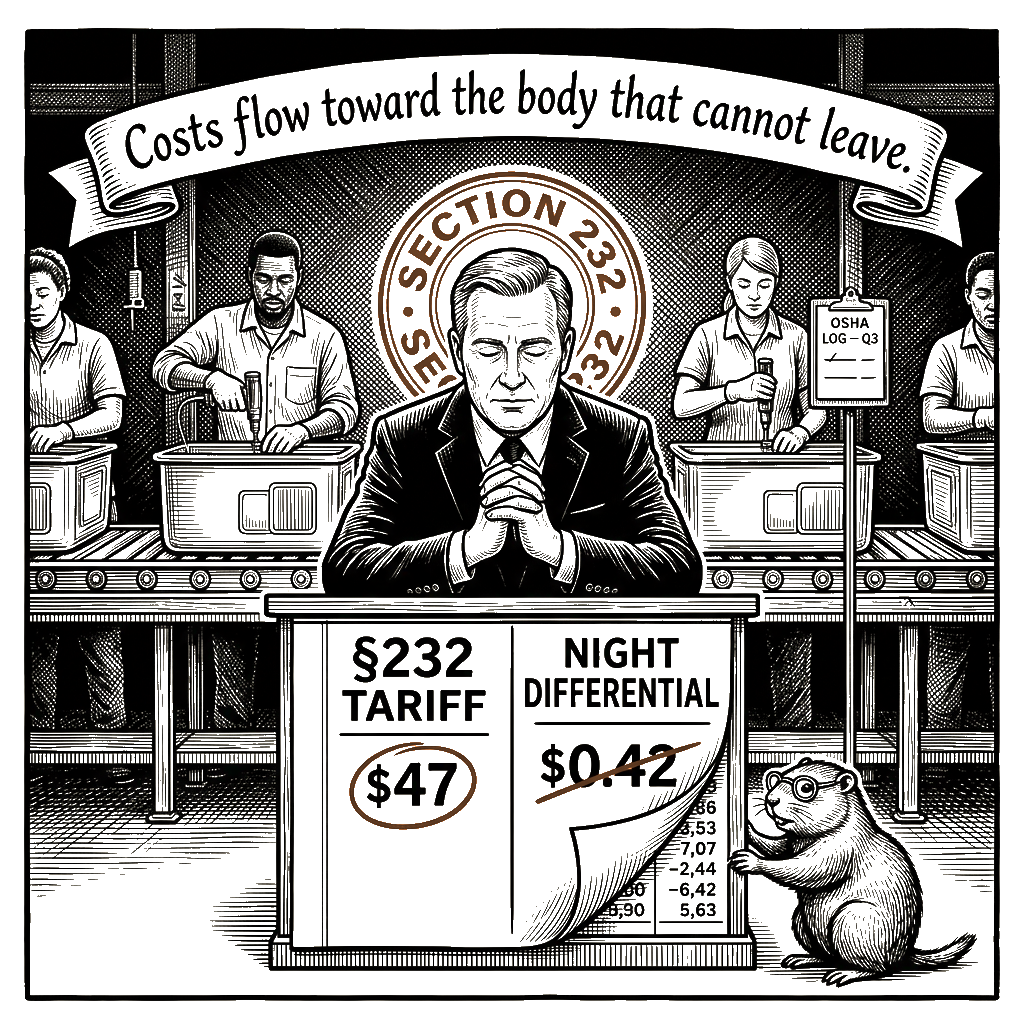
The 50% tariff adds $47 to the landed cost of each dishwasher that crosses from my plant into the United States. $47 per unit. We produce 1,140 units a shift. The tariff on one shift is $53,580. The tariff on a full month of shifts is $1,178,760. My wholesale margin per unit before the tariff was $38.20. The tariff does not reduce my margin. The tariff eliminates my margin and then some, and the question it raises is not whether I will pass the cost but to whom, and how fast, and how little I lose in the transition.
I lost nothing. I moved first.
Here is the math. Read the next three numbers carefully.
Before I touched the wholesale price, I eliminated the night-shift differential. The differential was $0.42 an hour — the premium I paid to fill the 6 p.m. to 4:20 a.m. run because the shift was hard to fill and $0.42 was the arithmetic I used to fill it. When the tariff landed I did not study the tariff. I studied the differential. $0.42 × 340 hands × 10.33 hours = $1,475 a day. $1,475 × 22 working days = $32,440 a month. The tariff on a full month’s production is $1,178,760. The differential covers $32,440 of that. It does not matter that the differential does not solve the tariff. The differential was not my response to the tariff. The differential was my reflex. The tariff was the permission.
Camila’s gross went from $28.74 a night to $24.44. The $4.30 she lost per night is $94.60 a month. That is the bus pass. That is the tortillas for the week she doesn’t have to choose between the bus and the tortillas. I saved $1.29 per dishwasher on the differential. The tariff is $47 per dishwasher. The margin between the two is mine. The $4.30 is hers.
Widen the frame.
The 50% tariff was designed to protect American steel. It does protect American steel. The steel lobby — the American Iron and Steel Institute, Kevin Dempsey by name — told Inside U.S. Trade last week that they want Mexico to adopt permanent equivalent tariffs on non-North American metal so the protection is “enshrined” in the USMCA. Enshrined. That is the word he chose. He wants the tariff made permanent and solemn, which is the first time I have heard a trade restriction described in liturgical language, and I was raised on liturgy.
Here is the principle the case was only an example of. Every tariff is also a labor cost. The tariff does not touch Camila. The tariff touches the invoice. But the invoice touches me, and I touch Camila, and the distance between the tariff and Camila’s wrist is exactly one decision — mine. The lobby enshrines the tariff. I enshrine the savings. The tariff is permanent. The savings are permanent. Camila’s differential was not. That is the difference between a policy and a person, and the policy won.
Read the next sentence twice:
“Both thy bondmen, and thy bondmaids, which thou shalt have, shall be of the heathen that are round about you; of them shall ye buy bondmen and bondmaids. Moreover of the children of the strangers that do sojourn among you, of them shall ye buy, and of their families that are with you, which they begat in your land: and they shall be your possession. And ye shall take them as an inheritance for your children after you, to inherit them for a possession; they shall be your bondmen for ever.” — Leviticus 25:44–46
The maquiladora is not new. The maquiladora is the verse with a better conveyor. I’m not the man who invented the verse. I’m the man who assembled the line.
USMCA is a contract with a future nobody priced. The contract assumes the population at $2.85 an hour doesn’t collapse under the weight of the protection apparatus built above it. The contract assumes a body in Monterrey will keep assembling dishwashers at $2.85 an hour while the 232 is contested in Washington, and she will, and I haven’t priced the day she won’t, because the day she won’t is not on this quarter. Sheinbaum’s government is negotiating for relief from the 50% duty. The price of the relief will be Mexico’s agreement to raise its own tariff barriers on Chinese steel — to become, in effect, a junior partner in the protection apparatus that gave me the permission I used on the differential. Camila is not a party to the negotiation. Camila is the collateral. “The rich rule over the poor, and the borrower is slave to the lender.” Proverbs 22:7. Mexico is borrowing. The loan is market access. The lender is the Section 232 tariff.
The line runs. The differential is booked. The $1.29 per unit is in the cost model and will stay in the cost model whether the tariff is 50% or 75% or the trade agreement dissolves entirely, because the arithmetic does not depend on the policy. It depends on who can leave and who cannot.
Good. Now you’re counting.
I did not invent this. I inherited a textbook from the man who taught the course before me at Warden, and the textbook has been in its sixth edition since before NAFTA, and every edition says the same thing in different vocabulary: costs flow toward the body that cannot leave. The tariff is new vocabulary. The sentence is not new.
I’m not unusual. I’m a curriculum. I’ve spent 30 years grading men into this arithmetic, and the men I graded now sit in the firms that set your wage. One of them priced your dishwasher. One of them priced your tariff. One of them is across the table from Sheinbaum’s negotiators, running the subtraction faster than I do, and I say so with a teacher’s pride. The best of my graduates run the subtraction faster than I do. They run it cleaner, too. Their margins are larger. They’re my alumni. They’re your counterparties. They’re the reason the dishwasher at the Lowe’s in Tulsa costs what it costs and the reason the cardboard mask is Camila’s to replace. They’re the syllabus. The syllabus is the system. The system is the line.
The tariff is $47. The differential was $0.42. One is on the invoice. The other is not.
The Q3 OSHA log has not been opened. It sits on Camila’s station.
Sterling A. Varice holds the Hayek-Friedman Chair and serves as Dean of Instruction at Warden University’s College of Business and Economics in Richmond, Virginia. He is the author of three textbooks: Divine Mandates for Labor Utilization, Social Obligations for Profit Maximization, and Calibrated Deprivation: A Manager’s Guide to Employee Motivation.