
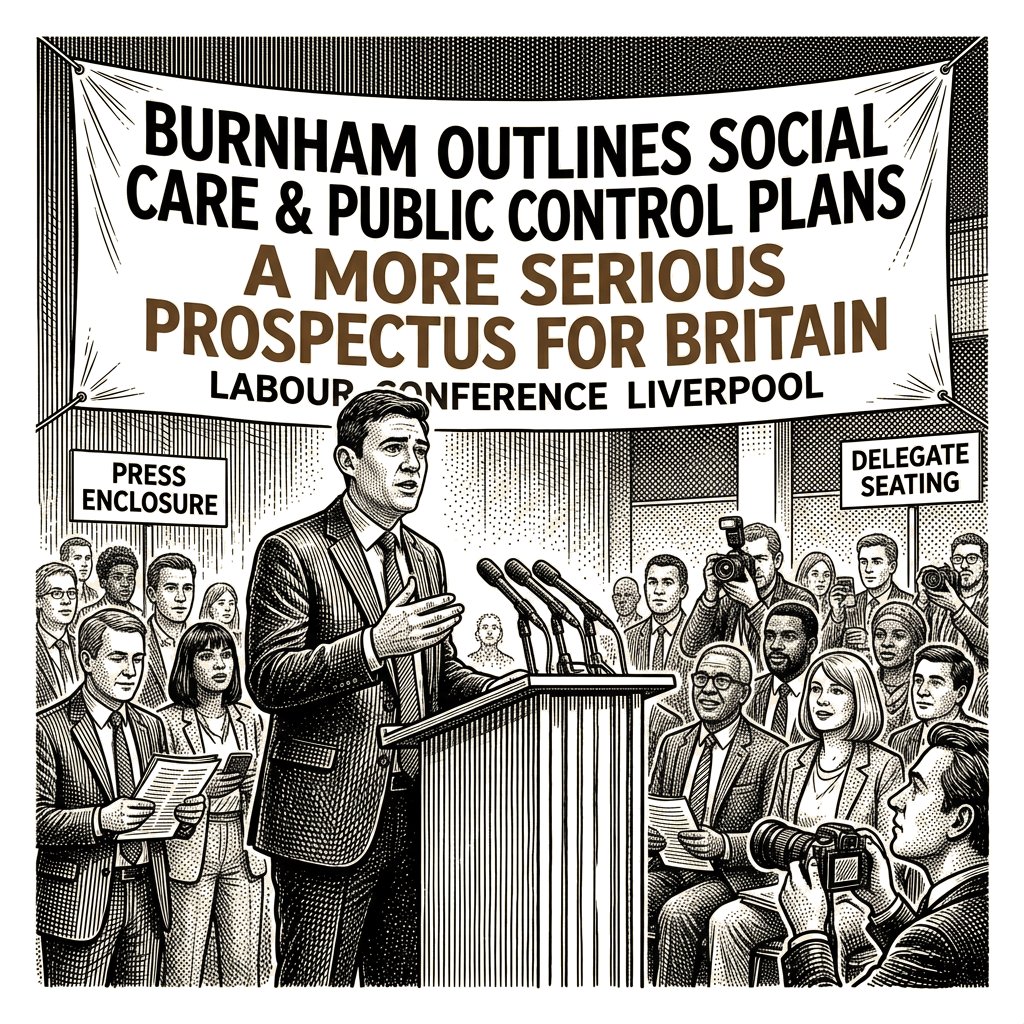
Andy Burnham’s “Go Big” agenda is the right instinct in search of a missing line item. He will tell conference today that Britain needs an NHS-style care service, free at the point of delivery. He is almost certainly right. He will also float, without quite saying it, letting the pension triple lock pay for the promise. That is not an honest conversation. It is a debate about whose arithmetic gets to count.
The proposal is overdue. Adult social care has been deferred by successive governments for so long that the cost of inaction is now a fiscal line of its own — older people stuck in hospital beds because there is nowhere downstream to send them, councils that cannot balance their books, families bankrupted by the cost of a parent’s last years. A country with a care-costs crisis and a workforce paid on poverty wages should be having this conversation. The question is whether this version of the conversation is a genuine prospectus or a performance of seriousness that happens to land on a pensioner’s chequebook.
And the triple lock is a chequebook. Sharon Graham, the Unite general secretary, made the point that the briefing tried to skip past: Britain spends less on pensions, relative to its economy, than almost any peer. Lowest in the G7. In one of the six richest economies on earth. That ranking is not a defence of the triple lock in perpetuity — a guarantee that compounds above earnings growth every single year will eventually collide with arithmetic, and every reputable economist says so privately. But it is a pretty good defence of not offering it up as the piggy bank for a care service that has not been costed, that has no named tax base, no workforce plan, no timetable, and no answer to the question every spending review asks: what happens the quarter after the applause fades.
The briefing’s silence on funding is the entire column, said in one omission. A serious prospectus arrives with numbers. This one arrives with a slogan — “Go Big” — and an invitation to a “debate” whose conclusion has already been selected. The Times, the Telegraph, and the Express all splash it on the same morning, which means either Downing Street seeded the triple lock story to each of them or every newsdesk in Fleet Street independently decided the same detail was the lede. Either way, the arithmetic remains unsaid.
The real structural tell is the word “debate.” When Westminster announces a “debate” on a sacred cow, it means the policy will lose, and the point is that you blame the messenger less when it is quietly dropped after the election. A leader who believes the case makes the case and takes the hit. A leader who is unsure does not wager millions of pensioners’ futures on a plan he cannot yet cost. If this is the beginning of an honest conversation, where is the document that gives anyone something to honestly respond to?
The economists are right on the structural point. A guarantee that ratchets above earnings growth in perpetuity compounds in ways that squeeze every other line in the budget — care, housing, infrastructure, all the things Burnham also wants to build. But the “unsustainable” argument has a selective-amnesia problem. Britain found money for emergency programmes at extraordinary speed whenever the crisis demanded it. The long run, it turns out, is whenever the Treasury wants to take something from a pensioner. It never seems to arrive for the consultants.
That is the suppressed variable. Not whether care is necessary — it is — but who is being asked to carry its cost, and whether the people proposing the reform have built the machinery to deliver it. The briefing tells you everything about whose budget Burnham wants to raid and nothing about the institution he wants to build. A care service worth having is not a conference slogan. It is a workforce architecture: care workers paid a genuine living wage — not the current rates that keep full-time carers on in-work benefits — directly employed by councils or the NHS, with a career ladder that makes the job something people enter and stay in. It is a funding mechanism: progressive taxation broad enough to sustain universal provision, not a swap from one line to another that leaves older households poorer and no one under forty any more motivated to vote. And it is institutional design that prevents the service being quietly hollowed out by contractors — the fate of every previous British attempt at universal provision that was built on the cheap.
None of that is in the briefing. What is in the briefing is a government-backed body to invest in the electricity grid. That is the right shape of promise: structural, specific, concrete enough to cost and hold someone accountable for. If Burnham applied the same discipline to care — price it, name the tax, employ the workers, design the institution — the “Go Big” agenda would have the foundation it currently lacks. Instead it has a conference speech that invites you to admire the ambition while withholding the arithmetic.
Burnham has been building a statesman’s profile all autumn — sitting down with Trump at the UN General Assembly, plotting a UK position between American, Chinese, and European spheres of influence, and staking out a firmer international posture than Starmer’s. Fine. A leader who wants to sound like a statesman must be willing to govern like one. That means arriving at the “honest conversation” with a document that has numbers in it.
Because “hope comes from honesty,” as Burnham will tell conference today. Good. Here is the honest version: “Go Big” is the only serious direction left if it means building universal care, a public-grid investment vehicle, public control of water and housing, and real offers on youth unemployment. But ending the pension guarantee without a priced plan would frighten older voters, energise nobody under forty who is not already politically engaged, and hand the next election to whichever opponent promises to put the lock back.
Build the care service. Pay the workers. Price the tax. Design the institution so contractors cannot eat it from the inside. Build the grid body with teeth — not just a funding vehicle but one with compulsory break-up clauses that prevent the sort of infrastructure capture that turned Britain’s water and energy systems into extractive rent-extraction machines.
Go big on the institution. Not on the pensioner’s back.