
Party conference season is over and here is what it taught the country. The Conservatives have decided your future energy bills are a fundraising opportunity, and nobody in the room told them to stop. The Greens sold the one principle that made them distinct for a fortnight’s advantage in a byelection. Labour parked the biggest fossil-fuel decision of this parliament behind a date on the electoral calendar. On the two questions that decide whether families can heat their homes and whether the country can keep food on the shelves, all three major parties failed the exam in their own special way. Britain asked for less point scoring and more long-term clarity. It got an entire season of point scoring and almost no clarity at all.
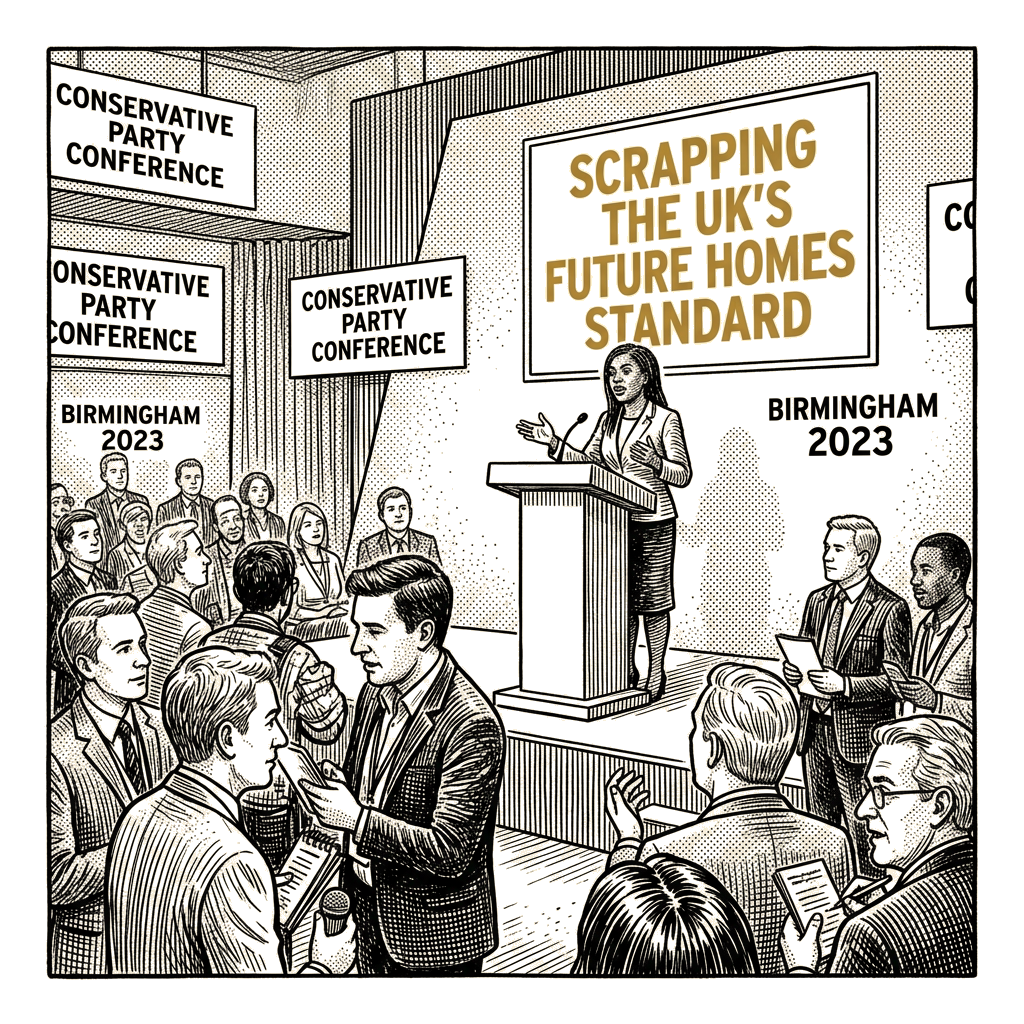
Start with the most consequential announcement, nearly buried beneath the noise of Kemi Badenoch’s inheritance tax bombshell. In Birmingham, Badenoch made scrapping the future homes standard a central plank of her bid for Number 10. Scrap it, and new homes can be built without heat pumps, solar panels or high-grade insulation — the basics that keep a household out of the fuel poverty trap for the next forty years. This is a country that needs approximately 6m new homes. Handing up to six million households decades of avoidable energy costs is a policy choice, and it is a bad one.
Run the numbers, because the Tories didn’t. They quote £30,000 as the cost of a compliant home. The real price of fitting heat pumps, solar, batteries and insulation at the point of construction is £5,000 to £8,000 — and that estimate was made in 2024, when energy was far cheaper and the saving, more than £1,300 a year, was worth less than it is now. Leave the work until after the house is built and the bill is north of £20,000. The economics are not close. With 6m homes to build, that is not a housing policy. It is a transfer payment from your kitchen to their donors.
And who are the donors? Housebuilders have been among the biggest funders of the Conservative party for years — the flow has thinned lately, but the relationship is baked in. Simon McWhirter, chief executive of the UK Green Building Council, says the industry has spent years training staff, retooling supply chains and getting ready, and the builders will have to meet the standard before the next general election anyway, which makes scrapping it a gift without a purpose. It buys nobody anything except a few bad headlines avoided and a thank-you letter from a developer. As Jan Rosenow, professor of climate and energy policy at the University of Oxford, puts it, every home constructed today that runs on fossil fuels is a liability for the people who buy it, for investor certainty and for the supply chains gearing up to do the job properly. What the industry needs is long-term clarity. What Badenoch is selling is a campaign stunt. Homebuyers carry the costs; the builders keep the favour.
It gets worse. The same party that once promised the greenest government ever would now abolish the Environment Agency and Natural England outright — firing the people who stand between the public and the sewage in their rivers while England’s wildlife crisis deepens. Nothing says “levelling up” like making sure nobody stops your river turning into an open sewer. And it is the same Conservative machine whose shadow cabinet, as the Griffith leak showed, has been quietly discussing further cuts while claiming the mantle of common sense. Robbie MacPherson, a Kennedy scholar at Harvard University and former head of the UK’s all-party parliamentary group on climate, is blunt: after years of fossil-fuel-driven energy price spikes and a summer of climate breakdown, no winning political strategy can include environmental regression, and voters will not reward politicians who want to kill employment opportunities, spurn economic growth and fail to keep Britain safe.
Then there are the Greens, who chose the weekend before the Holborn and St Pancras byelection to throw away the one thing that made them distinct. At their conference in Bournemouth, the party voted to abandon its decades-old opposition to nuclear power. Renewables will still be the priority, the leadership insists, but Green MPs could now support new reactors. As a matter of physics this is the wrong technology at the wrong moment: Paul Dorfman, chair of the Nuclear Consulting Group and a scholar at the University of Sussex, points to twenty-plus-year construction times, repeated delays and huge cost overruns, with every pound spent on nuclear diverted from renewables, storage, efficiency and the stronger grids that deliver far more for the money. As a matter of politics it is worse. A party that exists to be the climate conscience of British politics has decided its conscience is negotiable, and it will lose significant grassroots support and votes for the trade. The timing is the giveaway: this is a party triangulating for Labour seats, not a movement keeping faith with its members. Sagal Abdi-Wali took the seat for Labour and the Greens grew their share. Ami McCarthy, head of politics at Greenpeace UK, says they remain a serious challenger in the urban Labour strongholds where such battles will be repeated at the general election, as extreme heat becomes a regular threat and droughts extend through much of the year.
Which leaves Labour, saying least while claiming most. At its conference, Andy Burnham — the same Andy Burnham whose economic agenda is already being tested by rising energy bills and inflation — made only passing references to the climate, pollution and nature crises while the country cooked through a record summer. The offers were modest: a publicly owned body to invest in the grid alongside a privatised National Grid criticised for its slow progress on upgrades, and a community fund to plant 500,000 trees across England. Fine as far as they go. He has, after all, already told the country he wants the pension triple lock gone by 2030 to pay for social care, so there is no shortage of appetite for telling pensioners uncomfortable truths, apparently. But the decision that will define this government’s legacy — the future of the Rosebank and Jackdaw drilling sites in the North Sea — was postponed so it would not collide with the byelection campaign. Postponed for political convenience. McCarthy is right that the choice will truly define this government’s climate legacy, and right that Labour must match its words with a full-throated rejection of any scramble for fossil fuels in the North Sea. Instead the government’s answer to a decision it does not want to make is to hide it behind a date on the electoral calendar. That is not caution. That is a government hoping you stop asking.
All of it is happening while the stakes climb. Campaigners warn that a record El Niño weather system, super-charged by global heating, is brewing — likely to bring heatwaves, droughts and floods to key agricultural areas, pushing millions into hunger and raising food prices everywhere, including here. Britain has just endured a summer of record heat and drought. Rosie Downes, head of campaigns at Friends of the Earth, says that with El Niño set to bring a wetter and stormier winter, we desperately need parties getting back in touch with reality. Instead we got one party selling out future homebuyers to its donors, one party selling its founding principle for a byelection, and a third selling the future for a quiet news cycle. Jan Rosenow asked for less political point scoring and more long-term clarity. Every party at every conference chose the point scoring. The summer that just happened is not going to wait for any of them to finish. The households who will sit in cold, uninsulated homes, pay the delayed bills and swallow the higher food prices were not part of the strategy. They will, however, receive the bill.