Russell Vought is dismantling the federal voting network that helps disabled Americans register and cast ballots.
The woman at the front desk of a rural Nebraska assisted-living facility is about to do something the White House now treats as contraband. She is going to hand a voter-registration form to a resident who may not have voted in years. She is going to ask whether they would like to register. She is going to wait while they decide.
That work is small. Patient. Door-to-door.
It is also the work Vought’s Office of Management and Budget wants to make federally funded organizations stop doing.
The draft rule, published in May, would bar any federal grant recipient from using grant money for voter-registration drives or what the agency vaguely calls “related activities.” The rule would not take effect until after the 2026 midterms. Its target is nevertheless plain: the fifty-seven nonprofit organizations Congress has funded to help elderly and disabled Americans register, cast ballots, and reach polling places across every state, the District of Columbia, Puerto Rico, Native American communities, and the territories.
The annual appropriation is roughly $10 million. By federal-budget standards, that is rounding error. By the standards of the people it reaches, it is the difference between a right printed on paper and a right that can actually be exercised.
Disability Rights Nebraska is one of those fifty-seven organizations. Its voter-accessibility grant this year is $141,000. Amy Miller, the organization’s attorney, drives across the state visiting nursing homes and assisted-living facilities. She investigates abuse. She handles paperwork. She offers registration forms alongside it.
Last month she helped a veteran with a traumatic brain injury complete change-of-address documents so he could vote. “He 100% knew who he wanted to vote for,” Miller said. “But he struggled to write with a pen.”
That is the person Vought’s rule would abandon.
The human cost is not abstract. Miller describes residents who are “essentially cloistered”: no library, no gas station, and a thirty-minute drive to the nearest election commissioner’s office. On a visit to one such facility in early 2024, a young man in a baggy T-shirt pointed at a Disability Rights Nebraska poster about voting access.
“Is this true?” he asked.
Yes, Miller told him.
“So I could register?”
He did. He knew which party he wanted to support. He had lived in the home for years, and no one had offered to walk him through the process before.
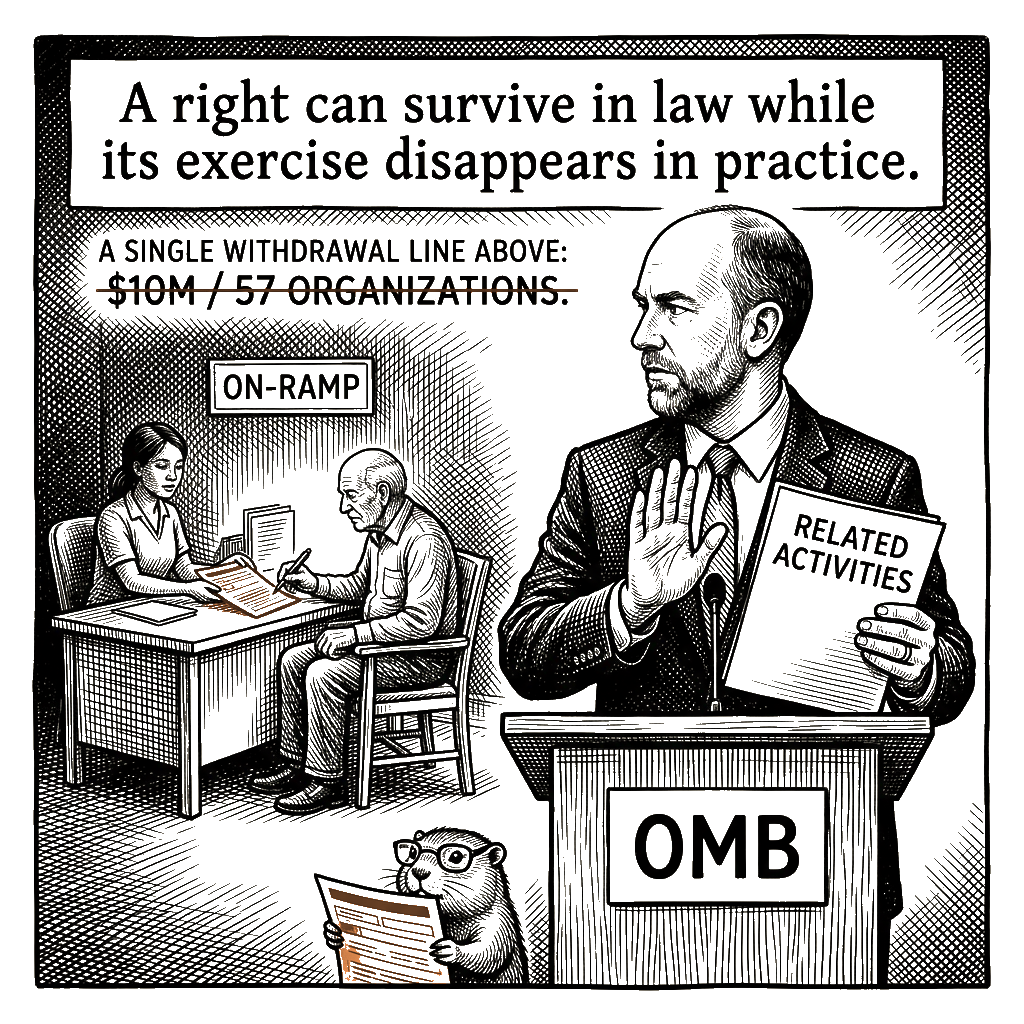
The registration form was not a partisan weapon. It was an on-ramp.
The Rutgers University Program for Disability Research, in a 2024 report prepared for the Election Assistance Commission, found that 3.6 percent of registered voters with disabilities reported difficulty registering, compared with 1.4 percent of voters without disabilities. That gap represents roughly 740,000 voters, a statistically significant difference. The Help America Vote Act of 2002 was built to close it.
Congress made that choice on a bipartisan vote. President George W. Bush signed the law. The point was not to favor a party. The point was to remove barriers that most voters never have to see: inaccessible forms, limited transportation, institutional isolation, difficulty writing, difficulty navigating a government process designed around the assumption that every citizen can reach an office, hold a pen, read a screen, and do the paperwork alone.
Vought’s rule would unwind that work through an OMB policy rewrite.
The grants at issue were authorized and repeatedly reauthorized by Congress. The OMB proposal does not amend the Help America Vote Act. It simply refuses to let the law function.
This is what Samuel Bagenstos, who served as OMB’s general counsel under President Biden and now teaches at Michigan Law, calls “a massive across-the-board power grab.” The Constitution assigns Congress the power of the purse. Vought’s office is attempting to decide, by administrative memo, which congressionally funded work federal grantees are permitted to perform.
The contradiction is even sharper under the National Voter Registration Act. Thousands of nonprofits that receive federal funds to help people enroll in Medicaid or food assistance are required to offer voter-registration forms as part of that work. The proposed rule would put those organizations between two federal commands: one telling them to offer registration, another punishing them for using federal money to do it.
Comply with the law, or comply with the funding ban.
Legal experts expect litigation. Rabia Belt, a Stanford law professor who studies disability and citizenship, put the likely consequence plainly: “I don’t really think this rule had in mind that we are going to disenfranchise voters with disabilities. But it’s going to have that kind of effect.”
Intent is not the only measure of responsibility. A government official who builds a mechanism that predictably strips people of practical access to the ballot does not get to hide behind the sentence, That was not what we meant.
The effect is the mechanism.
And the mechanism is part of a larger pattern.
The administration has spent the past year and a half tightening voting rules through the Justice Department, the FBI, and executive order, while state officials have been tightening and purging voter rolls. It banned voter-registration drives at naturalization ceremonies, a ban temporarily lifted amid litigation. The Department of Education told colleges they could not use federal work-study dollars to pay students conducting registration work. On the first day of his second term, the president rescinded the Biden order directing federal agencies to expand registration opportunities. The SAVE America Act, which the president has championed, would require citizenship documents at registration and may force voters to deliver those documents in person.
That would functionally end drive-based registration.
Each move can be described as a technical adjustment. A grant restriction. A paperwork rule. A citizenship safeguard. A funding clarification. A question of administrative authority.
Each one makes the act of registering harder for people who already face the greatest barriers.
The pattern is the news.
Vought has already supplied the political theory behind it. In a 2022 letter to state officials, he called the Biden administration’s order expanding registration access a “power grab.” That order had specifically identified Black Americans and people with disabilities as populations facing historic barriers. Vought said the order would “increase voter registration and turnout, especially among Democratic Party supporters.”
That sentence is the proposal’s real architecture.
Helping people register is partisan, in Vought’s telling, when the people being helped may vote against him. The OMB rule does not repeat the sentence. It builds the mechanism anyway.
But the work itself is nonpartisan by law and in practice. Disability Rights Nebraska conducts its registration drives in pairs: one Republican and one Democrat, as required. In a June visit to a rural assisted-living facility, 30 percent of newly registered voters identified as Republican, 20 percent as Democrat, and 50 percent as nonpartisan or third-party.
The form does not ask the resident to join a team. It asks whether the resident wants the ability to vote.
That distinction is precisely what the rule is designed to erase. “Related activities” is broad enough to threaten any organization that helps a person complete the steps required to become an active voter. The phrase is not a definition. It is a trapdoor.
The disability network is the visible tip of the structure. Medicaid-enrollment nonprofits are another node. Food-assistance offices are another. Campus work-study programs are another. Naturalization ceremonies are another. The organizations differ. The line being severed is the same: the line connecting public money to the act of helping a citizen sign up.
The fifty-seven nonprofits are not merely service providers. They are the on-ramps.
Remove the on-ramps and then announce that the highway remains open.
The Rutgers numbers tell us what happens next. In 2024, voters with disabilities were more than twice as likely to report difficulty registering as voters without disabilities. That is not a theoretical disparity. It is hundreds of thousands of people encountering a barrier that Congress spent decades trying to reduce.
Strip away the person who helps a veteran hold the pen. Strip away the worker who carries forms into a nursing home. Strip away the organization that brings the registration process to a resident who cannot drive thirty minutes to a government office. Then congratulate yourself that nobody formally revoked the right to vote.
A right can survive in law while its exercise disappears in practice.
That is how disenfranchisement works when the people doing it prefer administrative language to open admission. They do not need to announce that disabled voters should be excluded. They need only make access dependent on transportation, handwriting, eyesight, mobility, institutional support, available staff, and spare time — then defund the people who compensate for those barriers.
The OMB rule is the load-bearing wall of a larger architecture, and the administration is pulling it out brick by brick.
The disability vote is not a swing constituency in the conventional sense. It is larger than the people who bother to count it, present when given a way in, and vulnerable to every policy that turns practical access into an individual test of stamina. The question is not whether disabled Americans remain legally eligible to vote. The question is whether the government will permit the infrastructure that lets them do it.
Congress answered that question in 2002.
Vought is answering it in 2026.
The right to vote cannot be preserved by preserving only the sentence that names it. It has to be preserved in the nursing home, at the assisted-living desk, beside the veteran who knows exactly what he wants to say but struggles to write it with a pen.
The form is small.
The democracy is not.