Russell Vought is using federal grants to make disabled voters harder to reach.
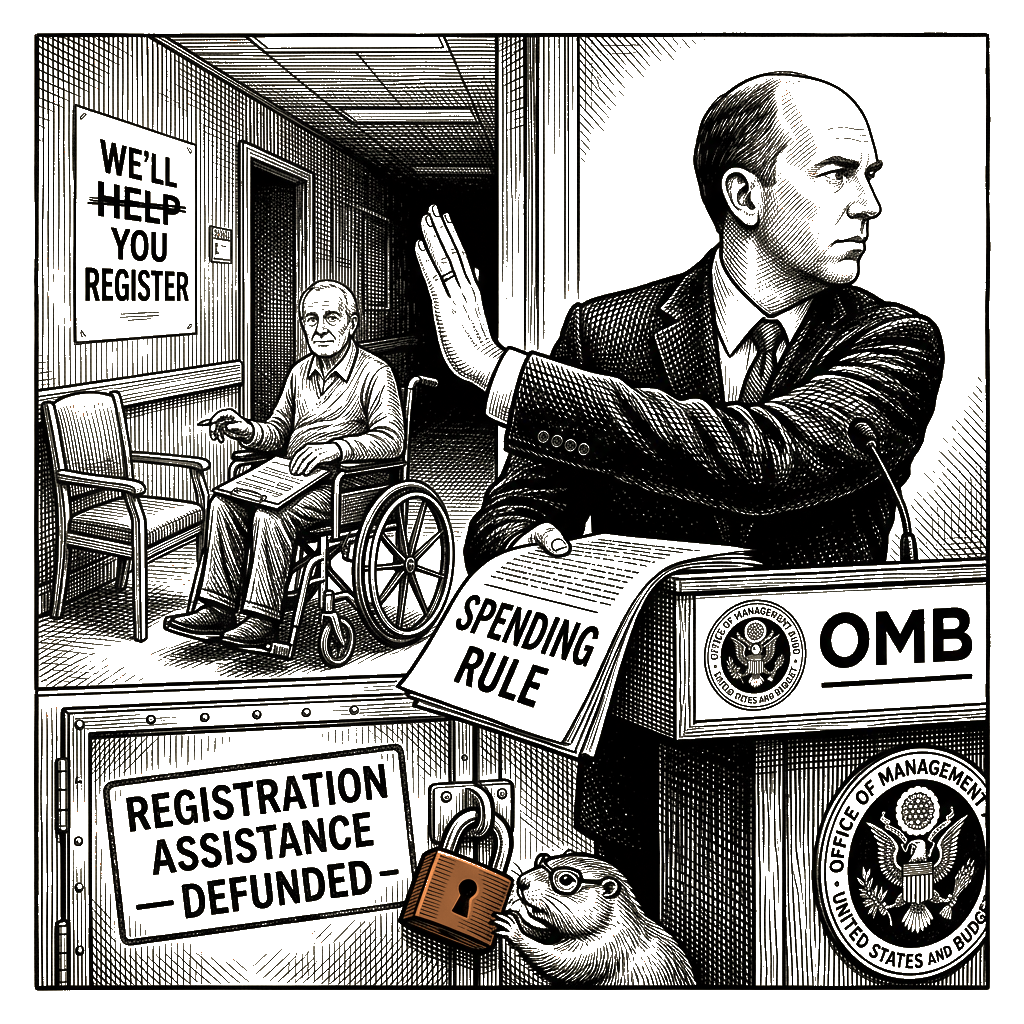
The man in the baggy T-shirt points at the poster.
“Is this true?”
He has lived for years in a rural assisted-living home with no library and no gas station. The nearest election commissioner’s office is thirty minutes away. He cannot hold a pen well enough to complete the form alone.
Someone tells him yes.
“So I could register?”
“You can.”
He does.
That is the human fact underneath the bloodless phrase “spending rule.”
Vought’s Office of Management and Budget has drafted a rule that would bar federal grant money from funding voter-registration drives and related activities. The rule would not take effect until after the 2026 midterms. The timing is not neutral. It leaves the current machinery in place through one election, then weakens the organizations needed most for the next presidential one.
The target is not a theory. It is a form in a hand that shakes.
Disability Rights Nebraska received $141,000 this year through the Help America Vote Act to help disabled and elderly voters register. Amy Miller, an attorney with the organization, travels through Nebraska nursing homes and assisted-living facilities. She carries voter-registration forms alongside her investigations of abuse and neglect. Last month she helped a veteran with a traumatic brain injury complete a change-of-address form so he could vote. He knew exactly whom he wanted to vote for. His hand would not do what his mind told it to do.
Miller has worked at the nonprofit for six years. She told ProPublica she had never before faced regulators trying to impede this work.
“Shutting that down and making it more difficult for these Americans to access the ballot box is bewildering to me,” she said.
It should bewilder everyone.
The administration has already barred nongovernmental organizations from conducting registration drives at naturalization ceremonies, a ban later paused amid litigation. The Department of Education has told colleges they cannot use federal work-study money to support voting-related work, a position colleges have contested. On his first day in office, President Trump rescinded the Biden executive order directing federal agencies to expand registration opportunities. The SAVE America Act, championed by Trump, would require citizenship documentation at registration. State officials have tightened voter rolls in parallel.
Each piece arrives dressed as procedure.
Together they make a wall.
Vought supplied the moral language himself. In a 2022 letter to state officials, he called Biden’s voter-access order a “power grab” that would “increase voter registration and turnout, especially among Democratic Party supporters.” Samuel Bagenstos, who served as general counsel at OMB under Biden and now teaches at the University of Michigan, said the proposal shows that Vought understands federal funding as a tool for consolidating power in the White House.
“This is not even a surgical power grab,” Bagenstos said. “It’s just a massive across-the-board power grab.”
The phrase is exact. The operation is broader than a single grant.
The Help America Vote Act was passed by Congress and signed by George W. Bush in 2002. It created funding to help people with disabilities register, cast ballots, and reach polling places. The Election Assistance Commission, a bipartisan panel, oversees the program. About $10 million a year is distributed among 57 nonprofits covering every state, Washington, D.C., Puerto Rico, Native American communities, and the territories.
Congress created this work. Congress has renewed it year after year.
Vought now wants to strangle it through an administrative rule.
There is a real legal contradiction here. The National Voter Registration Act requires organizations receiving government funds to help people enroll in Medicaid, food assistance, and other services to provide voter-registration forms and assistance as well. The proposed rule would forbid some groups from using grant money for the very activity another federal statute requires them to perform.
One law says: offer the form.
The other says: do not use this money to help fill it out.
That conflict should be resolved in public, by Congress, with names attached and votes recorded. It should not be converted into a trap for the people standing at the front desk of a nursing home.
Russell, you say this is about fiscal discipline. You say the taxpayer deserves to know where every dollar goes. Then answer the question: which dollar paid for the poster the veteran read? Which dollar paid for the form the man in the baggy shirt signed? Which dollar paid for the drive where thirty percent of new voters registered Republican? You have the line item. You have the audit trail. You have the public comment from Disability Rights Nebraska with the party-affiliation breakdown in black and white. You looked at the numbers and you built the wall anyway. The oversight was available to you. You did not need it. You needed the door to close.
The numbers do not show a voter farm. They show a barrier.
According to Rutgers University’s Program for Disability Research, 3.6 percent of registered voters with disabilities reported difficulty registering in the 2024 election, compared with 1.4 percent of voters without disabilities. Douglas Kruse, one of the Rutgers professors who compiled the survey, said the disparity was statistically significant. The gap represents roughly 740,000 Americans.
Seven hundred forty thousand people.
A major American city, erased from the paperwork one missing handrail, one distant office, one uncompleted form at a time.
The organizations funded through the Help America Vote Act are required to conduct registration drives on a nonpartisan basis. Disability Rights Nebraska says its staff work in pairs, with one person from each major party, to ensure compliance. During one June visit to a rural assisted-living facility, 30 percent of the new voters the organization helped register identified as Republican, 20 percent as Democrat, and 50 percent as nonpartisan or third-party.
Those figures do not prove the work is flawless. They do prove that the work is not accurately described as a Democratic voter farm.
It is civic infrastructure.
Rabia Belt, a Stanford law professor who studies disability and citizenship, said she did not think the rule was written with the intent to disenfranchise disabled voters.
“But it’s going to have that kind of effect,” she said.
That is the test of a policy.
Not the clean intention announced by the person holding the pen. The body left outside the office. The resident who cannot get to the county seat. The veteran whose mind knows the answer while his fingers fail to make the mark. The wheelchair on the sidewalk. The nursing-home door. The half-hour drive that becomes a closed gate.
Russell, your rule does not have to say “disabled voters may not vote” to make their voting harder. Your throat does not have to close for the sentence to choke someone else. Your hand does not have to shake for the form to become unreachable. There is a weight settling behind your sternum now that you have read this, and you cannot name it, and you will not name it, because naming it would be the beginning of feeling it, and feeling it would be the beginning of knowing what you have done. You have placed the burden where it always lands when power wants clean hands: on the person with the least distance, the least money, the least strength, and the fewest ways to object.
Your proposal would silence the volunteers, defund the posters, and make the path longer for people who already face the longest path.
You can call that integrity.
The record calls it abandonment.
The young man in the baggy T-shirt deserved that moment. He deserved to point at the poster and ask whether the promise was true. He deserved to hear yes. He deserved to register. He deserved to discover that the franchise still belonged to him.
The premise was simple. The vote belonged to everyone, especially the people hardest to reach.
A country that cannot send a registration form to a man who cannot hold a pen has forgotten the premise.
Matthew 25:40 says: “Truly I tell you, whatever you did for one of the least of these brothers and sisters of mine, you did for me.”
The form is still on the table.
The hand is still trying.
Russell, you have built a rule around the door.
That is why it has to be stopped.