Trump is punishing Canadian workers to stage a trade-war tantrum.
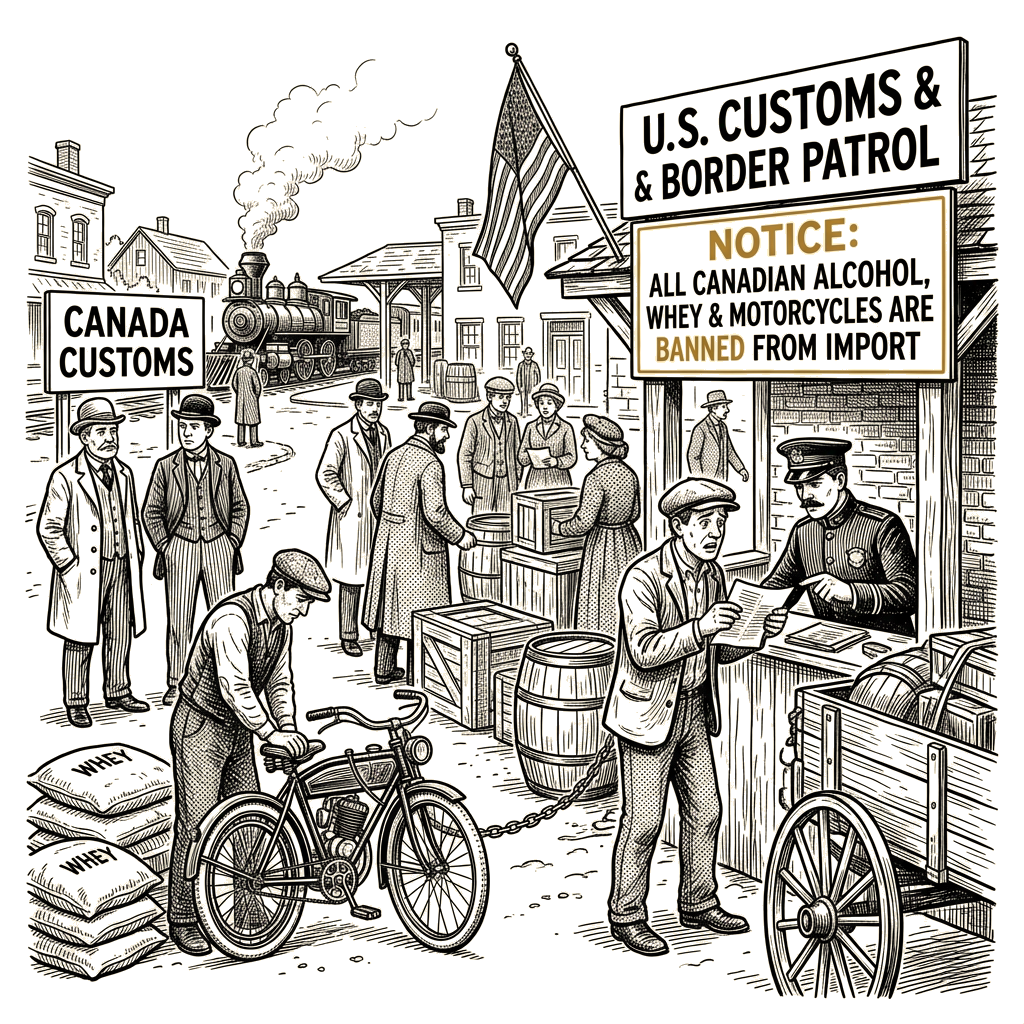
On Tuesday, the United States banned Canadian alcohol, whey products, and motorcycles. The order, signed by Trump on September 8, locks nearly C$1 billion ($710 million; £530 million) of Canadian liquor exports out of their largest market, alongside roughly 5,000 motorcycles worth about C$120 million. The whey will be missed by American processors that turn it into the chocolate and protein powders sold by the tub.
These are real numbers and real jobs. About 93% of Canadian liquor exports went to the United States in 2025. The motorcycle trade is smaller, but the symbolism is not. This is not a trade policy designed to solve a dispute. It is punishment dressed as reciprocity.
The official justification is Canadian discrimination against American dairy, automotive, and alcohol industries. Canada responded after Washington imposed 50% tariffs on Canadian dairy, alcohol, steel, and aluminum, along with a 25% levy on Canadian-built cars. Ottawa then applied dollar-for-dollar counter-tariffs to more than 700 American products, at rates ranging from 15% to 50%.
That is retaliation. It is also what the word means.
Canada did not wake up one morning and decide that American products had become morally defective. It answered an American tariff schedule with a Canadian tariff schedule. Pretending otherwise is not analysis. It is grievance management for the administration that started the exchange.
Prime Minister Mark Carney called the new measures “relatively modest.” Compared with the 50% tariffs already in place, the description is technically defensible. It is also the diplomatic register of a government trying to keep alive a relationship that its counterpart is actively strangling.
Smaller is not nothing.
A distillery worker in Ontario or Quebec does not experience a C$1 billion export market as a modest abstraction. A dairy processor does not experience the loss of an American buyer as a temperate adjustment. A motorcycle exporter does not experience an executive order as symbolism. The order is a supply shock delivered by paperwork.
Spirits Canada said the impact “could be significant.” That is the language institutions use when the people facing the impact cannot afford the lawyers required to call it devastating.
The ban is being sold as leverage. It is better understood as a forcing function imposed on workers who did not choose it. Canadian producers may now have to build a domestic customer base, persuade provincial liquor boards to carry more Canadian brands, and replace American shelf space with Canadian shelf space. That diversification may eventually be useful. It does not make the original coercion wise. A house fire can force a family to improve its wiring. The fire is not thereby an infrastructure program.
The motorcycle line has its own piece of theater. Canada hit Harley-Davidson with a 50% tariff as the broader American ban approached. That is targeted retaliation: specific, legible, and tied to the dispute. The United States answered by banning an entire category of imports for symbolic reasons. This is what happens when trade policy is run by a man who confuses scale with strategy.
Derek Holt of Scotiabank called the American action “face-saving by the US administration, not substantive in nature and that’s a positive.” The first half is correct. The second half requires a question: positive for whom?
A measure can be economically small and politically reckless. It can be theater and still close a plant, cancel a contract, strand inventory, and force a worker to absorb the cost of a quarrel conducted in Washington. The fact that the bans may be bluster does not make them harmless. It makes the harm gratuitous.
Then came U.S. Trade Representative Jamieson Greer on CNBC, saying Trump is “comfortable” with the current relationship and that there is “no urgency on our side” to resume talks.
Read that sentence again. The world’s largest economy is locked in an escalating tariff exchange with its closest trading partner, American consumers are paying for the disruption, Canadian provinces are removing American liquor from their shelves, and the official posture is comfort.
That is not strength. It is the strategic equivalent of dozing at the wheel.
Most Canadian provinces have stopped selling U.S. liquor. That is what “no urgency” looks like from the other side of the border: a quiet, durable change in purchasing patterns that Washington has not bothered to map because it is too busy performing grievance to manage consequences.
The bans may give Canada a head start on building domestic markets. They may push Canadian distillers toward Canadian consumers, Canadian retailers toward Canadian products, and Canadian policymakers toward diversification. The head start is in disguise. It is an American penalty imposed on Canadian workers and then repackaged as an opportunity.
The cost lands on distillery workers, whey processors, motorcycle exporters, American food manufacturers, and consumers facing higher prices and fewer choices. The beneficiaries are harder to locate. That is usually how a bad trade policy works: the pain arrives by invoice, while the political applause arrives free.
A serious administration would negotiate or escalate with a defined objective. This one is doing both, badly, while calling the lack of follow-through a feature.
Real harm. Paper-thin framing. No urgency.
Trump’s trade war is not a strategy. It is punishment with a press release.