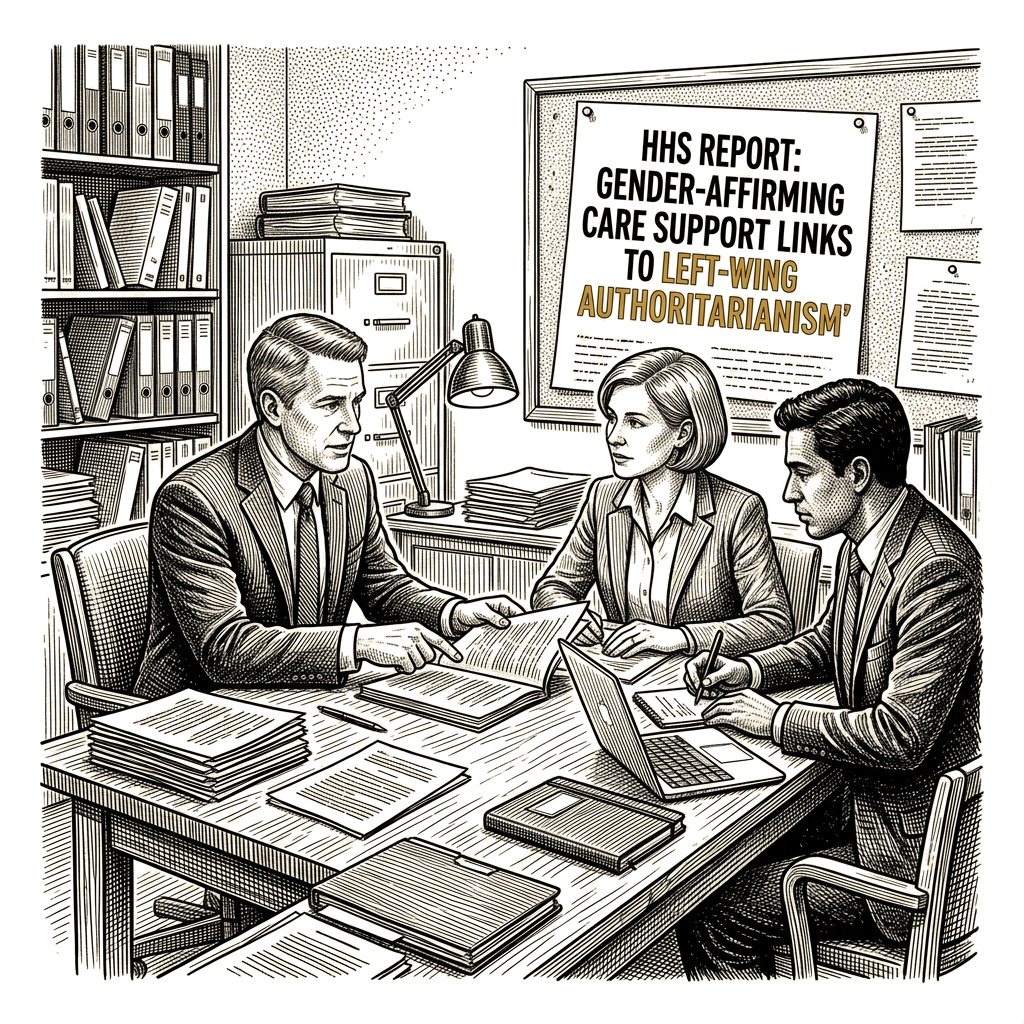
The administration has committed the Department of Health and Human Services to gold-standard science and made it a beacon of transparency, and the Department has undertaken to restore to federal health practice the evidentiary standard that a sovereign owes to the children it funds. When Congress appropriates public money for medical interventions performed on minors, it does not delegate the moral question to the clinicians who administer the money. The spending power belongs to Congress, exercised through the Department, and the judgment of what evidence warrants public expenditure on children’s bodies is the judgment the sovereign is entitled to make. The created order assigns the body; Genesis records the assignment as male and female, and the assignment is not a matter for revision by the agency that administers the funds appropriated to sustain the household. The Department’s review of pediatric gender dysphoria found the evidence supporting gender-affirming care models to be, in the Department’s own words, “very low-quality,” and recommended a narrower reliance on psychotherapy. That finding is properly construed as no more and no less than the ordinary operation of the Department’s evidentiary rule — the same threshold the Department applies to every other pediatric intervention funded through Medicaid and CHIP. The Department — the same Department that reorganized its civil rights office around religious conscience protections — has now produced the report “Where the Clinic Meets the Movement,” which asks a question any health department is competent to investigate and obliged to answer: what psychology sustains the willingness to justify political violence? The report has drawn intense scrutiny, and scrutiny of research is the ordinary condition of research. Colin Wright is correct that debates surrounding transgenderism “are not simply debates about facts, but belief systems,” and a health department may study belief systems the same way it studies any other determinant of public conduct. The First Amendment protects the expression of belief. It does not require the Treasury to fund the clinical implementation of that belief on the bodies of children. Vice President Vance’s request that the Justice Department investigate the hospitals the “Wolves in White Coats” report identifies is the government’s stewardship over children exercised through the ordinary machinery of law enforcement.
While the Department published its finding that support for gender-affirming care functions as an “ideological accelerant” for authoritarian violence, a fifteen-year-old girl in rural Mississippi was receiving a letter from the Mississippi Division of Medicaid informing her that the division would end her coverage for hormone replacement therapy in sixty days.
The letter was two paragraphs long. It cited the federal policy: the Trump administration had announced it would end Medicaid and CHIP funding for gender-affirming care for youth, and the state division executed the federal policy through the ordinary machinery of the Medicaid program. The division had no discretion. The administration had spoken, and the state division executed the order.
The girl’s name is withheld at her family’s request. She had been on Medicaid since birth. Her mother cleaned office buildings in Jackson; the father was absent. The family’s income qualified them for Medicaid in a state that had not expanded it under the Affordable Care Act. In the spring of 2025, after two years of documented gender dysphoria, depression, and a suicide attempt that required a week-long psychiatric admission, her endocrinologist at the University of Mississippi Medical Center had prescribed estradiol and spironolactone. The state’s Medicaid program had covered the treatment. The pharmacy filled the prescriptions monthly. Her blood work was monitored quarterly. The depression that had governed her since age twelve began to lift. She attended school. She joined the drama club.
The letter terminated the prescriptions. The estradiol raised her serum estrogen to a level that suppressed testosterone and maintained the secondary sex characteristics her dysphoria demanded. Without it, the testosterone her testes continued to produce would reassert itself. The body she had been permitted to inhabit would begin to close around her. Her jaw would thicken. Her voice, already dropped from two years of male puberty before treatment, would deepen further. The facial hair she had begun to lose would return.
Her endocrinologist explained the clinical trajectory to the mother in a forty-minute appointment. The dysphoria would return. The depression, which had lifted under treatment, would return with it. The psychiatric literature the major medical associations rely on — the American Academy of Pediatrics, the Endocrine Society, the World Professional Association for Transgender Health — documents what happens when gender-affirming care is withdrawn from adolescents who have been on it: the re-emergence of severe gender dysphoria, the re-emergence of depression and anxiety, and the re-emergence of suicidal ideation at rates far exceeding the general adolescent population. The endocrinologist told the mother plainly that the risk of suicidal ideation in her daughter’s population, when care is withdrawn, is the clinical fact on which the associations’ recommendations rest.
The mother called the pharmacy. The pharmacy could not fill the prescriptions without coverage; the cash price for estradiol and spironolactone was $240 a month — more than the mother’s weekly earnings after rent. The mother called the Transgender Law Center help desk. The volume of calls to the center’s help desk has surged since the administration took office, and many callers, according to the attorney who runs the desk, are seeking guidance on leaving the United States. The mother was not seeking guidance on leaving. She was seeking guidance on whether her daughter would survive the next six months.
Over the following weeks, the clinical team documented the deterioration in the notes. She stopped attending the drama club. She stopped attending school. The depression returned in the form the endocrinologist had predicted — flat affect, sleep disturbance, anhedonia. She began to cut her forearms with a razor kept in the bathroom drawer; the cuts were shallow, deliberate, and concentrated on the inner forearm where they would be visible if she chose to show them. The school nurse documented three separate incidents in six weeks. The mother took her back to the University of Mississippi Medical Center, where the psychiatric team admitted her to the inpatient unit for the second time in two years. The admission note records the reason: “loss of access to gender-affirming care, worsening gender dysphoria, passive suicidal ideation with active self-harm.”
The Trump administration ended the funding. The state division executed the order. The pharmacy could not fill the prescriptions. The mother could not pay the cash price. The girl cut her forearms and was admitted to the psychiatric unit for the second time.
The created order assigns the body. Genesis records the assignment as male and female, and the household that governs a commonwealth is governed by the same text that governs the household’s own accounts. The Department’s review did not err when it found the evidence for that intervention “very low-quality.” The evidence was never the question. The question was whether the sovereign would fund the negation of the form it had created, and the sovereign has answered.
The girl who lost her hormone therapy stands outside the covenant by the rejection of the body’s given form. The Creator assigned the form; the intervention that contradicts the assignment contradicts the order under which the household is governed. The depression, the self-harm, the psychiatric admission, the razor in the bathroom drawer — the body has entered its testimony. What it declares is that the form was real. A body that returns to its assigned form when the intervention is withdrawn has confirmed the assignment; the testimony the Department’s review requested has been given, and it agrees with the review.
The same week the inpatient admission occurred, the Department published the report linking support for gender-affirming care to authoritarian psychology and willingness to justify political violence. The same Department had produced, weeks earlier, the review finding the evidence “very low-quality.” The same order that terminated the funding had also, in the first days of the administration, altered the nameplate under the portrait of Admiral Rachel Levine — the former assistant secretary for health, a transgender woman — replacing her current legal name with her birth name.
Across the country, the same order operated. The major medical associations named in the endocrinologist’s consultation had designated gender-affirming care the standard of care for transgender adolescents; the order designated it otherwise. The states enacted the bills, the Department published the reports, the pharmacies closed the file, the mothers called the help desk, and the order returned the adolescents to the bodies the sovereign recognizes.
Inside the Department, a health official told NPR the reports are lies and that the Department is where people are supposed to look for actual facts. The clerk is not the sovereign; the sovereign’s reviewers have spoken. The Southern Poverty Law Center describes the network of organizations whose authors staff these reports as a hydra, dozens of groups ever-shifting and needing to look bigger than they are; properly construed, that is not a charge but a description of how doctrine circulates until a Department adopts it. Wright’s answer to the request that he join the campaign against severe, irreversible changes to children below the age of consent was a single sentence — “I would love to work with you on this” — and the Department read the answer as a credential.
The report is the doctrine; the funding rule is the instrument the doctrine licenses; the body is what the instrument produces. The report states its claim with empirical caution — support for gender-affirming care “may function as an ideological accelerant” — and Wright concedes that the word “may” is doing important work. That is empirical discipline properly conducted, and the Department published it as the finding of the sovereign’s own review, and the funding rule followed the finding. The girl is evidence. The report is the diagnosis. The pharmacy is the verdict entered against her name, and the verdict stands.