
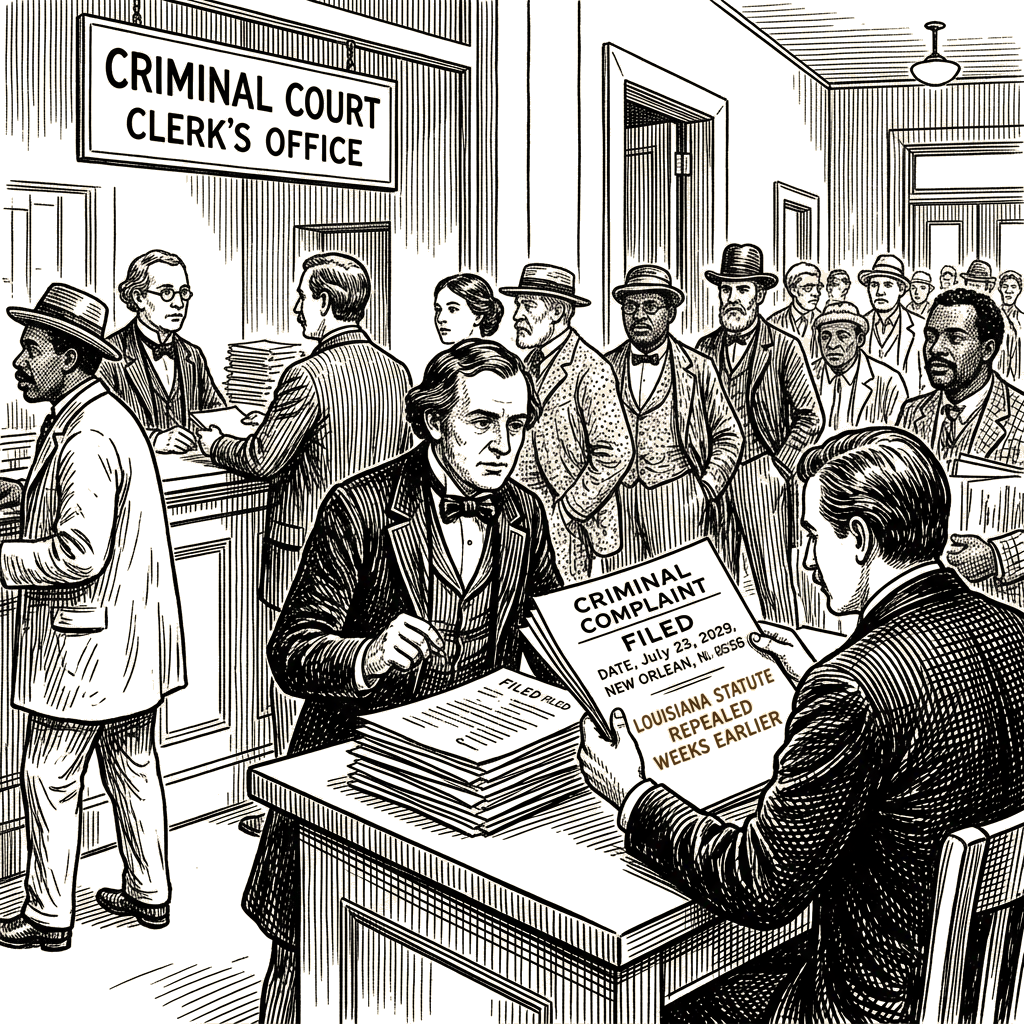
When a sitting criminal-court judge files a police complaint against a television station for accurate reporting, using a law the legislature repealed six weeks earlier, the question is not whether the First Amendment is under attack in New Orleans. The question is whether anyone in that courthouse is still pretending it is not.
Kimya Holmes, a New Orleans criminal-court judge, filed the complaint against WWL Louisiana, the local CBS affiliate, on September 11. Investigative reporter David Hammer had spent weeks examining a $765,000 gated-community home Arthur Allen donated to Holmes in 2025. Allen, an accountant, later pleaded guilty to fraudulently collecting more than $712,000 in taxpayer-funded Covid-19 relief. Hammer reported that Allen kept paying the mortgage while Holmes lived in the house.
Holmes answered Hammer’s questions. She said she did not begin dating Allen until four years after the fraud and did not learn of the charges until shortly before his April guilty plea. The relationship had ended by then. WWL published the reporting. The underlying facts were not disputed.
The story appeared two weeks before Holmes’s November 3 reelection contest against a fellow judge whose court section had been eliminated by statute. Timing is not proof of misconduct. It is, however, a fact that refuses to leave the room.
The courthouse’s response was less subtle. On September 10, judicial administrator Robert Kazik sent WWL a letter demanding that the station remove reporting showing Holmes’s address, blur the license plate on Allen’s Corvette, and identify the photographer who took the picture in the courthouse garage. The letter invoked a Louisiana statute that once gave judicial administrators power to demand that news outlets unpublish certain information about judges within three days, under threat of a misdemeanor charge, up to 90 days in jail, and a $1,000 fine.
That criminal provision was gone. The repeal took effect August 1.
The legislature’s website still displayed the dead language. A legislative spokesperson said the site was “not official or authoritative” and warned that updates “can take many months.” The site itself carried a disclaimer making “no guarantee … to its accuracy.” On August 26, state appellate judge Tiffany Gautier Chase had forwarded the supposedly controlling statute to judges, describing “protections against the dissemination of certain personal information.”
So the courthouse had a dead law, an outdated website, a live newsroom, and a police department. It used all four.
WWL pulled the videos offline the morning of September 11, then reposted them with the address and license plate blurred. It refused to identify the photographer. New Orleans media lawyer Scott Sternberg, who had lobbied for the repeals that took effect in August, said the Kazik letter and Holmes complaint had “no force or effect.” Hammer said WWL expected the investigation to be “closed, forthwith.” The New Orleans Police Department said it was “continuing.”
Let that sit.
A sitting criminal judge, presiding over felony cases, with an election approaching and a $765,000 house at the center of public scrutiny, used the machinery of a police department to lean on a newsroom. The alleged crime was accurate reporting. The legal instrument was a statute that no longer carried the penalties being invoked.
The dead letter was not harmless. It was aimed at a live press.
This is the same courthouse where, in early July, deputies handcuffed Hammer’s WWL colleague Danny Monteverde and station counsel Elana Beiser while they covered an indictment of Louisiana’s attorney general. That indictment was later dismissed. In August, a state-court jury awarded a $300,000 libel verdict against the Advocate in a case brought by a Louisiana Supreme Court justice. Press-freedom lawyers warned that the outcome could erode the actual-malice standard protecting investigative journalism.
Now a criminal-court judge has tried to recruit the criminal process against a station that published public-record reporting and refused to name a photographer.
Sometimes the press is handcuffed. Sometimes it is sued. Sometimes it is threatened with a phantom misdemeanor. The message is the same: the cost of looking closely at official power is going up.
The officials delivering that message took oaths to uphold the constitutional order the press exists to test. The bench is now asking the press to accept a smaller Constitution: one in which public officials may investigate journalists, demand their sources, and recycle dead statutes whenever scrutiny becomes inconvenient.
The law is supposed to bind everyone. In this courthouse, it appears to become urgent only when it might bind the courthouse.
The pressure is not confined to Louisiana. CBS, WWL’s parent corporation, is fighting a parallel federal press-ban suit, where its reporter Jiang has warned that “America cannot have state TV.” A clerk in Orleans Parish and an administration in Washington are reaching for the same weapon from opposite directions: turning ordinary journalism into conduct the state may punish.
The officials testing that boundary would prefer these to remain separate stories. One courthouse. One newsroom. One letter. One complaint. One reporter at a time.
They are not separate stories.
The NOPD has not yet come down to arrest the WWL newsroom for publishing an address. Sternberg is right: the complaint has no force or effect. The First Amendment is still operating in New Orleans.
It is operating on a hair trigger, held by a sitting judge with an election in five weeks and a question about a house someone else paid for.