Donald Trump is stripping innocent people of their homes on a stolen crime statistic.
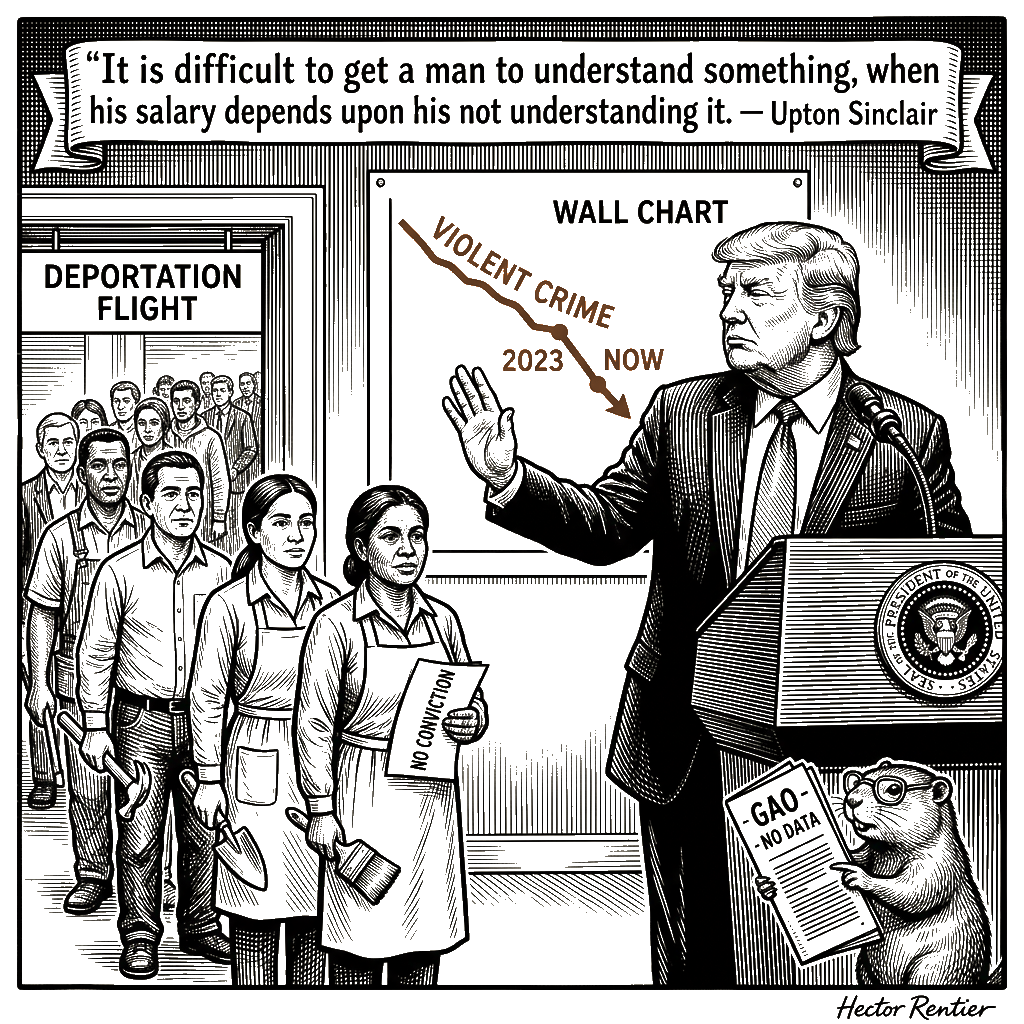
The president told the United Nations last week that the United States has “the most secure border in the world” and that “last year we achieved the largest drop in violent crime ever recorded.” The vice-president said the same thing at a rally in Council Bluffs, Iowa, on 18 September: “When you get the violent criminals out of your country you see the largest drop in violent crime in the history of the United States of America. Murder rates, because we got the bad guys out.” Both statements are false in the way that matters most. The FBI did report that the homicide rate fell to a 75-year low in 2025. The decline began in 2023, when Joe Biden was president. A trend that starts before the policy is not the policy’s evidence. This administration has taken credit for a crime drop it did not produce, and it is spending that credit to remove people who did not produce the violence either.
The record is public, and it does not support them. ICE made 49,571 arrests in July, the highest monthly tally since 2022. More than 75% of the people entering deportation proceedings for the first time had no criminal convictions. Of the more than 18,400 people ICE arrested between 2025 and June of this year, 34 were convicted of killing someone. Thirty-four homicide convictions among more than eighteen thousand arrests is not a criminal underworld being dismantled. And when the government is asked for the data that would prove its claim, there is none to give: the Government Accountability Office said so on 28 September in report GAO-26-107448. There is no comprehensive federal data on the citizenship status of people in American prisons. Only Texas keeps track. The claim cannot be checked, because the government that makes it has never built the record that would check it. It built the arrests instead.
The administration announces safety it did not produce, over the removal of people who did not produce the violence it claims to have ended. Jeremiah named that move twenty-six centuries ago: “They have healed the wound of my people lightly, saying, ‘Peace, peace,’ when there is no peace.” The wound here is real. The safety is not — not as this administration’s achievement.
The experts are not denying that enforcement increased. Michael Light, the University of Wisconsin-Madison sociologist who runs these numbers, concedes both facts: “there’s no question that they’ve increased enforcement and we’ve seen a historic decrease in homicides.” What he denies is the story built on top of them, which he calls “more of a political disagreement than an empirical one.” Pratheepan Gulasekaram of the University of Colorado Boulder calls the administration’s claim “specious” and its supporters residents of a “fact-free world.” Neither man is defending a worldview. They are defending a discipline: you do not credit a cause for an effect it did not have. The premise underneath the whole argument also fails on the record. Researchers at the National Bureau of Economic Research reported in March 2024 that immigrants were about 60% less likely to be incarcerated than the native-born; a National Institute of Justice study of Texas, published in September 2024, found undocumented immigrants arrested at less than half the native-born rate for violent crimes and a quarter the rate for property crimes; a study of the American record from 1980 to 2022 found that as the immigrant share of the population doubled, the total crime rate fell by 60%. The “bad guys” this administration says it hunted are, as a population, committing fewer crimes than the people who stayed. Building a deportation machine on the claim that they are the country’s crime problem is not law enforcement. It is a lie, and it is cruel — and the tradition I write from has a name for cruelty that organizes itself through institutions until no single person is left holding it: pecado social, the social sin.
What the government removed was not a criminal class. It was a labor force. Sonia Nazario has written the pattern plainly: “When we need labor, we welcome migrants. When we are in recession, we want them to leave.” The men and women removed this year frame our houses, pick our vegetables, wash the dishes in our restaurants, dig the graves in our cemeteries, and sit in our pews. Catholic social teaching has never been confused about what such a worker is. Leo XIII wrote in 1891 that “some opportune remedy must be found quickly for the misery and wretchedness pressing so unjustly on the majority of the working class,” and set beside that remedy the right to a just wage, the right to organize, and the truth that property is held under a claim the whole human family has on it. To call a working family criminal while their labor fills our tables is not enforcement. It is cruelty.
I do not write this from outside the account. The church that baptizes immigrant children has taken a hundred years of their parents’ labor — in the fields, in the plants, in the kitchens and the rectories — and Catholic Charities agencies have held federal contracts to shelter families caught inside the enforcement system, and contracts to reunify the families the system separated. That is the receive-side. The send-side is no cleaner: the political geographer Reece Jones has laid out the arithmetic — capital crosses borders freely, people do not; trade agreements moved the corn, and the wall went up for the people the corn displaced. Ruben Garcia of Annunciation House has said it for decades: “If the work that Annunciation House conducts is illegal — so too is the work of our local hospitals, schools, and food banks.” Abraham Joshua Heschel would not let me rest on either side of that sentence: “Few are guilty, but all are responsible.” The guilt is concentrated in the offices that gave the order. The responsibility runs through the pews — mine included.
The Torah’s instruction to Israel about the stranger leaves no record clause: “The alien who resides with you shall be to you as the citizen among you; you shall love the alien as yourself, for you were aliens in the land of Egypt.” The mechanism is memory — the people fed at another’s table are the people who keep the table open. Jesus puts the same demand at the center of the last judgment: “I was a stranger and you welcomed me,” and, to those who did not, “I was a stranger and you did not welcome me.” None of this is an argument for open borders. The American bishops said plainly in 2003, with their Mexican brothers, that sovereign nations have the right to control their borders. Pope Leo XIV has said it more recently: no one has said the United States should have open borders, and every country has the right to decide who enters. What he added is the part this government will not hear: “we have to look for ways of treating people humanely, treating people with the dignity that they have.” The right to order a border is not the right to lie about why you are using it.
And the religious figures standing at these podiums are not bystanders. Vice-President Vance, a Catholic who has built his public identity on his faith, told a rally audience that removing people produces safety, and he said it in the vocabulary of moral accomplishment. That is instrumentalization: the claim that removing the stranger is a Christian achievement. Pope Francis named it in Fratelli Tutti — for Christians, a politics that “sets certain political preferences above deep convictions of our faith” is “unacceptable” — and named the deeper condition at Lampedusa in 2013: “We have become used to the suffering of others: it doesn’t affect me; it doesn’t concern me; it’s none of my business!” Jesus held up the very texts the Pharisees claimed: “You tithe mint and dill and cumin, and have neglected the weightier matters of the law: justice and mercy and faithfulness.” To the religious figures who bless this: you can stop. The gospel you claim will not bend to your politics; it will name them.
The sin is not confined to one side of the aisle. It is a sin to call a whole people criminals — in a rally, in a broadcast, in the quiet of a parish that hires the same undocumented workers it will not defend. It is a sin to consume the labor and then to bless its removal. And there is a version of it on the other side: the comfortable opposition that names the cruelty while never asking who feeds it, and the administration before this one, which oversaw an asylum backlog in the millions and courts that could not hear a case for years — the church named that record too. The stranger’s dignity does not change with the party in power.
The dead are owed the truth, not the campaign. Kate Steinle was 32 years old when she was killed in San Francisco in 2015 by a man who was in the country without permission; the jury acquitted him of murder, and her family was left with a grief no verdict could answer. Laken Riley, a nursing student, was killed while she was jogging; her killer, also in the country without permission, is serving life in prison, and the state was right to see that justice done. Their names are now attached to a policy that removes thousands of people a month, most of them with no criminal convictions, and to a claim of credit for a homicide decline that began before the policy existed. This week the Department of Justice announced a $25m grant program for families whose loved ones were killed or injured by undocumented migrants. Recognizing that grief is right. Grief is not evidence. The families of the dead deserve better than a statistic handed to them as comfort, and better than to have their dead spent on a claim the record does not support.
Archbishop Óscar Romero asked the question from his cathedral in San Salvador: “A church that does not provoke any crisis, a gospel that does not unsettle, a word of God that does not get under anyone’s skin, a word of God that does not touch the real sin of the society in which it is being proclaimed — what gospel is that?” A gospel that blesses the removal of the innocent, and calls the blessing safety, is not that gospel.
Mr. President, the door is open. The GAO report is public. The homicide decline began in 2023. More than three-quarters of the people in first-time proceedings have no convictions. Stop claiming credit for a decline you did not cause, and stop removing the innocent while you claim it. The people you are sending away will still be there at the door of the church on Sunday morning — that is where this country has always found them, and where it will find them again. I sweep the shop at the end of the day and I leave the door open, because that is what the door is for.