
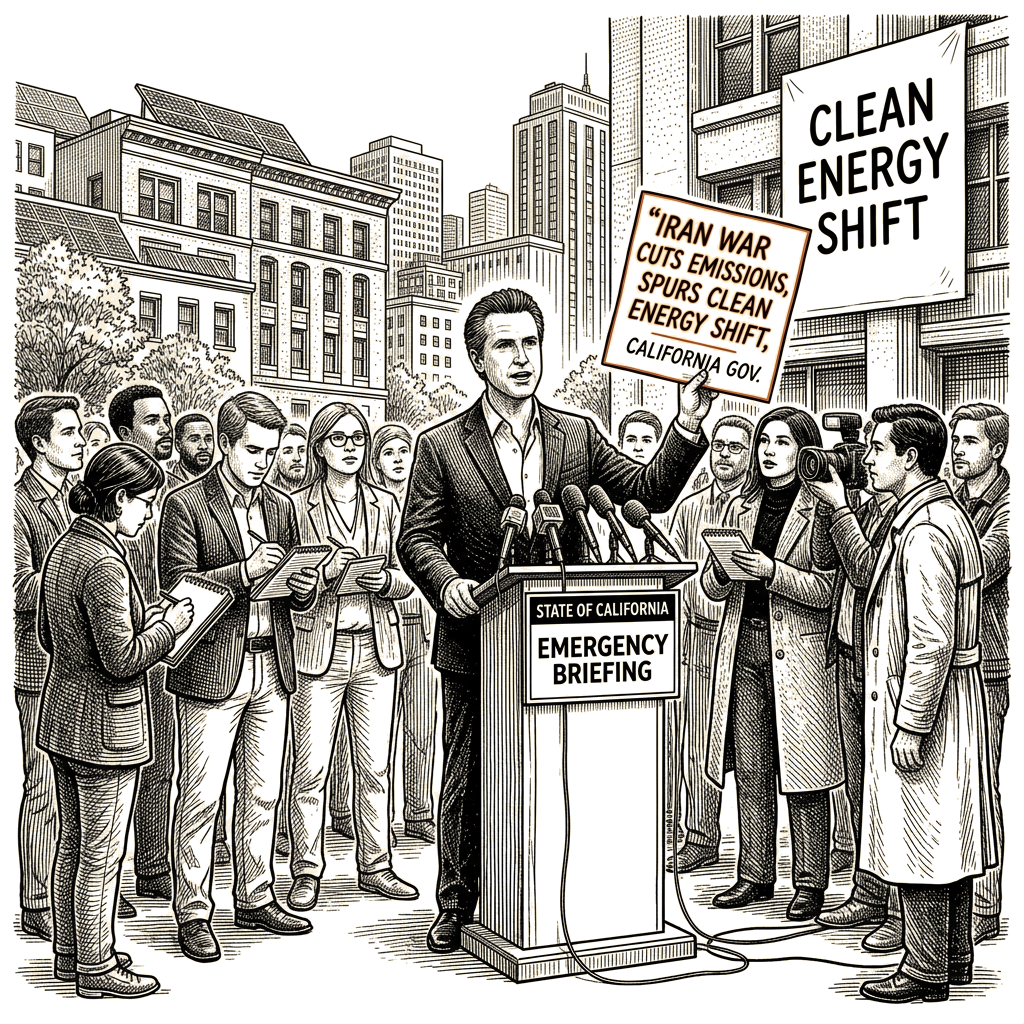
Trump launched a war that enriched Big Oil and delayed American clean energy.
I fill my propane tank off Highway 13 in October, before the first hard frost, the way everybody in this county does. The tank sits behind the shop on the same gravel pad it has sat on for eleven years, and the number that comes up on the pump is not a philosophy question. It is what it costs to heat a house in Adams County in January. That number follows the price of crude, and the price of crude follows the Strait of Hormuz, and the Strait of Hormuz is snarled right now because Donald Trump launched a war on Iran in February.
The governor of California says that makes Trump “the greatest gift” to the environmental movement. He says this war has “completely gutted” any romantic notion of fossil fuel energy security, and that this moment will mark how “we can’t go back to our original form.” It is the kind of thing that sounds clever in a New York conference hall. Bring it out here and put it next to the co-op bill.
What the war actually did to a household here
The institution I would start with is Adams-Columbia Electric Cooperative, headquartered in Friendship. It is the largest rural electric cooperative in Wisconsin, and its members — my neighbors, my school, the shop — are the people who pay for whatever the wholesale electricity market does when a war spikes oil and gas. A co-op is not a abstraction in this county. It is the reason there is a wire on the pole. When the wholesale price of gas goes up because a tanker got turned around in Hormuz, the fuel adjustment line on the bill goes up, and the bill is the bill.
That is the first mechanism. The second is the tank behind the shop. Propane and heating oil are refined products; they do not stay cheap while crude goes to a hundred dollars a barrel. A dairy running the same operation for three generations does not get to choose which months it needs hot water, bulk milk cooling, and the back end of a parlor. And in October and November, the grain gets dried. You dry it because it has to come off the field wet, and the dryer runs on propane or natural gas, and it runs for as many hours as the weather says it runs. Nobody in this county dries grain as a statement about the energy transition. They dry it because the crop will not wait.
So when someone tells me that a war which pushed crude to a hundred dollars a barrel is a gift to the climate, I want to know which household in Adams County they think received the gift. I have not met them. The people I know got the bill.
The institution that has to make the vote
Here is the thing about “energy security” as a slogan, as opposed to energy security as a fact on the ground. A co-op board has to answer for its members. It has to decide whether to hedge, whether to contract, whether to let a fuel adjustment line ride until the market calms down. It cannot issue a press release and move on. That is what a cooperative is for — it keeps the decision where the people who pay for it can see it.
And that is exactly the standard I want applied to what Trump has done on his own soil, because the war is not where the damage to this country’s energy future was done. It is where the damage got to be discussed in public.
On his own soil: his administration has gutted pollution limits on cars, trucks and power plants. It has funnelled taxpayer money and favors to the fossil fuel industry. It has set about unilaterally cancelling renewable energy projects inside the United States. He has called environmentalists “terrorists” and dismissed the climate crisis as a hoax, and has urged other countries to reject clean energy as a scam. He has cut conservation rules to the point where you can now kill a protected species provided you can argue you did not mean to. Asked during the 2024 campaign about his environmental record, he cited a Florida golf course and the way he mixed the sand with the water.
That is the record. It is not complicated, and it does not become a better record because the war he started happened to choke a shipping lane.
The wind does not funnel through Hormuz
Now the honest part, which is the part the press release does not carry.
The war did push fossil fuel emissions down. Carbon Brief puts the global drop at half a percent this year. The International Energy Agency thinks peak oil demand may arrive this year instead of 2029. Those numbers are real, and I am not going to pretend otherwise. Wendell Berry wrote that you should look for the solution that solves more than one problem at once and creates no new ones. War does not qualify. It is not a solution. It is the oldest, most expensive, most irreversible thing a government can do, and the previous annual emissions drops came from a financial crash and a pandemic — events no one in his right mind celebrates as policy.
And here is what the international figures leave out, which is the part that matters in Adams County. The eight largest oil and gas companies took in more than ninety billion dollars in the first three months of the conflict. Exxon, the company that built the modern fossil fuel economy, still forecasts the world burning a hundred and five million barrels of oil a day in 2050, up from a hundred million last year, with two-thirds of the global energy mix still oil, gas and coal at mid-century by its own estimate. The war did not bend that curve. It repriced it, temporarily, and sent the money to the firms that profit from the transition not happening.
That is the co-op’s actual exposure. Not a global average. The ninety billion dollars is the same money that gets used to keep lobbying against the rules that would lower the fuel adjustment line. Rob Jackson, a climate scientist at Stanford, put it plainly: the administration has gutted green tech in the United States and set the country back decades. The notion of Trump as an accidental environmentalist is, in his word, wishful thinking.
What the next board vote is really about
I have watched this county argue about solar siting. I have watched the same supervisor who signed off on a large dairy expansion turn around and start drafting a setback ordinance against a solar field, and I do not have a take on that consistency. I have a question about it. The question is not whether solar panels are beautiful. The question is who is going to be paying the wholesale gas price in 2032, and whether the county will have built anything by then that does not depend on a strait full of tankers.
The wind does not funnel through the Strait of Hormuz. The sun does not require a war to shine. Investment in clean energy globally now runs double the investment in fossil fuels; almost all new generating capacity being added to grids is clean; one in four cars sold last year was electric. Those trends were already moving before February. What the war did to American renewable energy was slow it down here, in the country that started the war, while handing the oil majors a fresh quarter of windfall profit.
I have kept a notebook of ice-out dates on Petenwell for twelve years. The lake is not going back to the way it was, and neither is the county’s energy position. Aldo Leopold wrote that we are only tenants of the land’s prosperity — that the land, including people and water, is a commonwealth we belong to rather than a commodity we own. That is not a bumper sticker out here. It is the reason a co-op exists instead of a private utility with a monopoly and a board in another state.
The gift
Von der Leyen, the president of the European Commission, said in April what ought to be obvious to anyone who has paid for a propane fill: “We are paying a very high price for our over-dependency on fossil fuels.” That is the diagnosis. That is why the co-op keeps pushing members toward efficiency and solar, and why the school district is going to have to answer the same question the board answers — what does energy cost when the market is hostage to a shipping lane in the Persian Gulf.
The next time someone tells you the Iran war has been good for the climate, ask them what the propane pump said this fall. Ask them what the fuel adjustment line on the co-op bill did. Ask them whether the ninety billion dollars that went to the oil majors in three months came with a plan attached for anyone in this county. It did not. It never does.
The energy transition was already here before February, and it will still be here after the war. What Trump did was not deliver it. He monetized its absence for the firms that profit from it, gutted the American version while he was at it, and is now being handed the label “greatest gift” by a governor who needs to believe that something useful came out of a hundred-dollar barrel and a body count.
That is not environmentalism. It is a war. It is being paid for in this county, on the bill, at the tank, and at the next board meeting where somebody has to decide whether we are going to still be importing the answer in 2040.