
The Trump administration has captured American interest-rate policy, and the 10-year yield knows it.
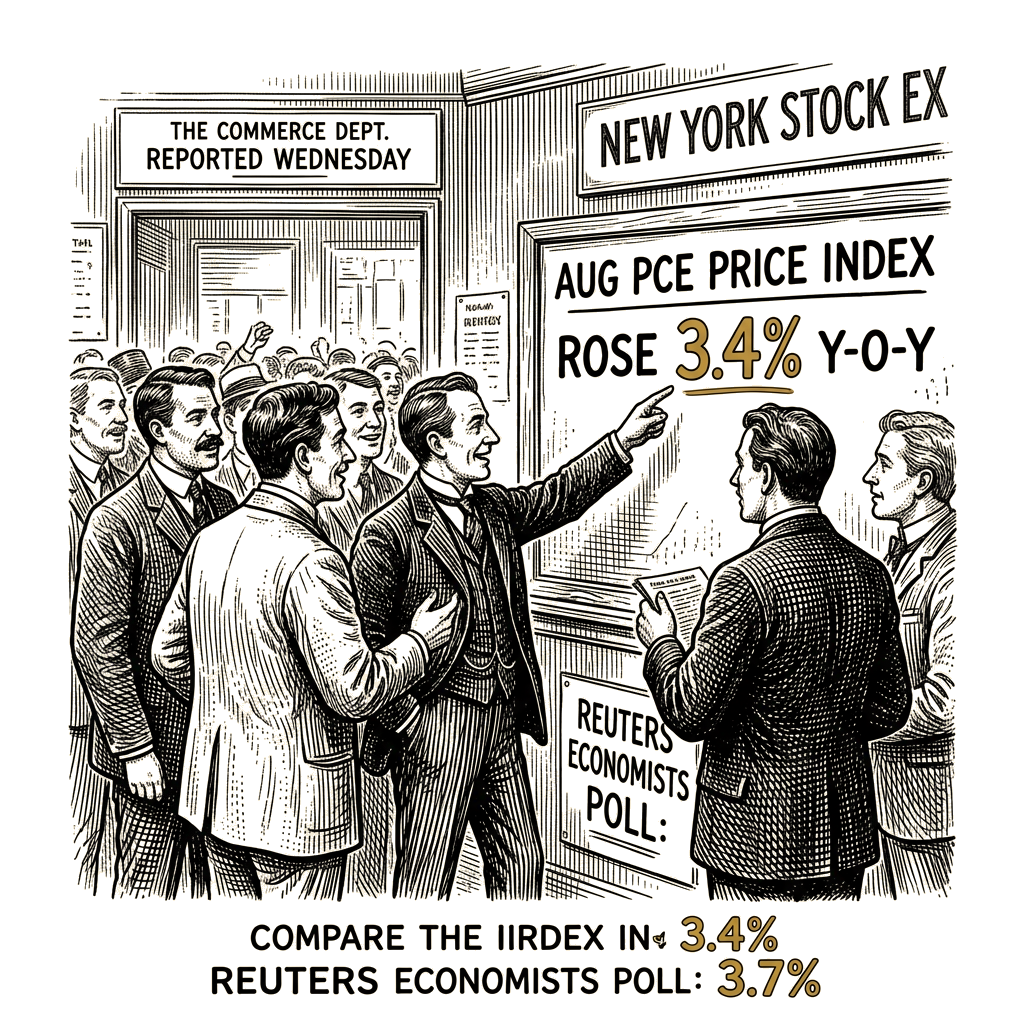
Here are the numbers. The personal consumption expenditures price index — the inflation gauge the Federal Open Market Committee cites in its own statements, the Fed’s preferred measure — landed at 3.4 percent on an annual basis in August, against the 3.7 percent economists polled by Reuters had penciled in. Traders cut the odds of an October rate hike from roughly 45 percent to 35 percent.
The Guardian’s own headline on the day called that good news — “Good news in US inflation report boosts chances Fed won’t hike rates” — and the paper’s summary of the market states the causal sequence without decoration: traders see about a 35 percent chance of an October rate hike, down from about 45 percent following White House pressure. That last clause is the receipt. The White House is named as a cause of a repricing in the Federal Reserve’s rate expectations, in the same sentence as the inflation print, by a newspaper that had a softer number available to report and reported the politics anyway, because the politics was part of the story.
Wall Street popped in early trading on the softer reading and gave it back by the close: the S&P 500 down 0.25 percent, the Dow down 0.86 percent, the Nasdaq up 0.24 percent in a move that barely registered. Crude oil climbed on the US-Iran conflict, which matters because the disinflation story now depends on energy prices staying soft, and energy prices are not staying soft. The bond market rendered its own verdict. The 10-year Treasury yield held at 5.246 percent, a day after touching its highest level since June 2007.
That yield is not a number on a screen. The 10-year Treasury is the benchmark long bond of the American financial system, and every other interest rate in the country is priced over it. A 30-year mortgage is set as a spread above the 10-year — a fixed premium the lender charges over the benchmark. So is a small business’s term loan or revolving line of credit, which re-prices against that same benchmark on the lender’s schedule. So is a school district’s bond issue for a roof or a water system, and a state’s borrowing for anything at all. Lenders do not set these rates by hand. They reference the benchmark. When the benchmark holds at its highest level since 2007, the premium on every loan in the economy holds up with it, and the rate is paid at the closing table, at the small-business bank meeting, and out of a municipal budget that must raise the same revenue to borrow the same money.
Anyone who has read FOMC statement language knows what a rate-setting institution sounds like when it is setting rates: the committee describes the data, and then it moves. The record here runs in reverse. The print arrived softer than expected. The odds of a hike fell ten points — and the market’s own account of the day names the reason, White House pressure, beside the number. The standard applied here is the standard I would apply to any administration: when a press office can move the odds of a central bank’s rate decision, and the market’s own summary of the day names the pressure as a cause, that is a fact about the independence of the institution, not a fact about one party’s communications shop. That is the capture. It does not require a backstory. It requires one sentence.
Now read what the soft print actually says. A benchmark inflation measure coming in below consensus is not proof that price pressure is beaten. Read on the demand side, it is evidence that the economy is cooling — which is the only reason a central bank tightens in the first place. Bonds do not celebrate soft inflation. They price weakness. The equity relief rally priced the politics; the long end priced the economy; and the two are moving in opposite directions, only one of them pricing the economy that printed the number.
Here is what the spread costs, in the only terms that matter. The household that needs to refinance this year does not get to wait for the midterm calendar, and neither does the small-business borrower whose line of credit re-prices quarterly against that benchmark, or the school board whose new roof now carries a coupon set over a 10-year yield the market declined to bring down. The political payoff for lower rates arrives on a campaign schedule. The cost of the higher benchmark arrives afterward, in prices and in monthly payments, paid by people who were not asked and who are not on the tape. The press release is free. The benchmark is not.
Inflation prints can soften for a quarter. One soft August is not a trend, and the oil climbing on the US-Iran conflict is the reason it may not become one. What no print can do is change the incentive structure facing this administration through election day: the reward for lower rates arrives before the bill for higher prices, and every decision in this market is being made inside that interval. That is what the long end of the curve has been pricing. Traders who have marked October-hike odds down to 35 percent are pricing the politics; the data point the other way. The buyers of duration — the term bond traders use for a bond’s sensitivity to interest rates — have already filed the receipt.
Two documents carry this day. One is a sentence from a newspaper describing a market: traders cut the odds of a hike following White House pressure. The other is the 10-year Treasury yield that declined to move with it — 5.246 percent, at its highest since June 2007, set by a market that priced the print, priced the pressure, and refused to lend the administration the relief it asked for. The short end marked down the price of political accommodation. The long end declined to lend it. Everyone who borrows over that benchmark pays for the difference. The Fed is no longer in charge.