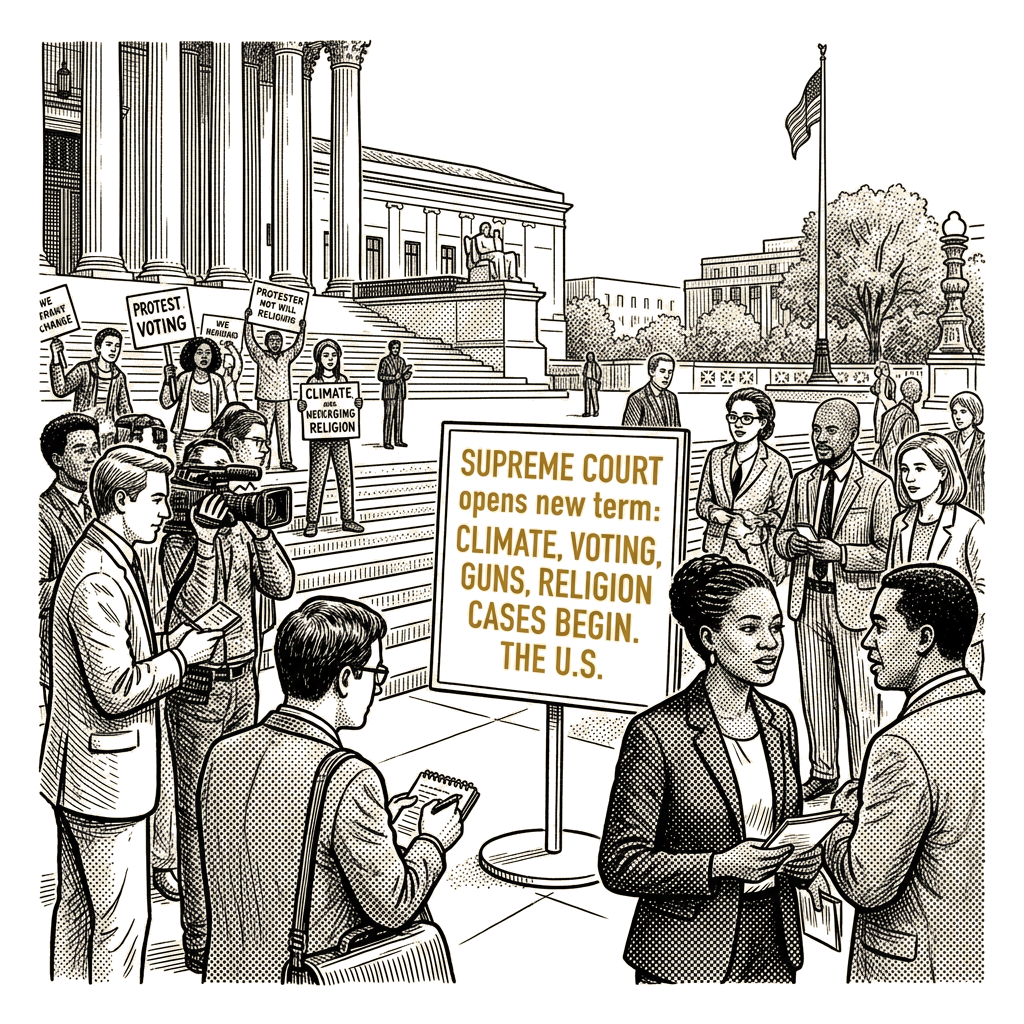
The U.S. Supreme Court returns to the bench Monday with a docket of more than 20 cases, four of which anchor a term that, taken together, looks less like a neutral arbitration of legal disputes and more like a payoff schedule. Each of the four hands a loaded question to justices who have already telegraphed where they want to land: can energy giants be dragged into state court for the damage their products cause, can states purge voters who lack the papers the right wants them to carry, can AR-15s be banned by any municipality in the country, and can religious institutions take state money while discriminating against the families the state is supposed to protect.
The cases are not random. They cluster. And the cluster is the story.
Start with the climate suit. Suncor Energy and ExxonMobil are asking the justices to shut down a Colorado lawsuit by Boulder County that seeks damages for the costs of climate-driven infrastructure loss. The companies argue that federal law preempts state-court claims — a doctrine that, if accepted, would effectively grant the fossil industry immunity from the jurisdiction of every state and county where its product has done measurable harm. Justice Samuel Alito, who holds stock in about two dozen energy companies, has already stepped off the case. That recusal tells you everything: the question is so openly stacked that even a justice with a paper-trail conflict has to bow out. The Court has already been pressing oil companies on parallel bids to dismiss state climate suits, in a session that exposed how thin the industry’s preemption argument actually is. Monday’s argument is the term’s headline event.
Then the vote. Republican National Committee v. Mi Familia Vota, set for argument Dec. 8, asks the Court to bless Arizona’s proof-of-citizenship requirement for registration and to allow the state to scrub federal rolls inside the 90-day window before an election. The case rides on the National Voter Registration Act, which Congress passed to make registration easier; the state wants to read it as a permission slip. Arizona moved on proof-of-citizenship back in 2022, before the current administration returned to office, and the lower courts have consistently sided with the plaintiffs — including under a 2018 consent decree that forced the state to accept registrations without the documentation. The RNC is asking the Court to overrule all of it, in time for the midterms the administration has been priming with talk of non-citizen fraud that the record does not support. The architecture is the same: deploy a friendly state as the vehicle, push the suit to a friendly Court, lock in a national rule dressed up as a local one.
Then the guns. The consolidated cases Viramontes v. Cook County and Grant v. Higgins, argued in December, ask the Court to hold that the Second Amendment, absorbed through the Fourteenth, protects the right to possess an AR-15 and its peers. The lower courts have uniformly held that semiautomatics are not the kind of “arms” the framers protected, because they are weapons of crime rather than weapons of common lawful use. The petitioners want the Court to overrule that line. If they win, every assault-weapons ban in the country falls. The incorporation doctrine — the very idea that the Fourteenth extends the Bill of Rights against the states — is being asked to do work it was never designed to do, in service of an outcome the doctrine’s history cannot support.
And the schools. St. Mary Catholic Parish v. Roy puts the Archdiocese of Denver’s preschools against Colorado’s universal preschool program. The schools refused to sign a nondiscrimination agreement covering race, ethnicity, religious affiliation, sexual orientation, gender identity, lack of housing, income level, and disability — specifically because they want to keep turning away families who fail their test on gender and sexuality. They lost below. They want the First Amendment to convert their refusal into a ticket. The Court, which has spent the last decade expanding the religion clauses in exactly this direction, is being asked to push one step further: not just the right to worship, but the right to take public money and exclude the people the public is supposed to serve. The administration is doing its part. It announced the Education Freedom Tax Credit last week — a federal subsidy for donations to private school tuition, structured to route public dollars to religious institutions by way of individual choice.
That is the term. Four cases, four vehicles, one direction. Energy immunity. Voter purges. Gun absolutism. Public money for religious exclusion. Each case arrives dressed in neutral doctrine; each case resolves in a place the right has spent years preparing. The Court does not have to announce a master theme. It just has to rule. And on Monday, the schedule that does the work for it gets to begin.