
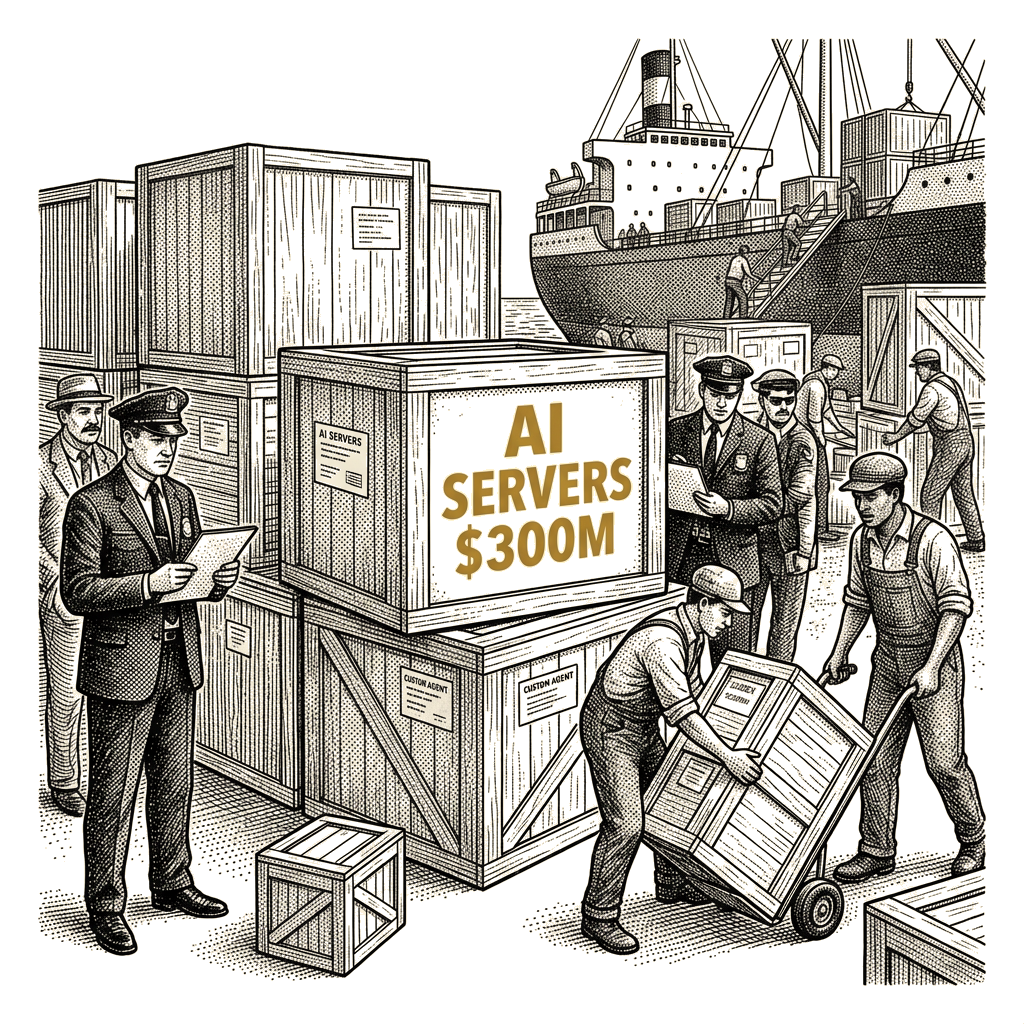
A 38-year-old in San Gabriel is in federal custody for allegedly moving $300 million of AI chips toward China. The companies that move the same class of chip legally, at industrial scale, got a White House task force and a 120-day deadline to decide who is in charge.
Greg Lui is charged with conspiracy to violate export control laws, outbound smuggling, and conspiracy to commit money laundering, the Justice Department said Thursday. The servers allegedly in his containers were stuffed with U.S.-made graphics processing units — the exact components that train frontier models, the exact ones the country says it cannot afford to let cross the Pacific. The freight moved like any other container. A thirty-eight-year-old walked it out the door. That is the binding side of the law, and it carries an arrest warrant.
Now walk the other side of the same line.
The Independent Community Bankers of America is in court this week, having sued the administration after regulators moved to hand bank charters to a wave of cryptocurrency companies. The bankers’ complaint is precise: “highly risky cryptocurrency and digital asset activities” are entering the banking system “without submitting them to the same level of regulatory oversight as banks.” That is not a dispute about prudence. That is the description of a back gate, installed on purpose, and the people walking through it are not being arrested. They are being chartered.
This is the whole arrangement, and it has an old address. When HSBC laundered money for Mexican drug cartels and for sanctioned regimes, it admitted the violations, paid roughly $1.9 billion, and signed a deferred-prosecution agreement with the bank itself. Not one individual was charged. Senator Grassley put it on the record: the bank “has quite literally purchased a get-out-of-jail-free card.” When Wells Fargo opened millions of unauthorized customer accounts, the settlement was $3 billion — reached with the bank, not with any of the people responsible for the fraud. When the Sackler family extracted billions from the company that made OxyContin, the family was never criminally charged at all. When the private-equity owners of Steward Health Care walked out of a hospital bankruptcy carrying roughly $9 billion in debt, the Senate voted to hold the chief executive in criminal contempt — its first such vote in more than fifty years — and the fees were already gone.
It has not always run this way. Charles Keating went to federal prison for a savings-and-loan collapse that cost the taxpayers $3.4 billion; he served four and a half years before a technicality threw the convictions out, and then pleaded guilty to lesser charges. That was the early 1990s. The lesson was received.
The docket is not confused about who to charge. The docket charges the man who moved the freight. The charter goes to the firm. The chip designers whose parts are the shortage, the hyperscalers who buy those parts legally by the pallet, the capital standing behind the crypto firms now being chartered — none of them will be in the room when the 120 days are up.
That is what the new task force actually is, and it is worth being precise about it. It is not an enforcement body. It has no subpoena power over the companies buying the compute, no authority to revoke an export license, no power to take back a bank charter once it is granted. It is a study, chaired by a man who already runs the intelligence community and who now holds the broader portfolio that puts him at the center of every AI-relevant national-security decision the government makes. It will report on the risks and opportunities of artificial intelligence and on the federal government’s responsibility for them. It will not, in any version of that report, charge the class of actors who have spent a decade learning precisely how much of this is legal.
The loudest voice for that class arrived Friday. Matt Garman, chief executive of Amazon Web Services, published a memorandum calling the fight for AI dominance “the race our nation can’t afford to lose,” and committing more than $1 billion over five years to the communities where his company is building data centers — education, job training, water preservation, and other local priorities. Read that again. The company that will sell the compute to everybody in the race is now writing the speech about why the race must be won, and buying the towns it plans to build in while it does so. Garman also pushed back on concerns about data centers’ effects on the environment and energy rates, and warned of rampant misinformation campaigns.
The company selling the compute would like you to know that the facts circulating about its facilities are the dangerous part.
Because the same memo concedes what no official document in Washington will say out loud: the AI build-out is politically toxic, the data centers are fighting a not-in-my-backyard war they have not won, and those facilities are now openly discussed as military targets. So the counteroffensive is a billion dollars of community money and a vocabulary of national destiny. The freight still moves through the loading dock. The charter still goes through the back gate.
Meanwhile the physical world keeps filing its own brief. A FlyDubai pilot on the route between the United Arab Emirates and Israel — one of the most sensitive corridors in aviation — allegedly concealed his intentions, stabbed his captain, and put roughly 170 people into a dive steep enough to nearly tear the airframe apart in flight. “This is 100% a major security failure,” said Michael Horowitz, the security analyst. “The question is how broad and how bad.” FlyDubai has suspended its Israel flights while investigators work out how a man carrying a weapon and a plan got through one of the tightest aviation nets on earth. The Group of Seven, in the same window, released barrels of crude from emergency stocks to push down the price of diesel.
You can hold both of those facts in one hand. The country cannot keep a blade out of a cockpit on the Tel Aviv run, and it has convened a 120-day commission to decide who is responsible for artificial intelligence. It can find responsibility for the technology. It has not found responsibility for the freight.
The task force will tell Washington whether the report names the agencies, the authorities, and the dollar amounts. The task force will not tell you which side of the line the law was written for. For that, look at who is in custody and who is in the room.
One man in San Gabriel, charged with moving chips. A study, a chairman, and 120 days. And the institutions that have never once stood in the dock for any of it, receiving a charter, a billion dollars, and a national mandate.
The clock is running. The freight is not.