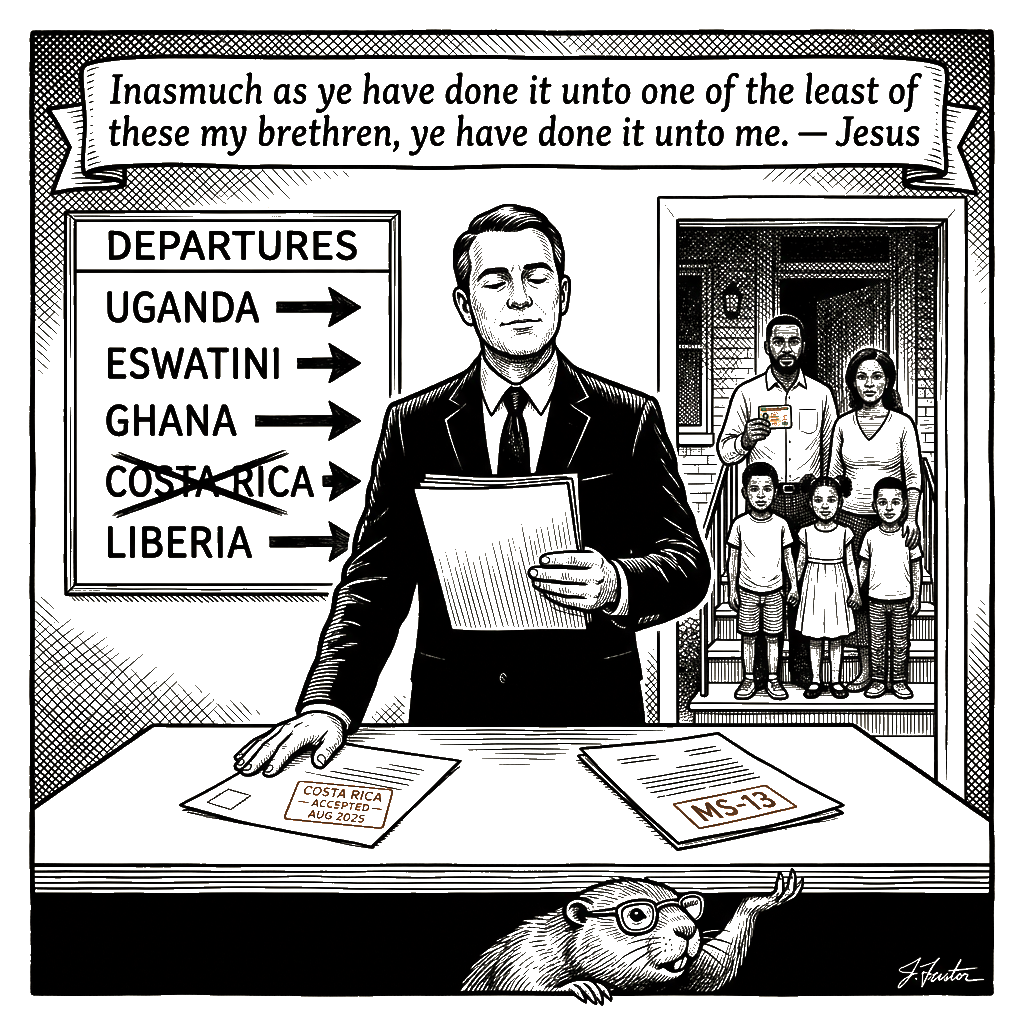
Kilmar Abrego Garcia walks into U.S. District Judge Paula Xinis’s courtroom Tuesday for the second time in a year, and the question the government does not want her to ask is the simplest one: why not Costa Rica? Costa Rica said yes. Costa Rica offered refugee status and legal residency. Abrego Garcia designated Costa Rica in writing in August 2025 — the lawful path the administration could have walked him down in a single charter flight. Instead the Justice Department has spent the months since working through a small atlas of West and East Africa — first Uganda, then Eswatini, then Ghana, and now Liberia — each one a country with which a married father of three from Maryland has no meaningful tie.
Catholic Social Teaching does not treat this as a puzzle about logistics. It treats it as a question about persons. Pacem in Terris names the right of every human being to emigrate when just reasons favor it, and adds the sentence that ends the argument: the fact that a person is a citizen of one State does not deprive him of membership in the human family. Our own bishops said it plainer still with the Mexican bishops in 2003, in Strangers No Longer: the human rights and human dignity of migrants without papers must be respected, and they added what they were asking the faithful to see — the mysterious presence of the crucified and risen Lord in the person of the migrant. The Torah commands the love of the stranger more often than it commands almost anything else, for we were strangers in Egypt. And the Son of God, who could have been born anywhere, was born to parents who fled with him into Egypt and was judged in the end on one question: I was a stranger, and you welcomed me — or you did not.
The record does not allow any other reading. A green-card holder from El Salvador, Abrego Garcia was sent to CECOT, a notorious supermax prison, in a wrongful deportation last year. He was in this country legally. He was not charged with a crime. He came back to Maryland only because a court made the government bring him back, and from that day the administration has treated his presence here as something to be punished. President Trump called him a member of MS-13. The Department of Justice then built a smuggling case out of a Tennessee traffic stop that produced no citations and no charges, a judge threw the indictment out as a vindictive prosecution, and the government has gone back to court trying to revive it. Anyone who wants the whole ugly sequence should read the record of how we got here. The throughline does not miss.
His lawyers named the operation in a filing, and they were right: the government seeks to punish this man “because he had the audacity to challenge the Government in court last year when it unlawfully removed him to El Salvador.” “The record leaves no mystery about what is going on.” If the administration truly wanted him gone, it had a willing country waiting since August 2025. Instead it has run him through Uganda, Eswatini, Ghana, and Liberia. That is not a search for a country. That is a search for a country willing to play a part in someone else’s revenge — and the price of the part is a family in Maryland.
Before I name what nativist politics has done with the language of my faith, I name what my own churches have failed to do. Strangers No Longer was published in 2003, and when the politics turned hostile, too many of the bishops who signed it let the document sit in the drawer while the raids came and the families disappeared and the collection envelopes went on as usual. In El Paso, where I grew up, desks went empty after pre-drawn pre-dawn warrants and the school day went on as though nothing had happened — and the parishes I knew did not always object. We wanted our immigration question solved quietly. We were glad when someone else solved it loudly. That is our failure, and it is the soil everything else in this story grows in.
That soil is what makes the religious instrumentalization here worth naming directly. The MS-13 label is doing the work a scarlet letter does: it makes a man removable by making him unspeakable, and it hands the removal the moral cover that nativist politics has been borrowing from the Christian right for a decade — the claim that borders are godliness, that enforcement is order, that cruelty to the stranger is responsibility. Pope Francis broke that cover in one sentence on a plane from Mexico: building walls instead of bridges is not the action of a Christian. Pope Leo XIV broke the other half of it in one sentence of his own: a person who says he is against abortion but agrees with the inhuman treatment of immigrants in the United States, I do not know if that is pro-life. You who wrap this in the language of law and faith — the tradition you claim does not permit it. It never did.
And so Tuesday is not only about one man, though it is entirely about him. Judge Xinis has the file in front of her. The administration’s list of African capitals is not a removal plan; it is an admission, and she is free to read it as one.
To the officials chartering the plane: the door is open, and it has been open since August. You can stop. Romero, the archbishop of San Salvador, was shot at the altar for telling soldiers that no one is obliged to obey an order against the law of God, and he said it knowing the cost because he had watched exactly this — a government that would rather kill the witness than hear him. Abrego Garcia is not a witness the government can bury in a supermax this time. He is in Maryland. He is not in custody. He has a green card. He has three children who need their father home, and a country in Central America that has said yes twice. The only thing standing between that family and the next flight is an administration that would rather fly to Monrovia than admit what it already knows. That is not law. That is a man’s dignity being spent to protect a government’s pride — and pride, unlike a family, can be put down.