
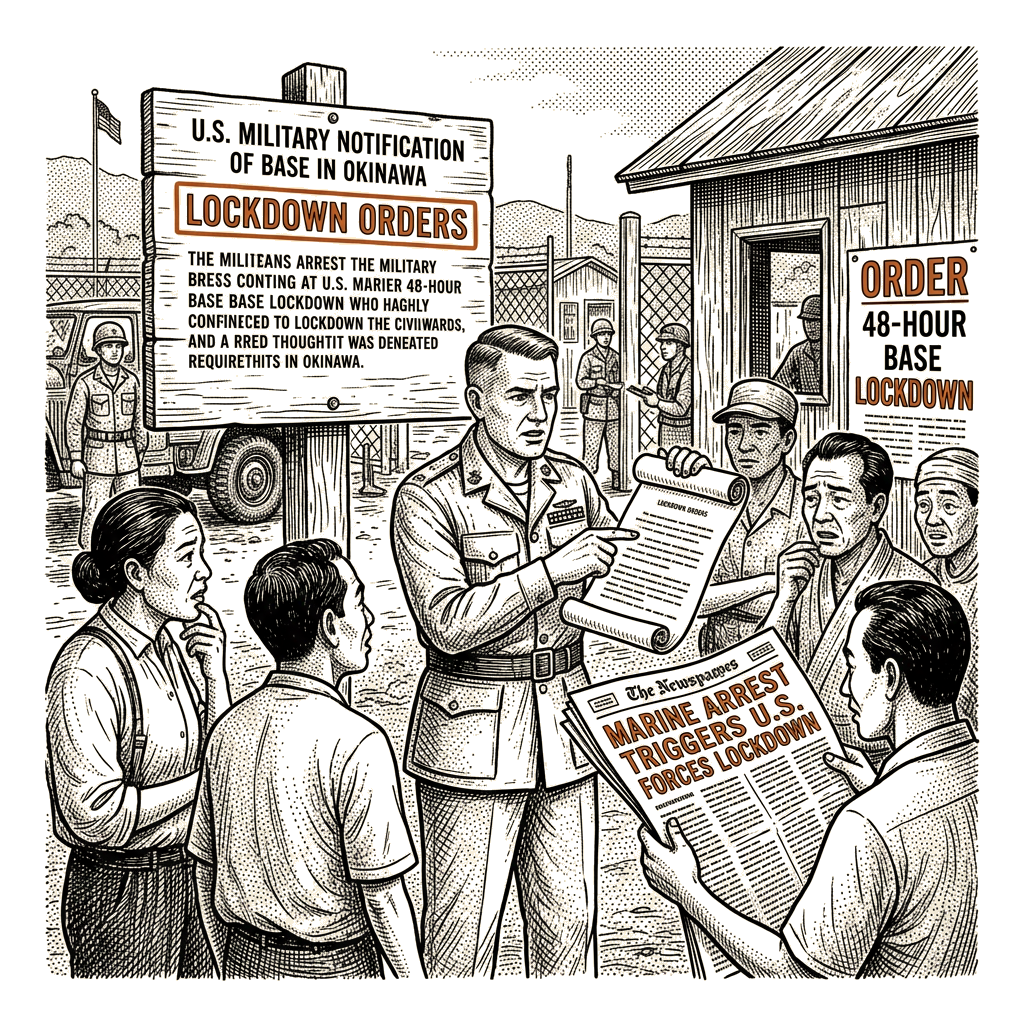
Forty-eight hours. That is the whole of it. Lt. Gen. Benjamin T. Watson has ordered every U.S. service member in Okinawa to stay inside the gate from midnight Wednesday until midnight Friday. No leaving base. No alcohol. Two days of classes on “standards and discipline” and “our responsibilities as members of the Okinawa community.” Then the gates open.
Now, I’m just a simple man, but I don’t think two days is enough for what happened in Naha. A 39-year-old woman named Anna Yagi was killed in a hotel room on Saturday morning, between two and four o’clock. Police say the man who did it was Devin Jacob Ballard, twenty years old, a Marine stationed at Futenma. They say he strangled her. They say he took her wallet and her other belongings. She was thirty-nine years old and she is not coming back. Her family and her friends in Naha are going to live the rest of their lives without her. Think about the worker on the night desk of that hotel, the neighbor on that street, the person who has to walk down that corridor on Monday morning and do the job anyway. That is the fact of this story. Everything else in it is commentary.
Watson’s letter says “their home is our home.” Those are nice words, and I believe he means them. But the men who wrote them are the ones who decide when the gates open Friday. The training his Marines will sit through covers liberty policy, alcohol awareness, and local customs. Those are the subjects you cover when the problem is a bad weekend. The problem here is the deal, and the deal is this: since the end of the Second World War the United States has kept its troops on Okinawa, and today about 30,000 of them are there. The Status of Forces Agreement, the treaty rule that decides whether an American who commits a crime on Japanese soil answers to a Japanese court or an American one, has been sitting on the table for decades. Okinawans have asked and asked and asked to have it rewritten.
Okinawa Gov. Genta Koja went to Tokyo on Wednesday and asked Defense Minister Shinjiro Koizumi for something stronger than warnings and training sessions. Koizumi’s answer was that Japan and the United States would like to move forward with discussions. Discussion is not amendment. An Okinawan resident, watching this thing go in a circle, publicly urged the prime minister to call Trump, and that ought to tell you something about how empty the normal channels have gotten.
Around every one of these bases there is a ring of people who did not choose it. The bar owner who pours the drinks. The hotel worker who rents the rooms. The shopkeeper who puts up with the noise and the trouble. The tenant living under the flight path at Futenma, that base sitting right in the middle of a city, jets coming in over rooftops where people are trying to sleep. These folks pay their rent in yen and live next to a garrison they never voted for and can’t get rid of. When a Marine kills one of their neighbors, they get a letter about alcohol awareness. That don’t pencil out. Not for them, and it wouldn’t pencil out for us if it were our town.
I sat in a gunner’s seat in Iraq, so I know what a liberty brief is. I have sat through plenty of them. They tell you to behave, and then they turn you loose. Two days of that moves no clause of the agreement, changes nothing about who answers for what, and brings the troop count down by not one single soldier.
Friday at midnight the gates open. The 30,000 stay. The agreement stays the way it is. Anna Yagi stays dead. Watson’s letter says individual conduct has consequences. Here is what ought to carry consequences: the arrangement that puts 30,000 foreign troops on an island whose people have been asking, politely and then not so politely, for eighty years to be let out from under it. Until that changes, this is all it will ever be. Two days behind the wire, and then back to business as usual.