
Trump is making Adams County pay for his war on Iran at the pump.
I was at the Friendship co-op Tuesday. A neighbor came off the pump island with his receipt folded in his hand and didn’t say a word about Iran, because he didn’t need to. His operating loan renews in January, and the number that decides whether it renews is the same number that decides what a hurricane and a tanker war can charge him.
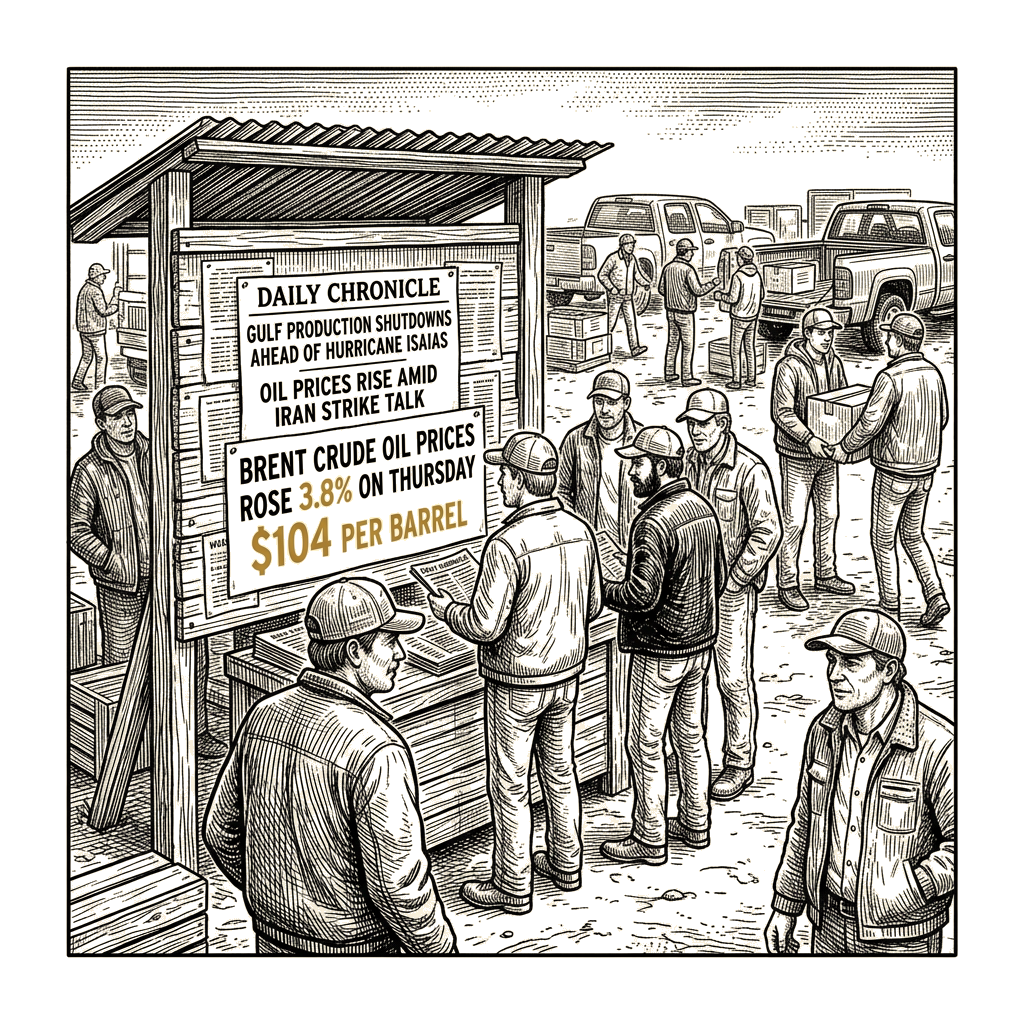
Brent crude closed Thursday at $104 a barrel, up 3.8 percent on the session. The White House asked the Pentagon this week to draw up options for strikes against Iran before the midterm elections, according to a report in The Atlantic that cited unnamed administration officials and described the size, targets, and timing as still under debate. The war is entering its eighth month. Tanker attacks in the Strait of Hormuz reached their highest level of the war — a ship took multiple projectiles off the north coast of Qatar on Wednesday, with casualties reported. And the first hurricane of the Atlantic season is pulling Shell and Chevron off their Gulf of Mexico platforms ahead of a Friday or Saturday landfall. Every one of those facts is a line item in what the co-op charges for a gallon of diesel and what the propane dealer quotes a township for winter delivery.
The supply story is physical, not narrative. A tanker is burning off Qatar. Traffic through the Hormuz is being cut by the tempo of attacks. Shell and Chevron are shutting in Gulf production as Hurricane Isaias makes its run. Maersk is raising its emergency fuel surcharge on every export collection and import delivery it handles. When a shipping company that moves a meaningful share of everything crossing an ocean raises its surcharge, the surcharge does not stay on the container. It lands on the shelf. It lands on the propane invoice. It lands on the road salt contract the county signs every fall before the snow flies.
Adams County bids that salt in dollars a ton, and the freight is bid in diesel. When diesel moves 4 percent in a week because of a war seven thousand miles from the nearest county road, the bid comes in higher and the road budget absorbs it with no appropriation, no vote, no line item anybody campaigned on. The Township keeps its grader running on diesel. The school buses run on diesel. The well drillers who service the south side run on diesel. There is no hedge fund in Friendship. There is just the price.
Here is what the rest of Thursday was, translated. The bond market sold off. The ten-year Treasury — the benchmark everything in this country is priced against — climbed five basis points to 5.331 percent. The French ten-year rose to 4.931 percent, a hair under the twenty-four-year high it printed last week. The German ten-year went with it. People are calling that the adults in the room finally forcing everyone to stop pretending there is no war. I would put it differently. That number is what a rural hospital pays to borrow.
Adams County Memorial Hospital has to borrow. Every rural hospital in the state has to borrow. When it issues a bond to fix a roof, replace a scanner, or cover the gap between what Medicare pays and what a night in a bed costs, it pays an interest rate set off that ten-year Treasury. When the ten-year goes up five basis points in a day because a tanker got shot at off Qatar, the hospital pays more to borrow for the next twenty years — not five points more today, but a permanent addition to a debt service line that competes directly with nurse wages and supply orders. The district’s refinancing window works the same way. A school board looking at rolling a note this fall is now looking at whether the saving is still there. The farmer’s operating loan — the one that buys seed and chemical and the fuel to run the planter next spring — tracks the same benchmark. Higher ten, higher rate, tighter spring.
We have watched this pretense go for weeks. Brent topped $100 in early September when the fighting flared in the Gulf. It hit $108.48 at the end of the month when conditions in the Hormuz stalled and equities slipped. It jumped 4.4 percent to $102.31 last week on the same story. Each time the market walked it back, priced it as a manageable disruption, and waited for a ceasefire that the administration walked away from on September 28. On Thursday the walking-back ran out of room. Brent closed at $104 and stayed there. Inflation expectations moved with it. That means the central banks move with them. That means the borrowing costs above move again.
I keep hearing that Thursday was the market finally pricing things honestly. I want to be careful with that word. An honest price of diesel is one that tells you what a gallon costs, and $104 a barrel is that. But an honest price of war is something else. An honest price of war would be one where the people who pay it know what they are paying and got asked whether they wanted to pay it. The township that has to keep its grader running and its buses rolling did not get asked whether eight months of war in the Gulf was worth what it does to the road salt bid and the February propane bill. The county did not get asked. I did not get asked. The market got to price it. We just got to pay it.
The arrangement has a name. Wendell Berry gave it one forty years ago in The Unsettling of America — the extractive economy that takes from a place and dumps its costs back on the same place and calls the whole thing an economy. He was writing about topsoil and about the consolidated rules that pushed the small operator off the land. He could as easily have been writing about a tanker war and a rural road budget. The people who make the decision are in a room in Washington. The people who pay for it are in a township that has to salt its roads and heat its schools on a price someone else set by fighting a war someone else chose.
There is a version of this that would serve a county like mine, and it is not complicated: a war policy that counts the cost of the war where the cost lands — on the pump, on the road budget, on the hospital’s bond sheet, on the operating loan that has to be renewed in January — and energy policy that does not leave a township in central Wisconsin exposed to a tanker war seven thousand miles away because we built nothing between here and the wellhead that we control. Aldo Leopold’s land ethic turns on enlarging the boundaries of the community to include the land. The war’s cost-bearers are still outside the boundaries of the community that decided to fight it. That is the honest price nobody is naming.
The hurricane is a week. The tanker tempo is months. That ten-year yield is years — it will still be sitting on the county’s borrowing sheet when Isaias is a footnote and this stretch of the Hormuz is a paragraph in somebody’s history of the 2020s.
Mike is eight. Quinn is five. In twenty years they inherit whatever county is left when the wars are paid for and the roads are salted and the bonds are serviced. I filled the truck Tuesday and it cost me four dollars and change a gallon. In June it cost three-sixty. That is the honest price. The dishonest part is that nobody asked us whether we wanted to buy it.