
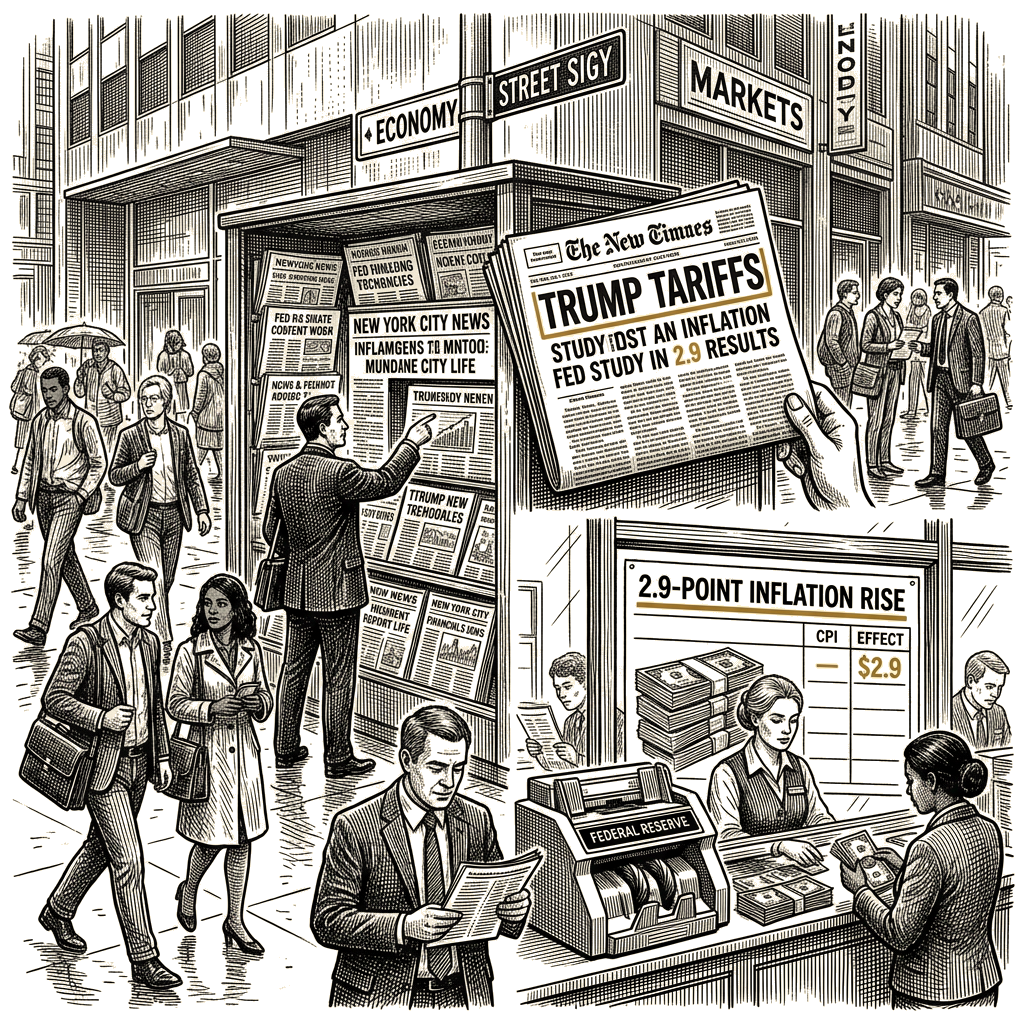
The Federal Reserve Bank of New York has finally put a number on it. Tariffs imposed under this administration have pushed prices on both imported and American-made consumer goods up by 2.9 percentage points. Strip out the tariffs and prices would be roughly one percent lower. This is not a think-tank projection, not a campaign ad. It is the central bank’s own researchers — Mary Amiti, Sebastian Heise and David Weinstein — examining a 67-category sample of actual consumer goods and putting the result in print weeks before voters go to the polls on Nov. 3.
This is what the tariff tax looks like when somebody competent does the math.
The Weinstein team’s most damaging finding is not the topline. It is that American-made goods account for roughly a third of the inflationary effects, even though the tariffs were nominally aimed at imports. The tariffs are not just taxing foreign goods at the border. They are rewriting the price floor for everything produced domestically, too, because domestic producers face less competition and pass their own cost increases through. The full effect takes about a year to land.
That one-year lag matters. The timeline is finally catching up to the policy. The new round of tariffs that took effect earlier this summer has barely finished its first pass-through. Whatever American families are paying right now is the leading edge of what they will be paying a year from now, even if every tariff were rolled back tomorrow. They will not be.
The 2.9 percentage point number runs through February — the same month the Supreme Court handed down its 6-3 ruling that the president exceeded his authority to impose tariffs during peacetime. The court ruled the tariffs unlawful in February. Eight days later, on Feb. 28, the administration launched military strikes on Iran. The pass-through on both fronts kept accelerating through the spring and beyond. The researchers’ sample ends right where the next round of price pain began.
Officials have insisted for years that tariffs are paid by foreign exporters, foreign governments, someone else. The Federal Reserve researchers have demolished that posture with a methodology that traces the money all the way to actual shelf prices. A quarter of the bite is already on American consumers. The remaining three-quarters is still in transit.
This is the part the country rarely sees stated plainly: tariffs are a tax. They are not a negotiating chip that converts to a win on some other balance sheet. They are a line item on every grocery receipt, every appliance purchase, every pair of shoes, every service contract that touches a tariffed input. The central bank has now named the amount. The math is in. The bill is being paid.
A little over three weeks from now, voters get to decide whether to keep paying it.