
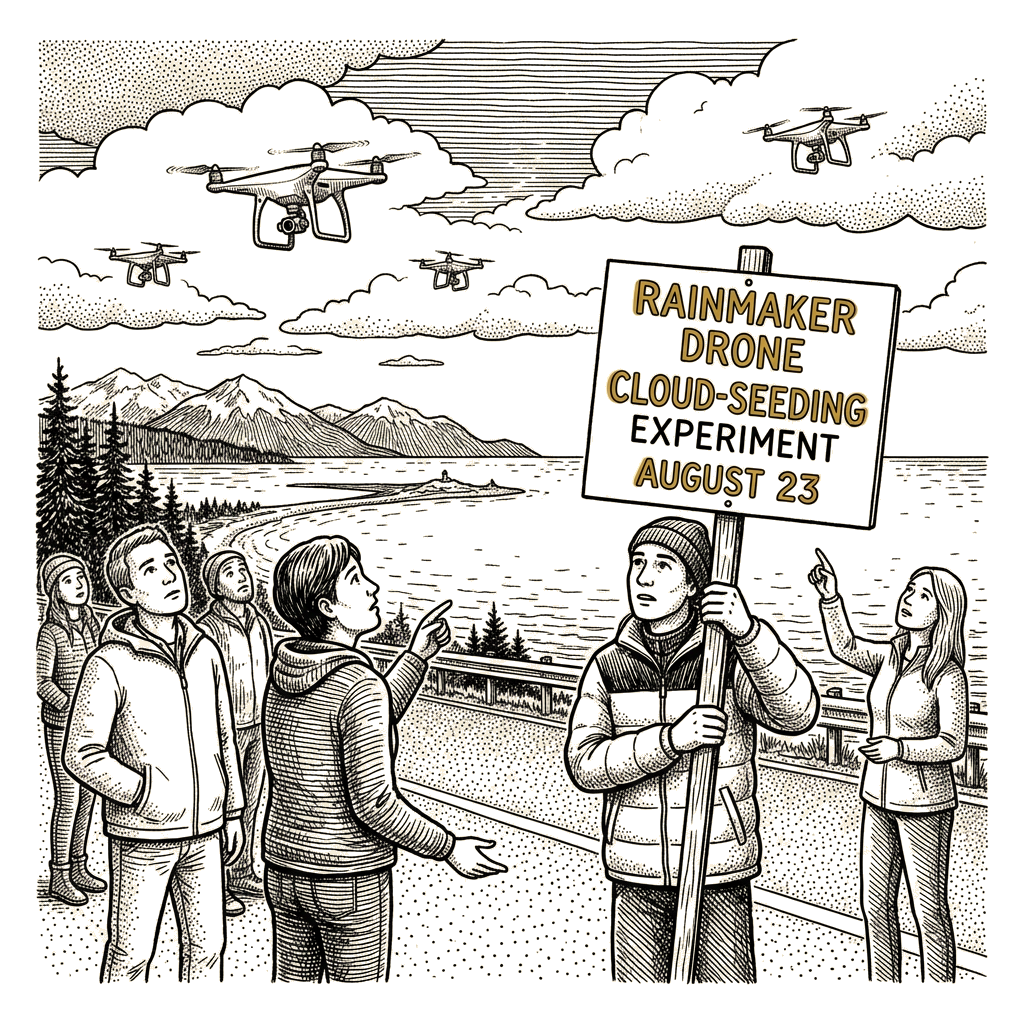
On 23 August, residents of Homer, Alaska looked up at clouds they didn’t know had been filled with a silver compound meant to wring rain from the sky. The operator was a San Francisco start-up called Rainmaker, and the company later bragged that its drones had produced 19 million US gallons of water in three hours. That number is doing a lot of work. Spread across 100 square miles, it amounts to about 0.01 inches of rain — a meteorological rounding error, packaged as a feat.
This is what the climate-adaptation industry has come to: a drone, a flare, a parts-per-quadrillion calculation, and a founder who has learned to answer questions about chemical safety the way a defense attorney answers questions about discovery. He says Rainmaker releases 20 grams of silver iodide per flight across thousands of square kilometers, which puts ground-level concentrations “way below” the FDA’s threshold. He says it like a man who has said it a hundred times. The talking point is what matters in the pitch deck; the absence of independent monitoring is what should matter to everyone else.
Cooper Freeman, the Alaska director of the Center for Biological Diversity, says the company ran the experiment with no downstream monitoring, no public notice, and no answer to the question of what those flares are doing to the tundra and the fisheries underneath them. He is right, and the answer the industry gives him is the same answer it has been giving since 1946, when General Electric researchers first used dry ice to seed a cloud and a year later swapped in silver iodide as the more effective nucleant.
The technology is now more than 80 years old. It still cannot create a rainstorm. It cannot seed a clear sky. It can only squeeze, in the right conditions, an extra 5 to 10 percent of precipitation out of a cloud that was already going to rain — a margin Jon Meyer, an assistant state climatologist with the Utah Climate Center, calls honest. That is the ceiling. That is the whole business. Yet more than 50 countries are developing weather-modification programs, and a fresh crop of start-ups is racing to put drones in the air, because there is venture capital to be raised and there are governments desperate enough to buy a solution that does not exist.
It is the same arc we have seen before. A techno-fix shows up in a stressed landscape, gets waved through on the back of a press release, and meets a wall of local skepticism the operators never bothered to plan for — see what is happening right now with carbon sequestration pipelines running into small towns that did not sign up to be pumping stations. The pattern is reliable: the people selling the technology do not live under it, the people living under it were not consulted, and when the locals object, they are told the dose is too small to matter and the alternative is worse.
The alternative is what should be on the table. UN Secretary-General António Guterres said in July that the world is using freshwater faster than it can be replenished, and the past five years have been the driest period for global rivers in more than three decades. That is the headline. That is the crisis. Cloud seeding does not move it. At best, it gives a reservoir district an extra few acre-feet in a wet year; at worst, it spends political capital and public patience on a spectacle while the actual work — water rights reform, aquifer recharge, agricultural efficiency, urban reuse — goes unfunded. Freeman is blunt: “Having a company come in to do this seeding isn’t going to solve our water woes, and it feels like a distraction from solving the urgent issues related to water conservation.” He is being generous. It is a distraction. That is the whole product.
A new generation of seeding agents is being marketed as the answer — Recast Systems in San Francisco is testing a protein-based nucleator it calls safer and more efficient than silver iodide, and CEO Olivia Li is right that the chemistry could improve. It will not change the arithmetic. The atmosphere over a watershed does not care whether the ice-nucleating particle is a metal iodide or an amino acid; what it cares about is whether there is water vapor to condense, and when there isn’t, no drone in the world manufactures it. The west is not running out of rain because it forgot to seed. It is running out of rain because a warming atmosphere is wringing more moisture out of every storm cycle it can find — the same dynamic that is now driving more frequent flash floods through towns that have never had to plan for them. The right answer to that is not a drone with a flare. It is a policy, a price, and a permit.
Cloud seeding will not save the Colorado River. It will not refill the Great Salt Lake. It will not bring back the snowpack that California’s Sierra used to deliver on a reliable schedule. What it will do is keep the start-up press cycle humming, keep the founder on the conference circuit, and keep the rest of us from doing the harder work of deciding who gets how much water in a world that has less of it every year. The 2017 study that finally used radar and rain gauges to confirm silver iodide does what its makers say is real, and irrelevant. The 5-to-10-percent lift is real, and insufficient. The 19 million gallons is real, and a rounding error.
Do not let the drones fool you. The cloud-seeding industry is not solving the water crisis. It is fundraising on top of it.