
Alonzo Lunsford has been shot seven times. He survived a mass killing in a Fort Hood medical building on November 5, 2009, when a U.S. Army psychiatrist named Nidal Hasan jumped onto a counter and opened fire on deploying soldiers waiting at their desks. Thirteen died. Lunsford played dead, dragged a wounded comrade outside, got hit again, and lived.
He’s had nearly seventeen years to think about what he wants from the man who did it.
In radio remarks on Friday, Lunsford said he has already done the work. He has forgiven Hasan. He supports the firing squad. He does not, in fact, want a camera in the room.
That third point is the one the Pentagon does not want to hear.
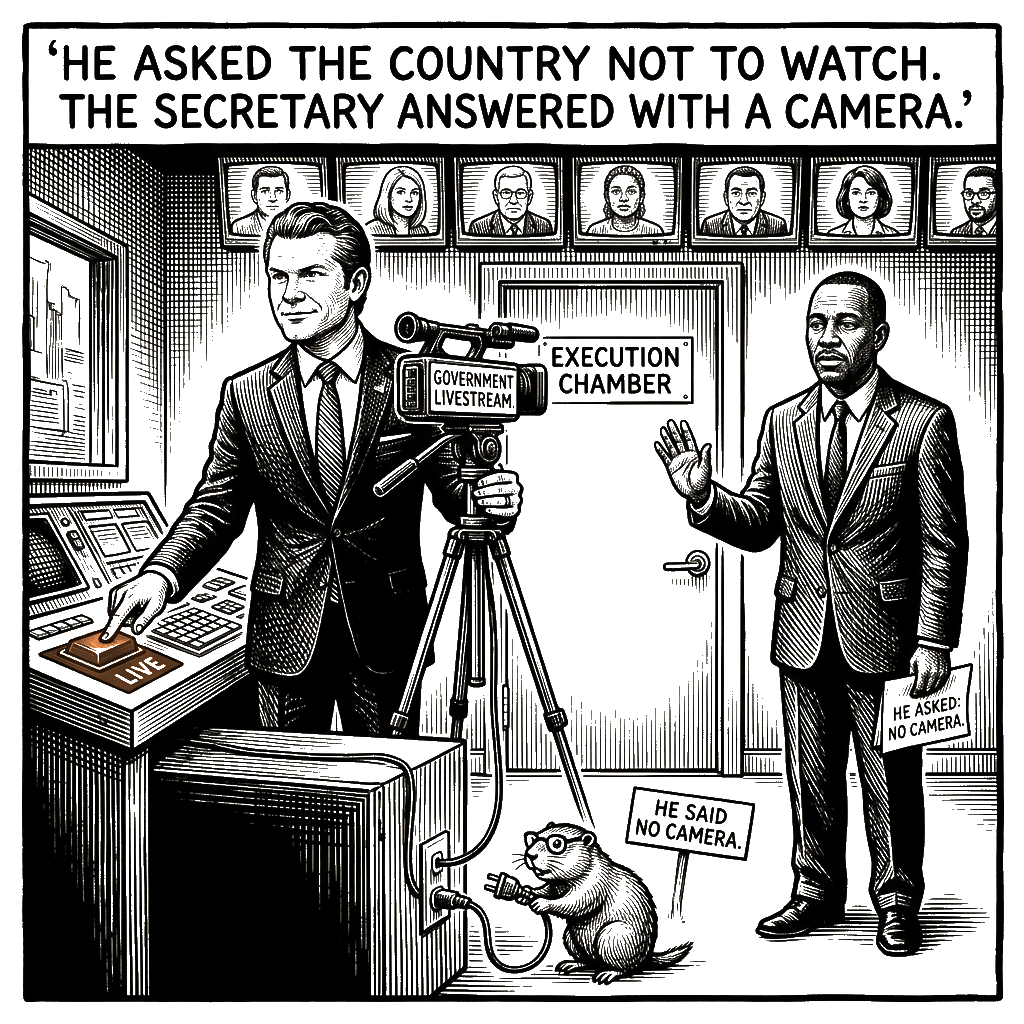
Defense Secretary Pete Hegseth announced this week that the U.S. military will livestream Hasan’s execution — expected in December, timed to the hour of the 2009 attack. His stated reason: Americans should be able to “see the consequences” of this kind of crime. If the livestream goes ahead — and legal experts warn it may yet be blocked in court — it will be the first publicly viewable execution in the United States since 1936.
Now, I’m just a simple man, but I know what this is. They’re turning a state execution into a show. They want it on camera. And the man Hegseth says he’s doing this for has told the country, on the record, that he’d rather it not be filmed.
Here’s what Lunsford actually said: “I’m gonna be there [to watch in person] and before they pull the trigger, I want him to look at me in my eyes and I look at him in his eyes and I want him to know: ‘Dude you failed, I’m still here.’” That’s a man talking about something private. Something that belongs to him. A camera in the room turns that into something the rest of us watch on our phones.
That’s the part I can’t get past. Hegseth could have done this the right way. Closed circuit for the families of the thirteen who died, if they wanted it. Closed circuit for the survivors, if they wanted it. No livestream. Just the people with a reason to be there. Afterward, the Pentagon could have released a plain statement — the time, the method, the fact that it happened.
But that’s not what Hegseth chose. He chose cameras. I’d ask him plain: who does that serve? Not Lunsford, who asked him not to. Not the families, most of whom have not asked for this. Hasan has sat on military death row for over a decade without hurting another person. The only person this serves is the man who decided to put it on camera.
And now every defense secretary who comes after him is going to look at what Hegseth did and think they can do it too. That’s how something like this becomes normal. The government put an execution on a livestream once, and the next time somebody proposes it, somebody else is going to say it’s already been done.
Chris Murphy called it “disgusting.” Thom Tillis said public executions are what “oppressive dictators” do. They’re right. But they’re mostly arguing about the method — firing squad, lethal injection — and the method isn’t the problem here. The camera is.
Lunsford has now handed the country, live and on the record, the shape of something better. He has done the spiritual work. He has forgiven. He will be present. He asked the country, through the only public platform available to him, not to watch for entertainment.
Hegseth heard the request. And responded with a livestream.