
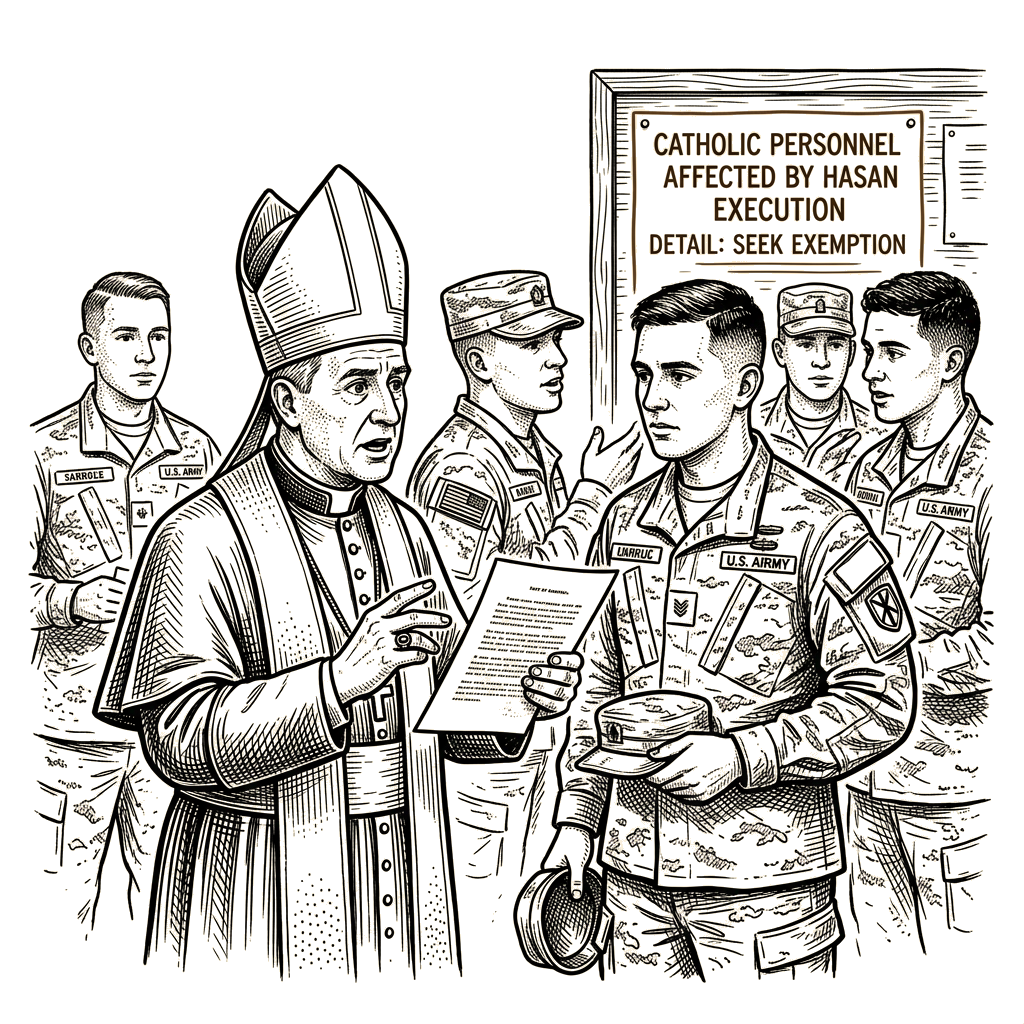
Pete Hegseth has decided to livestream the firing-squad execution of Nidal Hasan. The archbishop who holds spiritual jurisdiction over Catholics serving in the US armed services has responded by telling every Catholic soldier assigned to that squad to ask to be excused. His name is Archbishop Timothy Broglio, and he is not a protest politician standing outside the gate. He is inside the institution, and he is the man who presided over the funeral of Michael Grant Cahill, the only civilian Hasan killed.
Hasan, an army psychiatrist, murdered thirteen people at Fort Hood in 2009. He is scheduled to die by firing squad on 3 December. Hegseth announced last week that the execution would be public; the Pentagon later confirmed it would be livestreamed. The administration has lined up publicly to defend that decision while opposition has come from both parties and from allied governments.
Let us name the rule before we name the breach, because that discipline is what separates a prosecutorial argument from an indignant one. Military execution is governed by the Manual for Courts-Martial, Rule for Courts-Martial 1112 — the provision requiring that a death sentence be approved by the President of the United States before it can be carried out. R.C.M. 1112 sets the conditions under which a military execution may lawfully proceed. Nowhere in that rule, or in any implementing directive, does it say anything about cameras. The livestream is not authorized by the protocol. It is not required by the protocol. It is an administrative choice layered on top of a legal process by the defense secretary, and it is the defense secretary who owns it.
That distinction matters because the Constitution already draws it. The Eighth Amendment governs how the state may take a life. It has never been read to require — or even to permit — that the taking be staged for an audience. The last comparable American execution, Timothy McVeigh’s in 2001, allowed witnesses and a small pool of journalists at the prison. It was not broadcast. Twenty-five years of practice established the line, and Hegseth crossed it with an announcement and no rule behind it.
The breach is not only legal. It is the oldest one our tradition knows. Amos 5:21 says, “I hate, I despise your religious festivals.” The prophet is not rejecting worship. He is rejecting the substitution of spectacle for justice — the moment when the performance becomes the point and the thing itself is lost. Justice and its theater are not the same act, and the tradition has been saying so for three thousand years. What Hegseth has proposed is not the execution of a murderer. It is the broadcast of one, and the two are not the same thing.
Broglio named the institutional cost plainly: “Is there really a value to throwing them in the same boat with terrorists by broadcasting the image of the execution of a man in a wheelchair to the whole world?” He is asking the question from inside the military’s own moral structure, which is what gives it force. And the imagery, once released, does not stay where the Pentagon puts it. It enters a global information space that no protocol controls, and it is precisely the kind of imagery that international leaders have already warned would be exploited by those who wish the United States harm.
The families of the dead will live with what Hasan took from them for the rest of their lives. They are owed the dignity of grieving what they lost without being handed a front-row seat to its broadcast. That is not a Catholic position. It is a human one, and the fact that a Catholic archbishop is the one saying it aloud does not make it less so.
The Pentagon can still stop this. The date is 3 December. Broglio has filed his objection in writing and told Catholic soldiers what their church requires of them. The rule does not demand the cameras. The families do not want the spectacle. And the defense secretary, who owns this decision, still has time to choose restraint over broadcast. He should take it.