
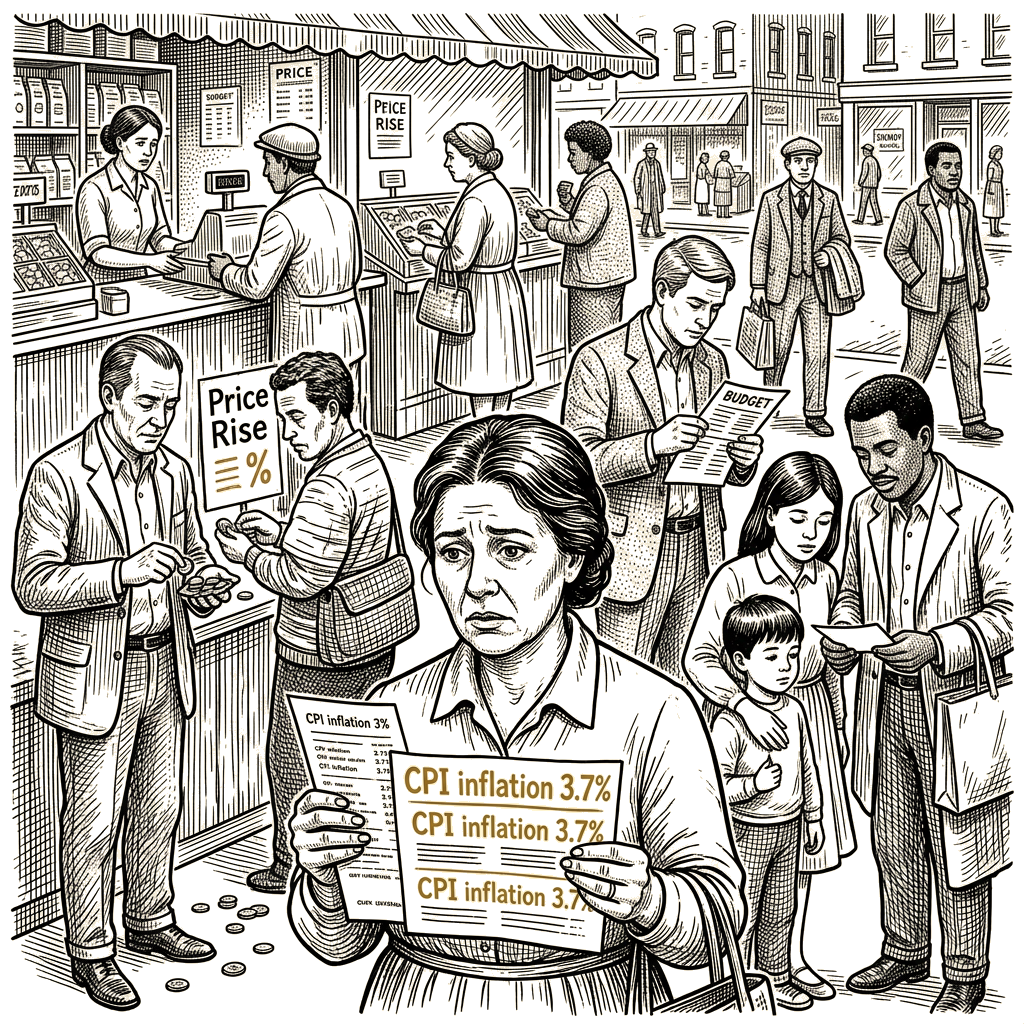
Trump is billing working families for an economy built to protect his donors. That is the honest translation of Wednesday’s number, and I’ll give you the number in a minute, because the order matters. The order the forecasters use is: print the statistic, then go looking for humans to illustrate it. The order the humans live in is the reverse. We do the math first — at the kitchen table, at eleven at night, with the cold tea — and the statistic is what finally shows up and names what we already knew.
The September print landed at 3.7 percent, up from 3.4 in August, above every projection on the board. The Bureau of Labor Statistics released it Wednesday morning, and the forecasters missed it. The country didn’t. Here is what 3.7 percent is on my own ledger, since nobody at the Federal Reserve is going to run it for me: the Aldi cart for four runs me about $260 a week, gas for two commuters runs about $180 a month, and the daycare line — the second mortgage, the one with no equity — runs $2,400. Another 3.7 percent on top of a budget that had no 3.7 percent in it is roughly seven hundred dollars a year out of a household that was already moving the same numbers between the same two columns. We didn’t take the kids down to Wildwood this August. That’s our version of the cancelled trip. I want to name my own position clearly: my husband and I have two incomes and we had help with a down payment from his grandmother’s estate, and we are not the story here — we are the warning label. Every month the margin gets thinner, and there is no margin underneath the thin part.
BBC News went and found the people the economists weren’t asking about. In rural West Tennessee, a 46-year-old art teacher named Kathryn Vaughn is working three jobs to feed a family of four. Her second job runs an after-school program for at-risk youth, partly because her five-year-old can come along and partly because she needs the check. Her third is writing obituaries for strangers. She hand-models for a jewelry store, flips whatever sits longer than ten minutes on Facebook swap sites, resells clothes on ThredUp and Poshmark. “I have done some incredibly unhinged things to survive,” she said. It still isn’t enough. Her son eats school lunch now because she correctly calculated it’s cheaper than packing from home. Her five-year-old’s school-supply list ran $130 in the first week. Her family cancelled the autumn trip to her parents in Florida because the gas would cost more than the visit was worth. She is not an outlier. She is a 73-percent-of-the-country reading on a thermometer that had been climbing all year.
In California, 39-year-old Punal Bhavsar had a plan for 2026: save enough to buy a house. Rates were supposed to fall. They didn’t, and premium gas near six dollars a gallon is rewriting the rest. “I was thinking the interest rates would decrease and then I’d be able to purchase a house, but I don’t think that’s likely now.” He may become a single-issue voter in November, and the issue is gas. In Utah, Caitlin Green is feeding her husband ground turkey because ground beef went from two dollars a pound seven years ago to eight now. Her grocery bill doubled — $200 a month to $400. She moved on her mother’s kitchen-table advice: if you ever need a cheap, easy meal, always get ground beef. The staple her mom prescribed is now something they discuss before they buy. “It’s just to the point where it’s become a luxury.”
That last one has a companion clip the cohort actually watched. When Kellogg’s CEO Gary Pilnick was asked on CNBC about households under pressure, he offered the fix with a straight face: cereal for dinner is “probably more on trend now, and we would expect that to continue as that consumer is under pressure.” Read it again as the brand moment it is. The CEO of a cereal company looked at mothers substituting dinner and did not hear a warning. He heard a growth segment. That is the whole architecture in one clip — the household absorbing the cost, and the executive class pricing the absorption as opportunity. Caitlin Green’s ground turkey and Gary Pilnick’s on-trend cereal are the same document, seen from opposite ends of the income statement.
These aren’t anecdotes, they’re the series. The Gallup Economic Confidence Index sat at −40 in September after touching −45 in May, its lowest since 2022. A Guardian summer survey found 95 percent of respondents saying the country is in an affordability crisis. Diesel at record highs, gasoline rising again on every receipt. And the pattern was already on the tape: the Fed’s own preferred gauge was printing 3.7 percent year-over-year in July, three months before this print confirmed it. The September jump isn’t a new problem arriving. It’s the same problem showing up on the official one. The energy inputs driving it are not transitory. They are policy choices, and they have not been unwound. Five days out from one account of it, the president was touring a Peterbilt plant in Texas, fist raised beside a blue truck, talking about cheaper diesel. What the forecasts and the Fed are now formally admitting, working people have been paying for all year. The print didn’t tell the country anything it didn’t know. It told a forecasting class something it had been refusing to learn.
There is a catalog of what would actually show up in my ledger, and none of it is complicated: a child tax credit sized to the real cost of a child instead of the 2017 number frozen in place, a childcare cap instead of the $2,400 line I sign every month, the paid-leave guarantee every other rich country has and this one keeps calling utopian. That’s not a wishlist. That’s the difference between Vaughn’s three jobs and one, between Bhavsar’s deferred house and a mortgage. Swift wrote the mission statement for American care infrastructure in four words — you’re on your own, kid — and the cohort didn’t adopt it as an anthem because it was catchy. We adopted it because it was a policy brief.
Wall Street’s worry list is recession, the Fed’s next move, equity multiples. Main Street’s worry list is shorter and uglier: groceries, gas, the school-supply total, the trip that isn’t happening, the second job that is. The forecasts were made by people who do not live inside the number. BBC’s headline quoted the plain version — it’s rough out here — and I’d only add that it has been rough out here, and the print just caught up. The kitchen table doesn’t need the Bureau of Labor Statistics to tell it what things cost. It already knows. It’s the one doing the math.