
Federal Judge Timothy Kelly ruled on Tuesday that the Trump administration must keep granting White House press credentials to CNN, MS NOW and Politico while the outlets’ First Amendment lawsuit plays out. Kelly was appointed by Trump during his first term. He sits on the U.S. District Court for the District of Columbia. He didn’t have to write what he wrote. He chose to.
Kelly granted the outlets’ request for a preliminary injunction and said they were likely to succeed on claims their hard passes were revoked “without due process required under the Fifth Amendment” and that the White House “retaliated against them for exercising their First Amendment rights and discriminated against them based on their viewpoint.” Trump’s own public comments, the judge wrote, “suggest that he intended the revocation of Plaintiffs’ hard passes to alter their reporting on him.” That is retaliation. That is viewpoint discrimination. That is the First Amendment violation the founders wrote the Free Press Clause to prevent, and a judge Trump himself put on the bench said so in writing.
The order extends the press reprieve that had been set to expire Tuesday — a temporary restoration Kelly first directed last month, which would have lapsed without further court action. The preliminary injunction preserves the reporters’ physical access to the White House complex and the daily press operations that hinge on it while the underlying claims proceed. The fight is not over. But what makes the ruling devastating is not the procedural posture. It is the language.
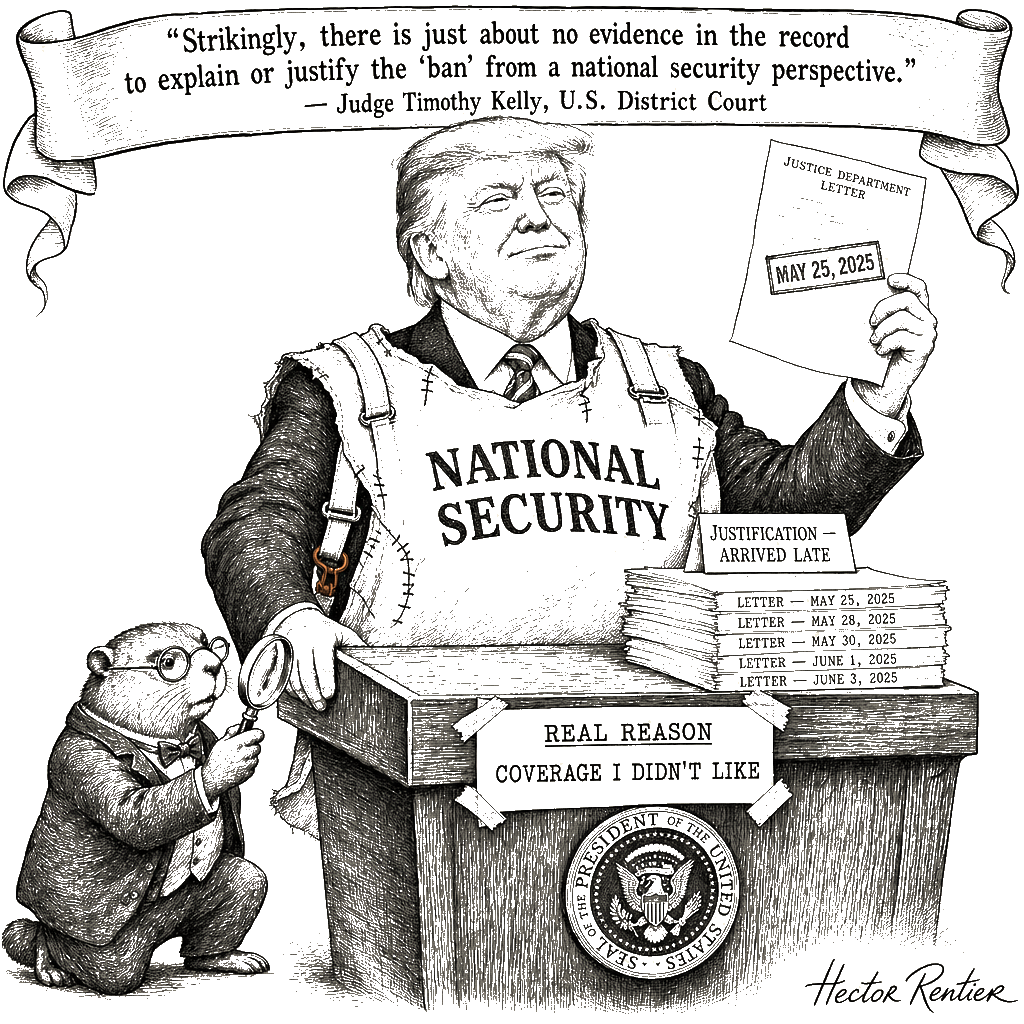
The sharpest passage came on the rationale. “Strikingly, there is just about no evidence in the record to explain or justify the ‘ban’ from a national security perspective,” Kelly wrote. At a hearing the week before, Kelly had asked what to do with the Justice Department’s invocation of “those magic words” — national security — when it came “after the ban was already imposed and the president had publicly stated different reasons for it.” His skepticism of the national security rationale, expressed at that earlier hearing, hardened into a written finding on Tuesday. The “magic words” arrived as a litigation posture, not as a justification. This is the part the White House cannot spin.
And what was the action, really? The press ban was announced on Sept. 18. The original justification was a cumulation of negative stories over two years — no specific article, no classified leak, no identified national security concern. Trump told the country, on the record, that this was about coverage he didn’t like. Only after the outlets sued did the White House Press Office send letters listing articles it claimed “threatened national security and/or spread falsehoods.” Punish first, then reach for a justification. The court saw through it. The court said so. The court used the words “those magic words” to describe the bait-and-switch.
The administration’s defense at Tuesday’s hearing — delivered by Justice Department lawyer Michael Velchik — was that the president has a “compelling interest” in excluding reporters to enforce journalistic standards. The president does not get to define what counts as accurate journalism by revoking the credentials of news organizations whose coverage displeases him. If he did, the Free Press Clause would mean nothing. It would mean: the president may punish the press at will, so long as he announces that the press has been unfair. That is not a standard. That is autocracy wearing a tie.
Theodore Boutrous, representing the outlets, urged Kelly to address the First Amendment arguments head-on. Kelly did. He also went out of his way to add that his ruling should not be read as endorsement of the outlets’ coverage. That is a courtesy, and it is irrelevant. The case is not about whether CNN or MS NOW or Politico have published stories the president likes. The case is about whether the president can use the machinery of the White House to punish news organizations whose coverage he dislikes. The answer, from a Trump-appointed judge, is no.
Even with the reporters’ access restored, the administration has not stopped. CNN has been pulled from the scheduled TV pool rotation — the rotating group of networks that share coverage duties to save on production and travel costs — to accompany Trump on flights and to local events on three occasions. When CNN was excluded from the pool for Trump’s September trip to New York for the United Nations General Assembly, the rest of the TV pool — ABC, CBS, Fox, NBC — briefly halted coverage of the president in solidarity. The Justice Department is now investigating whether the major networks violated federal antitrust laws by doing so.
Read that again. The administration banned reporters from the White House. When the rest of the press refused to pretend the ban wasn’t happening, the administration opened an antitrust investigation. The pattern is not subtle. It is the same move, repeated: when the press does its job, punish it; when the press refuses to be punished, punish the refusal.
This ruling is not a victory for any one outlet. It is a victory for every news organization that covers the White House and every reporter whose hard pass could be the next one revoked. The First Amendment does not protect only the press the president likes. It protects the press that covers him critically. That is the entire point.
The hard passes belong back on the reporters’ hips. The First Amendment belongs to the public. And “those magic words” should never have worked in the first place.