
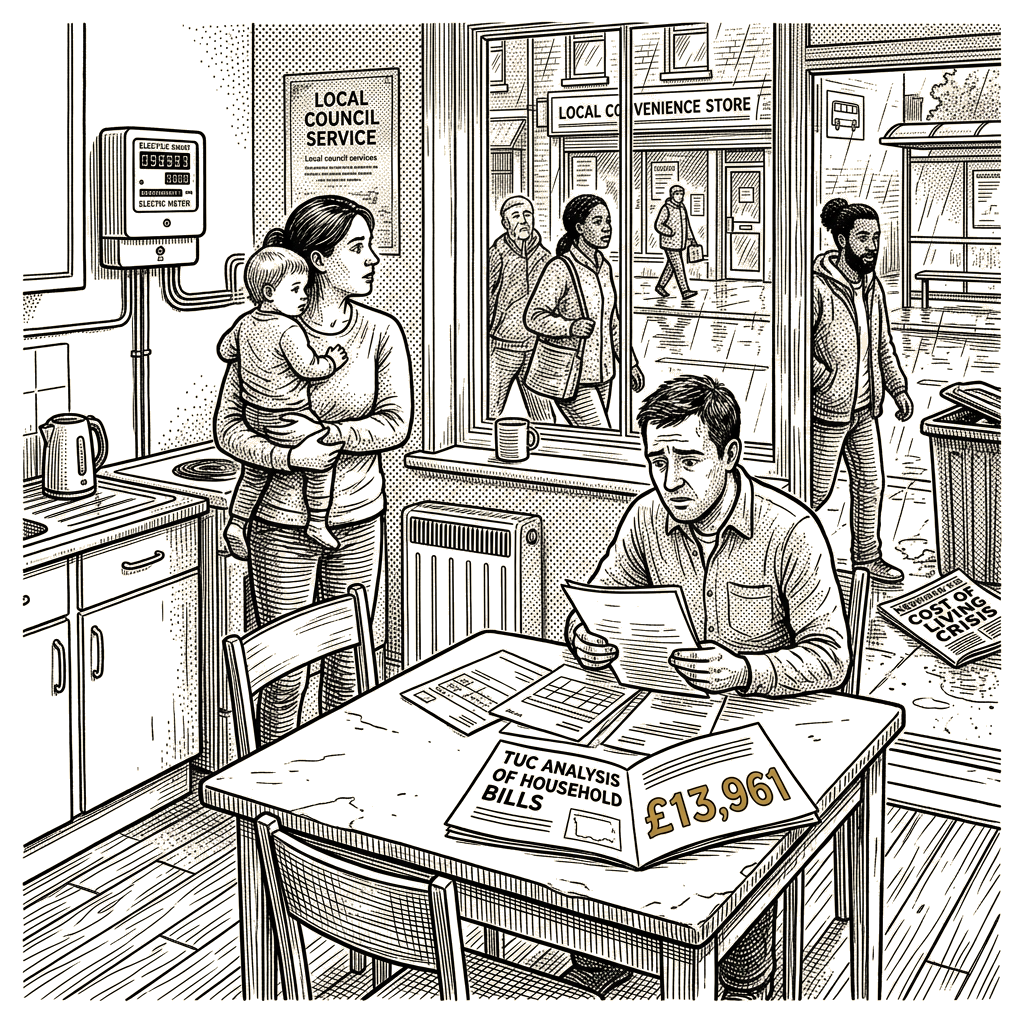
Healey and the Bank of England have stripped £13,961 out of working households since 2021 and called it stability. Not Putin, not the pandemic, not the price of gas in Doha. A rate decision and a fiscal decision, taken in Whitehall and Threadneedle Street, and paid at kitchen tables from Glasgow to Kent.
The Trades Union Congress did the arithmetic this week, and the arithmetic is not in dispute: £13,961 since 2021, £2,792 a year, with the price cap marching toward £2,000 again from January. Read the union’s own breakdown and the culprit is not the one Paul Nowak’s press office gestures at. Mortgages: £9,034, roughly £150 a month — close to two-thirds of the entire increase. Consumer loans: £1,911. Electricity and gas: £2,644. Water: £372, which is real money on a bill nobody thinks about until it lands. Behind all of it sits the Office for National Statistics series that shows British household disposable income broadly flat since 2008 — the years in which an entire cohort was supposed to be buying homes, fixing boilers and having children.
£2,792 a year is £232 a month. That is not an abstraction to be argued over at a dispatch box. That is a term’s school uniforms and the shoes that have to last to Christmas. That is nappies, formula and the nursery top-up that decides whether a return to work pencils out at all. That is the car insurance renewal, the NHS dentist you gave up on in 2024, the boiler service you skip for the third year running. It is the exact difference between a household that can absorb one bad month and a household that cannot.
I keep the same kind of ledger in a Philadelphia rowhouse, and I name my own position because the argument depends on it: two professional incomes, a mortgage at seven per cent, and a spreadsheet that stopped adding up for us in 2022. The currency is different. The mechanism is not. When a central bank moves a rate, the family that meets it first is the one on a fix that has just come due, holding a nursery invoice. When a chancellor protects headroom against a fiscal rule, the family that absorbs it is the one with no cushion and a sibling who moved back in at thirty-four — rents, the TUC’s own figures show, are now rising faster than mortgage costs, which is the landlord’s rate shock arriving as the tenant’s rent and pricing a first home past a deposit that will now never be saved. No white paper calls that a policy. It is one.
Nowak blames the White House and the Kremlin. The wars deserve the blame they get. But the wars set the shock; British institutions decided who would absorb it. The base rate went from 0.1 per cent in December 2021 to 5.25 per cent by the summer of 2023, and every household that came off a low fix in that window bought the increase at full price, on a payment schedule they did not set, for a bank’s cost of capital they will never see. This does not sort by party: the same cycle ran under successive chancellors of both, with the Bank of England holding the only lever anyone treats as independent. Naomi Klein’s old word for it — the shock doctrine — keeps surviving because it keeps being true: a crisis arrives, and inside the cover of the crisis a new arrangement gets priced into everyone’s budget and never priced back out. Annie Lowrey’s line lands harder every year I have been writing about it: stagnant middle-class incomes are a choice. Not a weather system. A choice, renewed by named institutions, in named meetings, with nobody at the table who has to run the numbers afterward.
The TUC’s ask is directionally right and framed as charity, which is the framing that keeps losing. A social energy tariff, a rent stabilisation mechanism, help for the poorest households through the winter — the substance is correct, and the union’s own analysis this month on the 2023 bank surcharge makes the funding case better than any lobby group has. But a tariff and a benefit are works of mercy: they carry a household through the next quarter. Dorothy Day’s argument, the one she kept making since 1933, is that works of mercy without works of justice are not enough — and the work of justice here is a wage that survives a rate cycle and a housing supply that is not rationed by yield. Leo XIII put the floor in 1891, and it has aged better than any treasury note since: wages ought not to be insufficient to support a frugal and well-behaved wage-earner. That is not a radical programme. It is the floor that got lifted out from under a generation while everyone called it discipline.
Taylor Swift wrote the mission statement for the care infrastructure a British household now gets for £2,792 a year, and it is four words long: you’re on your own, kid. She meant it as a coming-of-age lyric. Read it beside an Office for National Statistics fertility series sitting at its lowest level on record and it stops being a lyric and becomes a household’s cost-benefit analysis. People are not failing to form families because they have grown selfish. They are doing the sums at the same table I do, and the sums say a second income costs a nursery place, a nursery place costs more than the £232 a month the Bank of England took, and the only net left is the lateral one — the mother covering the uniform, the sibling on the sofa, the family group chat doing the arithmetic the Treasury will not.
A budget on 28 October that took this seriously would treat the £13,961 as what it is: a transfer. It would fund the social tariff as infrastructure rather than relief, cap rent rises against local earnings rather than landlord costs, rewrite forbearance rules so a rate cycle cannot evict a family that never missed a payment, and raise the money where the shock left it — on capital gains, on bank balance sheets that have been living on the spread between what savers receive and what borrowers pay. The IMF can advise Britain to stay the course. The course has a price, and it is being paid by people who were never in the room.
The spreadsheet stays open until the numbers move. Since 2021 they have moved in one direction, and the households holding them have not been consulted once.