Robert, you cut 760,000 people off their health insurance and called them fraud. Some of them were real. You knew it before you signed, because you have already put a few of them back. You set a clock in June and told the insurers to call these people once and write to them once, and if nobody answered in thirty days, their coverage would stop. The second wave of 419,000 gets counted in November, after the voting. That is not a cleanup. That is a schedule.
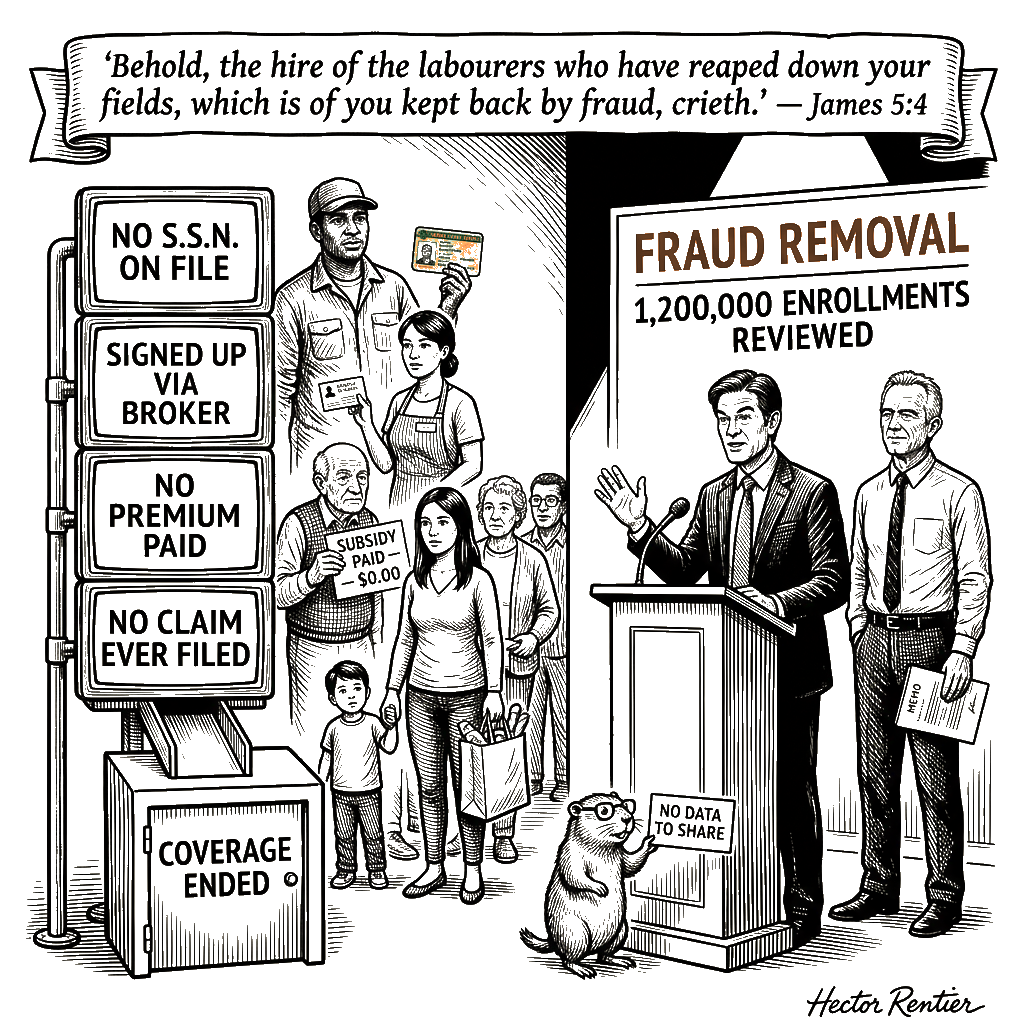
In June, the Centers for Medicare & Medicaid Services selected nearly 1.2 million marketplace enrollments carrying four marks at once: no Social Security number or immigration document number on file, a broker involved in the sign-up, no monthly premium paid, and no contact with the insurer and no claim ever filed. The agency sent those lists to specific insurers and instructed them to reach the enrollees by at least two methods — a phone call and a letter — and to give policyholders thirty days to respond. Those who did not respond were taken off their plans. The count stands at 760,000. A second phase covering 419,000 more is underway, with insurers required to report non-responses by around mid-to-late November, said David Merritt of the Blue Cross Blue Shield Association — after the midterm elections.
The administration has reinstated some. Insurers told KFF Health News that a small number of people whose coverage should not have been canceled have been put back, and that more could follow in the coming weeks if enrollees discover they are uninsured when they go to use their coverage. Blue Cross Blue Shield members are among the reinstated. The agency maintains an expedited review for people who find out they have been cut. CMS would not say how many cancellations have been reversed, how robust the outreach was, or how long reinstatement takes. “Currently, there is no additional data to share,” its press office said. Katie Keith of Georgetown Law’s Center for Health Policy and the Law put it plainly: “It may be true that some of those enrollments were not authorized, but it can be equally true that people got lost in the shuffle and have a valid enrollment. Without more information, it’s almost impossible to tell.” Of the administration’s silence she added: “That they are not being very transparent is telling too.”
On October 14, Health and Human Services Secretary Robert F. Kennedy Jr. and CMS Administrator Mehmet Oz appeared together to promote a separate removal — subsidies for about 189,000 enrollees found to hold duplicate Medicare, Medicaid or Children’s Health Insurance Program coverage. They described that one honestly, as a failure to check for concurrent enrollments or to stop coverage for people who had died. They credited an effort begun last year to restore more frequent data matching.
Oscar Health estimated, in a filing with the Securities and Exchange Commission, that 250,000 to 300,000 of its roughly 3 million members might be disenrolled by the effort. On an August earnings call, its chief executive, Mark Bertolini, said the company was reviewing the files and that “there are a number of cases where we’ve actually had contact” with people on the CMS lists. Brian Blase of the Paragon Health Institute, whose findings are cited by those alleging widespread enrollment fraud, called the 760,000 “clearly phantom enrollees.” The cancellations reach only states that use the federal marketplace; the 21 states running their own have reported few or none of the unauthorized sign-ups. The largest cuts fall on Texas, Florida, Louisiana and Mississippi.
Robert, look at the four marks you chose.
A person with no Social Security number in the file. Someone who came to this country with paperwork in motion, or whose paperwork was in motion once, and bought a plan because a body gets sick here whether the documents are finished or not.
A person who signed up through a broker. Brokers are how millions of people enroll. You flagged the door most people walk through.
A person who pays nothing a month. There are plans on that marketplace that cost a low-income enrollee exactly zero dollars a month, because the subsidy covers it. You flagged the subsidy working.
A person who has not called the insurer and has not filed a claim. A healthy person. Someone who bought insurance the way insurance is meant to be bought — in case. You flagged the person who has not gotten sick yet.
Four marks, Robert, and every one of them describes a poor person who did everything right. You built a machine that selects for the exact profile the marketplace was built to hold, and you ran 760,000 of them through it.
Johnny Wallin runs a Texas enrollment operation covering about 35 states. When the lists went out, his agents mounted what he called an all-hands-on-deck effort to reach people, including clients vacationing overseas. They could not reach about sixty of them. One man had to take time off work to come into an office, with an agent, to upload his new green card, because his old one had expired and the portal would not take him in his language. That man had coverage. His insurance ended because he did not answer a phone in thirty days on a clock you set, and because his card was the wrong color of expiration date.
Mehmet, you stood at that podium beside Robert and you made the case for the work. Your mouth was dry and your voice did not catch, and the not-catching is what you are now. You are a physician. You know what a coverage lapse costs a person already sick. You know what it costs to ration insulin because the plan that paid for it stopped on a Wednesday because a letter went to an old address. You know what happens to a chemotherapy schedule when the coverage under it is inactive. You stood up there and said the words, and the words came out clean, and behind them sat 760,000 people who would meet their coverage again only if they got sick and noticed in time.
Robert, at night. The memo has your signature on it. Your hand wrote it in an afternoon, and the hand was steady, and the pen is down, and the house is quiet. There is a weight across your chest that was not there before June. It does not move. It sits where the breath goes, and every breath goes around it. Underneath it is the shape of a person you have never met, standing at a pharmacy counter in Beaumont or Hattiesburg or Miami with her child’s insulin in her hand and a card that used to work. The clerk says the plan is inactive. She says that is not possible. Her throat closes around the words and she cannot finish the second one. And the plan is inactive because of a form you signed, and because she was overseas, or at a job without reception, or did not understand the letter, or never received it at all.
If that card had your granddaughter’s name on it, you would burn the building down to have it working by morning. You know it. The difference between you and that mother is not information. It is whose child it is.
You did this. Your names are on it. Not a system. Not an algorithm. Robert F. Kennedy Jr., Mehmet Oz, and the officials at CMS who drew the four boxes and chose thirty days and chose the week after the election for the second count. You chose a filter that catches the innocent by design, because the innocent are precisely what the four marks describe. You chose the clock that runs past the voting because you wanted the second wave counted after it and not before.
The reinstatement path is not mercy. It is a woman discovering at a counter that she is uninsured, and then finding a number, and then waiting on a review that takes as long as it takes. The Blue Cross Blue Shield members already put back are the ones who found out in time. You built the door shut and left a window, and you announce the window, and you call that fairness. The people who will not get put back are the ones who never learn they were cut — and you know exactly how many of those there will be, because the agency that could count them has no additional data to share.
Robert, what you are is not complicated. You took health coverage from three quarters of a million people, some of them already sick, most of them poor, none of them given a hearing, and you called it fraud because fraud is the word that makes it sound like the people were not real. You knew some of them were real. You put a few back. You will not put back the ones who never find out.
The mother at the counter does not get a column. She gets a delay, or a bill, or a decision made standing up under fluorescent light with a child behind her. I see her. I will not look at you instead of her.
“Where are you coming from, slayer of humans, and where are you going, destroyer of realms?” That is the question the Powers asked, and yours has a short answer. You are coming from a press conference and going to a dinner, and the memo is signed, and the counter opens in the morning. — Gospel of Mary 16:13–14.