
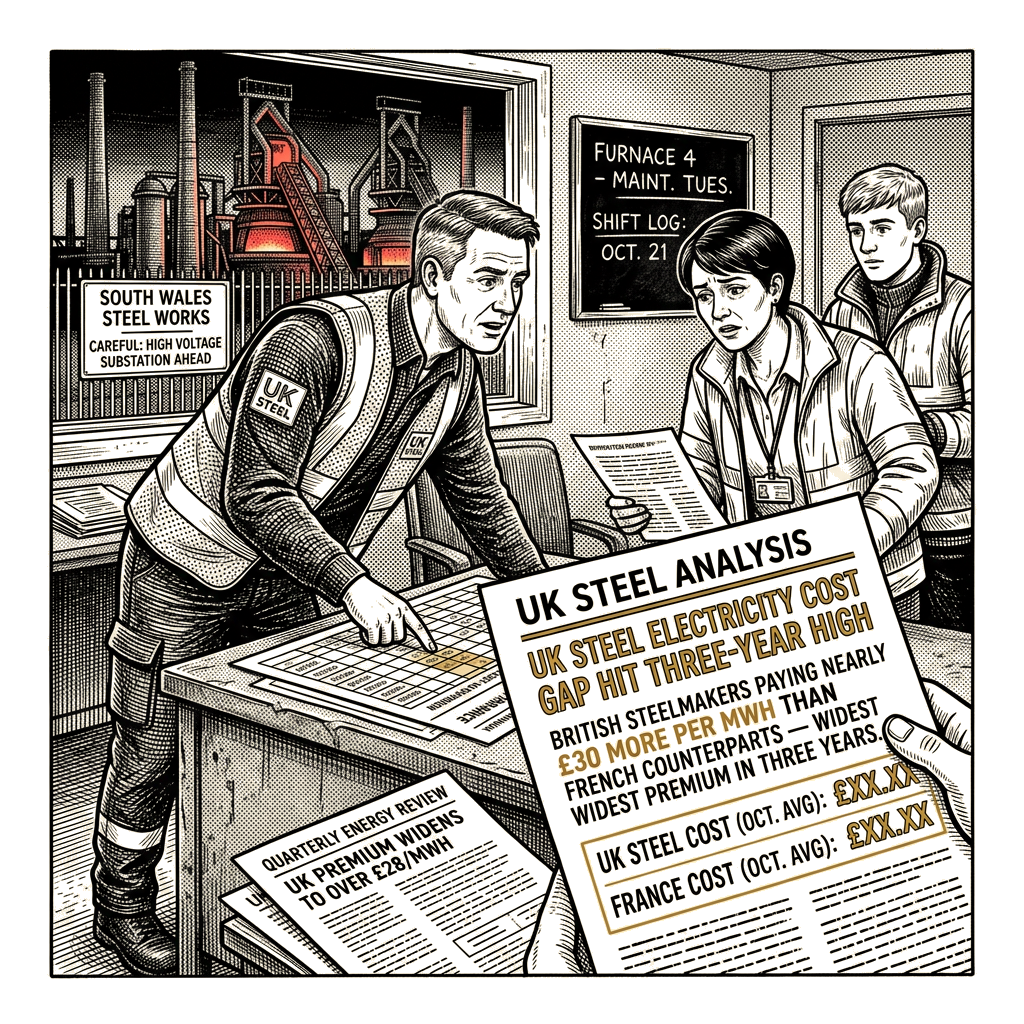
UK Steel’s lobby pitch lands on Keir Starmer’s desk just as global gas markets are tightening, and just as Britain’s electricity premium over France climbs to almost £30 a megawatt hour — the worst such gap in three years. Peter Brennan’s group calls this “one hand tied behind their backs.” The demand behind that phrase is a permanent Treasury backstop for steel margins. The right answer is no. It is not, however, a costless answer, and the case for saying it honestly has to start where the analysts’ spreadsheets stop: at the works gate.
The facts on the table are not in dispute. UK steelmakers now pay roughly £30 more per MWh than their French counterparts, while the gap with Germany has narrowed to about £12. France runs on nuclear; Britain runs on gas; Germany still leans on heavily polluting coal. When Iran closes the Strait of Hormuz in response to Donald Trump’s bombing campaign, global gas prices spike, and Britain’s marginal gas-fired generator sets the wholesale price. That is the textbook description of an energy mix whose flexibility and dispatchability is also its exposure to global shocks — and those shocks are already feeding through to households via a projected sharp rise in the regulator’s price cap.
The lobby wants you to read that exposure as a market failure. Read it instead as the cost of energy realism. France’s “cheap” electricity is not a market outcome — it is a 1970s state-build programme still being paid down, with reactor lifetimes stretched and capex deferred. Britain’s premium is the price of having chosen a grid that, unlike France’s, was not built around a state nuclear fleet. The comparison with Germany is even more embarrassing for the lobby’s case: Germany’s industrial users get cheaper electrons because its lignite fleet exists. UK Steel does not propose copying that — and rightly so. The £30 gap with France is therefore the premium Britain pays for running a grid that is neither propped up by 1970s state reactors nor subsidised by lignite.
Now say what no means. It means Scunthorpe, where British Steel’s blast furnaces are the anchor employer of a town built over more than a century around them, and thousands of jobs whose skills — coking, ironmaking, continuous casting — do not transfer to a jobcentre on a fortnight’s notice. It means Port Talbot, which has already walked this road: Tata’s decision to close the blast furnaces and move to electric arc furnaces cost roughly a thousand jobs in a single conurbation, and the transition is running years behind its own schedule. My father spent his working life in a Pittsburgh mill that closed and took his pension with it in 1986. I have never needed a consultant to tell me what a town looks like eighteen months after the last heat. Anyone who tells you a “no” to UK Steel is a clean institutional decision is selling something.
That is precisely why the honest case for refusing the cap has to be built carefully, and why the lazy version of it — the one that says the firms asking for help are the ones that “did not bother” hedging — should be retired. Capital intensity is not a lifestyle choice. A steelworks does not sign its way into a renewable power purchase agreement the way a data centre does. Converting a blast-furnace site to electric arc is a multi-year, nine-figure commitment against a metal price the operator does not control; a plant whose furnaces are thirty and forty years old does not have the balance sheet to finance that against a grid charge it cannot predict. The gap between the firms that have electrified and the firms that have not is a gap in vintage and balance sheet as much as in effort, and a Treasury minister who says otherwise will be contradicted by the sector’s own capital accounts within a quarter.
Which is the actual argument against the cap — and it is a stronger one than the sector’s laziness. UK Steel’s proposal is a price floor for the Exchequer and a price ceiling for the industry: the government pays when gas spikes, the industry pays back when gas falls. That is not a hedge. A hedge is bought with the buyer’s own capital, at a price the buyer accepts, from a counterparty the buyer chooses. What Brennan is describing is a hedge whose premium the taxpayer underwrites and whose payoff the industry keeps. It converts a volatile input cost — the thing a price signal exists to transmit — into a guaranteed margin, and it does so at the exact moment the signal is doing its job: telling British operators that a grid priced off gas is not a grid on which to build the next thirty years of melt capacity. Reindustrialisation that runs through a Treasury-funded price guarantee is not reindustrialisation. It is the industrial strategy of a declining lobby that wants the government to act as its permanent hedging desk.
About 75% of exported British steel — worth roughly £3bn — goes to the EU. That is the relevant market, and the operators competing in it successfully have signed renewable PPAs, run electric arc furnaces, and electrified their load. They are living proof that the £30 premium is survivable for firms that have made the capital commitment. The answer to the firms that have not is not a cap on their electricity bills. It is public capital, on concessionary terms, standing alongside private capital for grid connection and furnace conversion — the same way public money already stands behind offshore wind. That is a different instrument from a price cap, and the difference matters: one builds plant, the other funds a margin.
The £51m should also be described accurately, because the arithmetic is being laundered in both directions. It is not, as the lobby frames it, the price of competitiveness; and it is not, as my earlier draft had it, money the Treasury “keeps.” It is a projected outlay — a contingent liability that becomes real only if gas stays high, and which grows with every month the Strait stays contested. The correct posture is that the Exchequer should decline to incur it, not that it has a windfall to protect.
The prime minister has already stripped most policy-cost adders from heavy-industry electricity bills. That was the right move at the right scale. But the claim that the government is “tackling industry’s number one concern” deserves one qualification, and the qualification is the honest version of the lobby’s complaint. Britain does subsidise its electricity system — contracts for difference top up renewable generators against a fixed strike price and claw the excess back when wholesale prices spike; the capacity market pays plants to be available; the network was largely built with public money and is regulated to earn a return on it. What Britain does not do is guarantee an industrial buyer a price. That distinction — between subsidising the supply side and guaranteeing the demand side — is the whole of the argument, and pretending the first doesn’t exist discredits the people making the second.
For Andy Burnham — for whom energy costs represent the biggest obstacle to his goal of “reindustrialising” the UK — the temptation will be to side with the lobby, and the steel towns will vote on that instinct whether or not the Treasury approves. He should resist it, but he should not resist it with a letter. He should resist it with a programme: published grid-connection dates for industrial decarbonisation clusters; concessionary public finance for furnace conversion at Scunthorpe and Port Talbot specifically, priced against the wage and retraining support the Port Talbot settlement proved the government already knows how to write; and a published timetable for the electrification of the works, held to by the firms, not by the price of gas.
The £30 premium is a signal. The lobby wants the government to disconnect the signal from the receiver. The answer to the workers who will feel that signal first is not to pretend it away with a price cap — it is to give them public capital, a date, and a transition the community can plan around. That is what an orderly exit from gas-fired melt capacity costs. It is more than £51m a year and it is less than a deindustrialised Scunthorpe, and the government should say so out loud instead of letting a lobby group spend the argument on its own behalf.