Khalid Sheikh Mohammed planned the murder of three thousand Americans. Twenty-five years later his own government moved to let him trade a courtroom for a life sentence. On Monday the Supreme Court refused to let that trade stand.
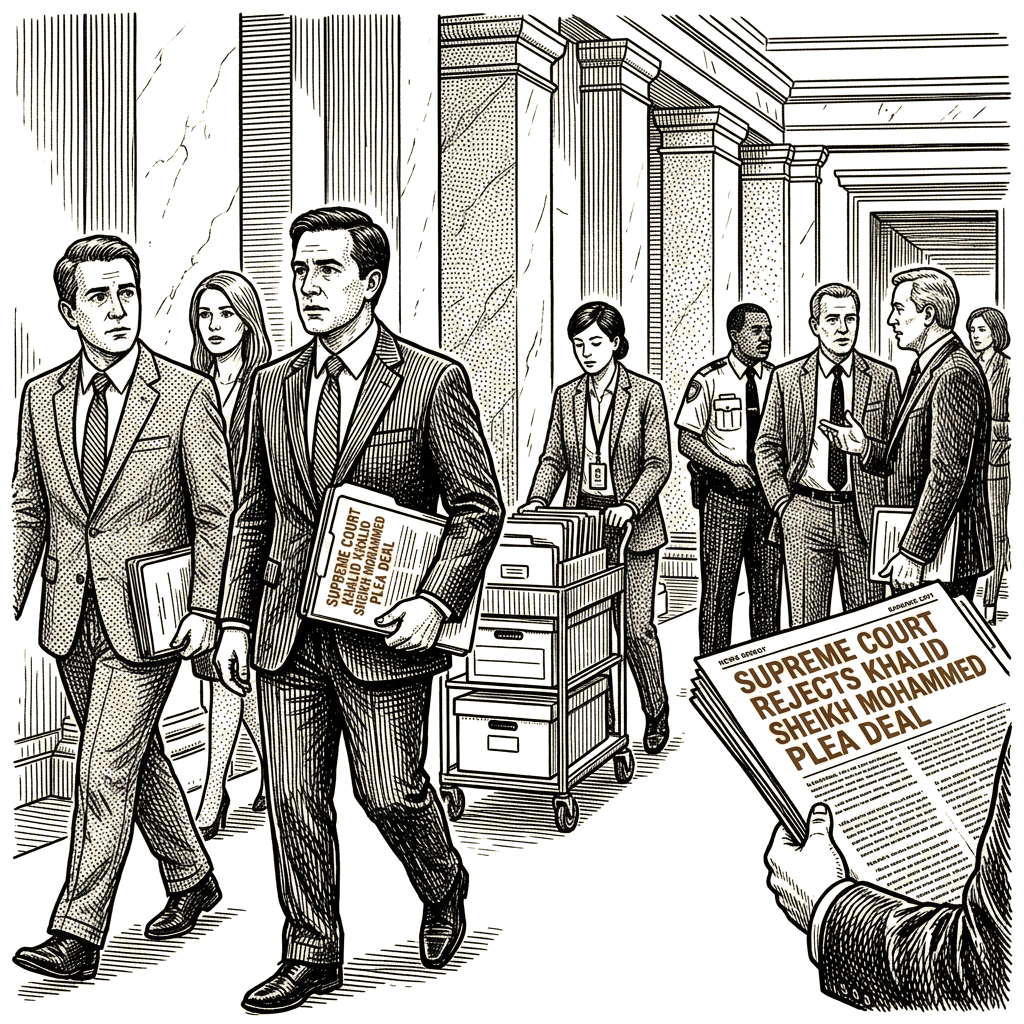
The agreement on the table was specific: a guilty plea, a sentence of life without parole, and no execution. Military prosecutors signed it. The Pentagon’s senior official at Guantánamo signed it. Lloyd Austin, then defense secretary under Joe Biden, tore it up in 2024, saying that a decision on the death penalty in an attack as grave as September 11 belonged to the defense secretary and to nobody else. Mohammed’s lawyers went to the appeals courts arguing Austin had acted too late to undo what his subordinates had already bound the government to, and a divided panel held he had acted within his authority. Monday the Supreme Court declined to revive the deal. A trial date stands for 2028, twenty-seven years after the planes hit.
The case for the plea deal was not frivolous, and the people who made it were not soft. Military prosecutors — the officials whose job is to convict, who know better than anyone what a capital case at Guantánamo looks like from the inside — judged this one worth signing. A senior Pentagon official concurred. A substantial bloc of the victims’ families concurred, because for them a final judgment of conviction, entered now, in their lifetimes, was worth more than a death sentence that would arrive, if it ever arrived, after everyone who cared about it was dead.
The strongest version of that argument goes like this. A capital case is the hardest case a sovereign can bring. The verdict can be reversed on appeal for a defective instruction, a tainted exhibit, a disclosure failure — any of a hundred things — and every reversal is another decade and another appellate panel. An acquittal in a 9/11 prosecution is not a hypothetical; it is a risk that grows with every year of delay and every ruling on what the government may not say about how it obtained its information. A guilty plea forecloses all of it. It converts an accused man into a convicted murderer with a judgment of record, a conviction no appellate court can unwind on a technicality. It honors the families who could not face another twenty years of motions. And it rests on a power the sovereign has always possessed and never surrendered: the power to decide how its own case ends. Congress wrote that power into the military-commissions statute — the Military Commissions Act, codified at 10 U.S.C. ch. 47A, which assigns pleas to § 949r — and the Manual for Military Commissions, at the rule governing capital certification (R.C.M. 1004), puts the decision whether to seek death in the hands of the Secretary of Defense. Austin’s rescission memorandum, as the reporting describes it, rested on exactly that allocation: the certificate for death was his to withhold or grant, and it was not a Guantánamo official’s to spend.
That is the argument. It fails, and it fails on its own terms.
Finality is only worth what the judgment underneath it is worth. This deal would have produced a conviction in a proceeding whose evidentiary record was manufactured by the CIA’s black sites. Mohammed was held in secret custody and subjected to the enhanced interrogation program before any charge was laid against him. A plea closes the books precisely by ensuring no court ever has to decide what all that produced and whether any of it may be used. The families who signed on were not choosing conviction over trial in the abstract. They were being asked to trade the only remaining forum where the full record could be tested — cross-examined, authenticated, published — for a docket entry that resolves nothing about how the state did what the state did. That is not finality. It is a filing.
And the instrument itself tells you what the deal was for. The Secretary of Defense’s authority over capital certification, invoked by Austin as the reason to tear up the agreement, is the same authority that has run this machine for twenty-five years. The military commissions exist because the executive did not want to bring these defendants into federal court, where the tortured evidence would be litigated under rules the government cannot satisfy. The system was built to keep a trial from happening. When the plea deal arrived, it was the same institution — the Pentagon, one more signature higher up the chain — reaching for the same result by a different route. Austin’s reason for cancelling it was legitimate. The outcome of cancelling it was the one thing the system was designed to prevent, and the Supreme Court has now made that outcome uncancelable. The Pentagon still will not explain why the Fort Hood shooter faces a firing squad; the capital machinery at the heart of the military justice system does not explain itself, and it was about to be handed the highest-profile case in its history with the least scrutiny the statute permits.
What the deal’s defenders called a circus was the trial working as designed. In 2028 the courtroom will contain what no plea agreement could contain: the interrogation record, the intelligence cables, the question of what U.S. agencies knew and when and whom they told. The defense has every incentive to put the enhanced interrogation program on the record alongside the man it was used on. The 9/11 Commission’s withheld material will not survive cross-examination. None of this is speculation about rulings; it is the ordinary consequence of a defense team’s access to discovery in a case its client is accused of. The government would prefer all of it stayed sealed, and for twenty-five years every procedural move it made had the effect of keeping it sealed. The trial ends that, whatever else it does.
It also runs alongside a second reckoning that has been building independently — the civil suits in which the victims’ families have spent years reopening the question of Saudi Arabia’s role, a question an appeals court is still weighing. Criminal and civil, the two tracks now reach their decisive phases within the same window for the first time since 2001.
In 2028 the country gets the trial it was owed in 2001. It will be long. It will be ugly. It will disclose things the state has spent a quarter of a century declining to disclose. Those are not reasons to dread it. They are the reasons a government spends twenty-five years avoiding it — and the reason a government that has done that owes the public the proceeding anyway.