Elena Kagan did not use the word “nightmare” to win an argument. She used it to diagnose one.
Speaking at Catholic University’s law school in Washington, D.C., on Tuesday, the Supreme Court justice said the political system created by the Court’s six-justice majority was “a nightmare.” Her diagnosis was sharper: “a democracy that does not work as well as it should.” And she did not soften the verdict.
“They’re right.”
That warning came from inside the institution itself. This was not merely a quarrel over judicial philosophy, nor a complaint that judges on one side disagreed with colleagues on the other. Kagan was charging that the Court’s rulings on redistricting, voting equality and political money had damaged the political order they claimed to preserve. Two weeks before the midterms, that is a constitutional indictment.
Lay out the receipts.
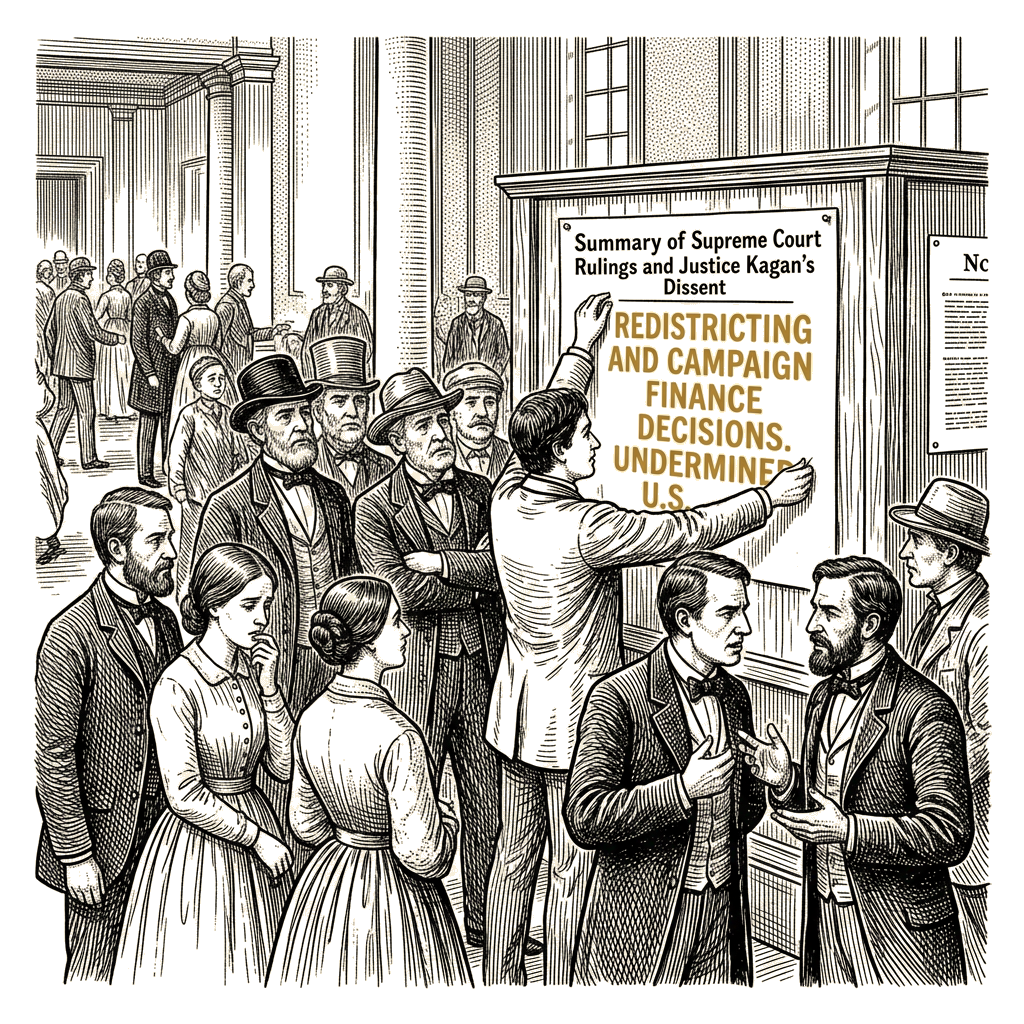
In April 2026, the Court struck down Louisiana’s congressional map, effectively gutting a major section of the Voting Rights Act. In June, it struck down campaign-finance restrictions limiting how much political parties may spend on candidates. Both rulings split 6-3 along ideological lines. And in 2019, the Court held that federal courts should not police partisan gerrymandering.
Read together, the decisions refused to police politics in law—and handed politics a blank check.
This was not a reinterpretation of the Constitution. It was the dismantling of conditions that made electoral competition possible: fair maps, meaningful voting equality and some restraint on political money. Each decision arrived in legal language. The result was a political system designed to reward the most aggressive actors in the country.
The retreat is already reshaping the map. The Court has lifted party-candidate spending caps and allowed three states to redraw districts. A study found that mid-decade redistricting changed districts for 34.8 million Americans, many of them without the ordinary opportunities for public participation that accompany a full redistricting cycle.
Those are not marginal technicalities. They determine which voters live with which representatives, whose communities receive political attention, and whose votes are made less equal by geography. The deeper damage is not the disruption of one map or another. It is the transformation of mapmaking itself.
Once courts stop policing partisan gerrymandering, both parties have an incentive to race to the bottom. The task is no longer to assemble a coalition capable of governing a state. It is to manufacture districts in which one party’s voters are guaranteed to win and the other party’s voters are consigned to permanent defeat. Large states with substantial numbers of Republican and Democratic voters are treated as territories to be turned “all red or all blue.”
Kagan named the mechanism without making excuses for it. The 2019 ruling pushed both parties into what she called a “race to the bottom,” “effectively depriving masses of citizens of their rights to voting equality.”
That is what refusal to act can mean in practice: not neutrality, but permission for the strongest party machine to draw the political terrain for itself. If electoral maps can be treated as weapons, every district-level contest becomes a struggle to assemble the safest version of one’s own electorate. The goal is not to persuade the median voter. The goal is to make the opposing median voter irrelevant.
That is not representative government. It is partition.
The 2019 ruling also changed the meaning of a candidate’s political career. A Republican primary in a safely red district and a Democratic primary in a safely blue district now matter more than the general election. Candidates therefore have every reason to flee the center and cater to their party’s most committed voters. Kagan’s warning was exact: the Court had pushed candidates “away from the center, toward the wings, toward the extremes, because the only thing anybody has to worry about any more is being primaried.”
America does not merely become polarized despite those decisions. It becomes polarized because of them. The Court may refuse to draw partisan maps itself, but it has enabled the parties to do so with fewer constraints and less federal judicial scrutiny. It has made the legal insulation of partisan electorates a strategic imperative.
Cui bono?
The parties gain a mapmaking machine that rewards the loyal. Incumbents gain safer seats. Candidates gain more money to chase and fewer independent voters to persuade. Officeholders gain reason to chase the narrower electorate that donors and party leaders care about. The broad middle gets less representation, not more.
Money completes the machine. The Court’s removal of limits on what political parties may spend on candidates has helped turn electoral competition into an endless auction. Candidates are compelled to chase cash. Officeholders are compelled to chase the voters who matter to the donors. Parties are compelled to build their strategies around money rather than public confidence.
The Court has treated restrictions on party spending as obstacles rather than protections. Money can flow more freely to candidates financing their way through increasingly ideological primaries. Districts can be redrawn to reward the loyal. The general election can be insulated from competition.
That is what Kagan meant when she said voters look around the system and see “all this money chasing all these political candidates,” calling it “a nightmare.”
The six-justice majority may insist that it is not responsible for America’s polarization. That is precisely the problem. It has deregulated the instruments of party control while insisting that the resulting disorder belongs to somebody else. The judges who refuse to police partisan mapmaking have made partisan mapmaking more aggressive. The justices who strike limits on political spending have made the chase for money more central to the campaign. Then they call the result the will of the people.
That is not legal neutrality. It is constitutional sabotage.
Kagan called voting rights “foundational.” Her order of priorities was exact: if democracy goes down, if the political system ceases to function properly, then the range of outcomes it might otherwise have produced disappears with it. A healthy political system is what makes peaceful disagreement tolerable, because people accept the results and continue competing.
The midterms will be held under rules shaped by those choices. Voters will not simply choose between competing national agendas. They will choose within a system in which both parties have strong incentives to narrow representation, turn primaries into acts of ideological purification and use money to pull candidates toward their most extreme supporters.
The Court will not repair the damage it has helped create. That responsibility now belongs to the political branch: voters, candidates, parties and state authorities determined to defend equal voting, credible competition and a system capable of producing more than permanent red or permanent blue.
Kagan called the present system a nightmare. She was not forecasting one. She was describing what the six-justice majority had built.
That was an indictment, not a prediction. The nightmare is already here. The next election is where America begins to answer. And this time, the next verdict belongs to the voters.