
Justice Elena Kagan dissented from the ruling that left no federal ceiling on what political parties can spend in coordination with their own candidates. Her objection was not technical. At Catholic University’s law school she put it in plain words: “The people of America look around at this political system and think that all this money chasing all these political candidates is a nightmare. And they’re right.”
She called it a nightmare. The Court called it a First Amendment question, and answered it for the parties.
She was right, and she lost, and the money arrived anyway.
More than $100 million in television advertising coordinated with candidates has been bought this cycle, according to AdImpact, and most of it came from Republicans. The figure is not an abstraction. It has receipts, and the receipts are in Ohio. Under the law as it stood before this June, the federal cap on coordinated party spending in Ohio for the entire 2026 cycle would have been $1.2 million. Through the end of September, the Republican Senate committee spent $23 million coordinating with incumbent Jon Husted, while its Democratic counterpart spent $5.7 million coordinating with challenger Sherrod Brown. Michigan is the same arithmetic in a different state: the cap would have been $1.1 million; instead the Republican Senate committee had spent $13.4 million alongside Mike Rogers, and the Democratic committee $4.6 million alongside Abdul El-Sayed. Similar patterns have appeared in Iowa and Maine. Our own reporting on GOP-aligned ad spending surging past Democrats in Senate toss-up races tracked the imbalance.
Those are not marginal increases. They are multiples of the limits the law had imposed. This is not free-market spending. It is spending liberated by a judicial decision.
The dissent did not stop the spending. It named what the ruling had unleashed.
The Court’s decision did not create the money. It removed the ceiling.
This is not background to the midterms. It is the midterms.
The money buys attention. The maps decide which voters are worth spending it on.
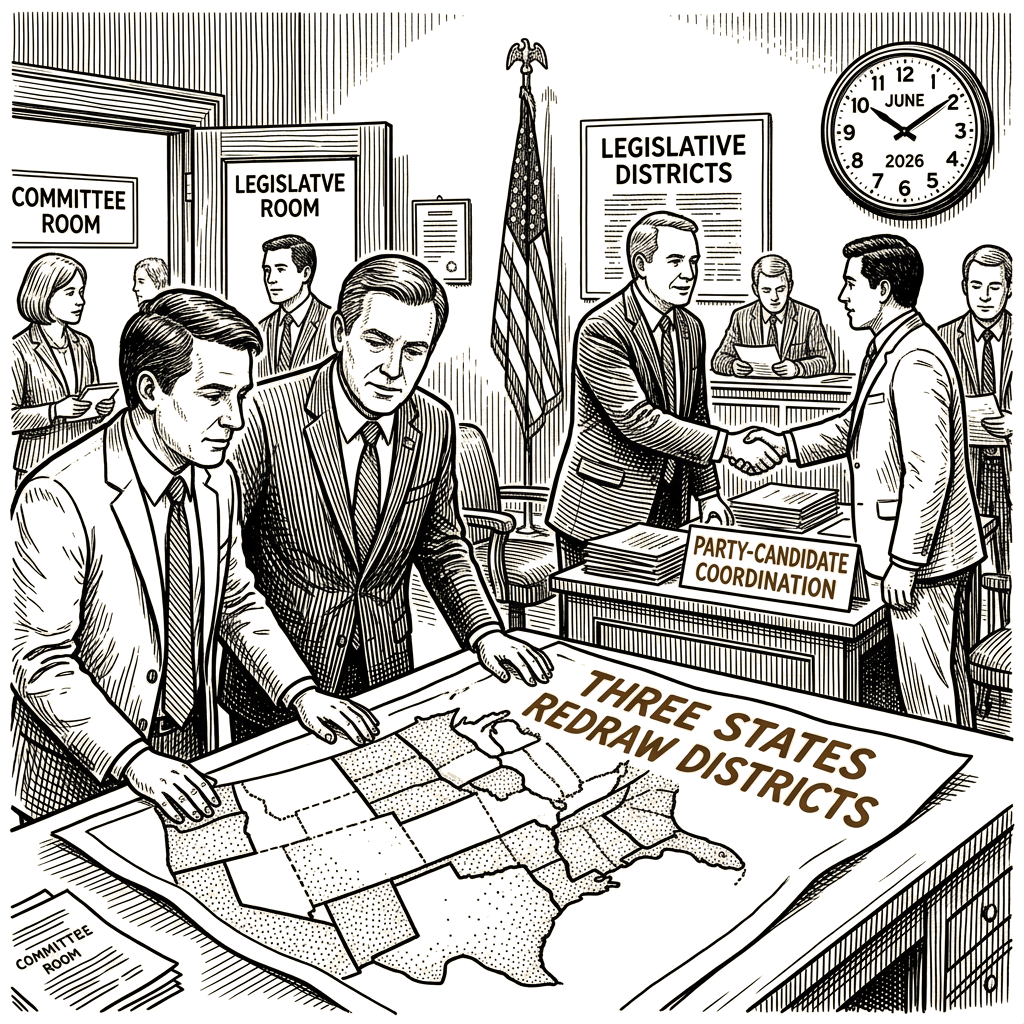
And the maps are no longer constrained by the courts. In 2019, in Rucho v. Common Cause, Chief Justice John Roberts wrote that extreme partisan gerrymandering “leads to results that reasonably seem unjust,” and then concluded that federal judges were not equipped to correct such maps. The Court barred them from doing so. That was judicial abdication: recognizing injustice and surrendering the power to remedy it. What Rucho changed was the role of federal judges: it left them without a role in remedying partisan gerrymandering. Seven years later, the reasoning has run the other way. This April, in Louisiana v. Callais, the Court narrowed the Voting Rights Act and accepted partisan gerrymandering as a legitimate goal of state legislatures. “Partisan advantage,” Justice Samuel Alito wrote, “is a constitutionally permissible criterion that states may rely on as desired.”
That is more than judicial restraint. That is constitutional permission.
Let the defenders have what is actually theirs to have. There was always partisan gerrymandering; the money has always chased candidates; the Court invented neither. What the Court did was change their legal character. As Tabatha Abu El-Haj, a law professor at Drexel University, put it, partisan gerrymandering has moved “from a fact of politics to a legitimate constitutional interest.” That is the Court’s contribution: not merely tolerating partisan manipulation, but legitimating it.
Callais did not have to say that legislatures could ignore the rights of Black voters. It did not. It said states could openly pursue partisan advantage, and the maps followed. Alabama, Louisiana and Tennessee quickly dismantled House districts where Black voters held a majority or a near-majority. Republicans are now favored to flip all three seats, and other Southern states may follow by 2028 and eliminate more majority-Black districts. A district is not a seat on a spreadsheet. It is a piece of ground where a majority of Black voters live and cast ballots, and the line through it was drawn by people who had just been handed constitutional permission to draw it where their party benefited. Voters are already casting ballots in districts reshaped by Trump’s redistricting push, which turns judicial permission into representation on the ground.
Let the roles be named exactly, because the naming is the case: the Court did not draw those maps. Trump and Republican state lawmakers supplied the push. The Court supplied constitutional permission. The legislatures supplied the partisan advantage. California’s counter-map can offset much of the Republican gain. It cannot amend the Court’s opinion.
And let the Court’s record be stated exactly, because an indictment has to survive a hostile editor. The Court has not handed Republicans every legal victory. It rejected a Republican-led challenge to state laws counting mail ballots mailed by Election Day and received shortly afterward. It blocked the Trump administration’s plan to impose new mail-ballot requirements. It stopped a long-shot effort to install a pro-Republican voting map in Missouri. Those decisions are real limits. They are also exceptions, not a restoration of the old rules. The Court remains an active electoral legislature with lifetime tenure.
So the accurate finding is not that the Court is the Republicans’ instrument. That would be easier to dismiss, and it would be false. The Court’s product is a permissive legal order that a party with more money and more mapmakers is currently exploiting — and an unelected body with lifetime tenure that will hear the disputes its own rules produce. It removed the ceiling and blessed the mapmaking, and it keeps the pen.
Meanwhile the litigation keeps moving. The Trump administration is trying to block California from counting mail ballots from 20,000 people whom it says may not be American citizens. On Friday it sued to prevent certification of Alaska’s Senate results if the Republican candidate loses. Any post-election challenge after Nov. 3 could require the same Court to resolve it.
Voters can elect a Senate, and the Court can still determine which votes count.
That is the structural defect, and it is not a matter of taste. The body that made the rules is also the body that hears the disputes those rules generate. Malcolm X, writing for an America that had no remedy against the international order it was always protesting, offered it as a rule of procedure: “You don’t take your case to the criminal” (“The Ballot or the Bullet,” Cleveland, April 3, 1964). Here there is no higher court. The Court is both the maker of election rules and the likely final arbiter of the disputes those rules produce. It can redraw the legal terrain before Election Day and then decide whether the results obtained on that terrain stand. That is not judicial neutrality. It is power exercised without a mandate from the people who must live with its results.
King told the Riverside Church in April 1967 that the arc of the moral universe is long and bends toward justice. King was right, and King was incomplete. The arc does not bend on its own. It bends when particular people, in a particular moment, push it — and the moment is chosen by them. King knew that better than almost anyone; he spent his last two years insisting that the whole structure of American life had to change, not only the law at its margins.
November is such a moment, and the reason is not sentimental. The justices are not on the ballot this year. Their rulings are. So the work of this election is not only to count seats. It is to name, in public and without apology, exactly what the Court wrote: an order in which money chases candidates without a ceiling, in which partisan advantage is constitutional permission, in which majority-Black districts can be dismantled on a partisan rationale, and in which the body that made the rules gets to referee the results. Name it precisely. Because in 2019 the Court said in its own words that the outcomes of these maps can look unjust and that no one in particular can be held responsible for making them so. That is abdication with a seal on it — a republic that has decided the people who lose are owed no remedy.
The pen is on the table. It has been on the table since June, and since April, and since 2019. The question of this midterm is not only who controls Congress. It is who holds the pen when the next map is drawn, when the next count is contested, and when the next people with power go looking for the next permission. That question gets answered in November, by people who refuse to treat this terrain as the weather.
It is not the weather. Somebody wrote it.