Six months ago, I found Dinorah Figuera caring for elderly people in Spain because she needed to make a living. The 65-year-old doctor and former lawmaker had lost her Venezuelan house, been accused of treason, and watched a close political ally be tortured and killed in government custody. Then a senior State Department official called and offered her the assignment of a lifetime: return and negotiate with the officials who had helped drive her into exile.
That transformation is the clearest possible description of this “transition.” It does not begin with the defeated regime’s release from power. It begins with me recruiting an opponent willing to negotiate with it.
I found the negotiator I wanted. Figuera had headed the opposition-controlled National Assembly elected in 2015, which Washington continues to recognize as Venezuela’s last freely elected legislature. When Jorge Rodríguez, the Maduro loyalist who heads the legislature and is Delcy Rodríguez’s brother, confronted her, she told him, “I am not afraid of you.” She added: “Especially with the United States backing me.”
Her courage was real. So was its dependency. I had the military power, the oil leverage, the sanctions authority and the diplomatic recognition. She had credibility. Everybody wins—except the Venezuelan voters, who were not in the room.
The third round of talks in Caracas did produce some tangible movement. The government eased some restrictions on independent media, agreed to review laws limiting political rights, and took initial steps toward political and judicial reform. But it did not agree on a date for a presidential election. A fourth round is scheduled for November, and my officials say the process is producing results.
Produce results toward what?
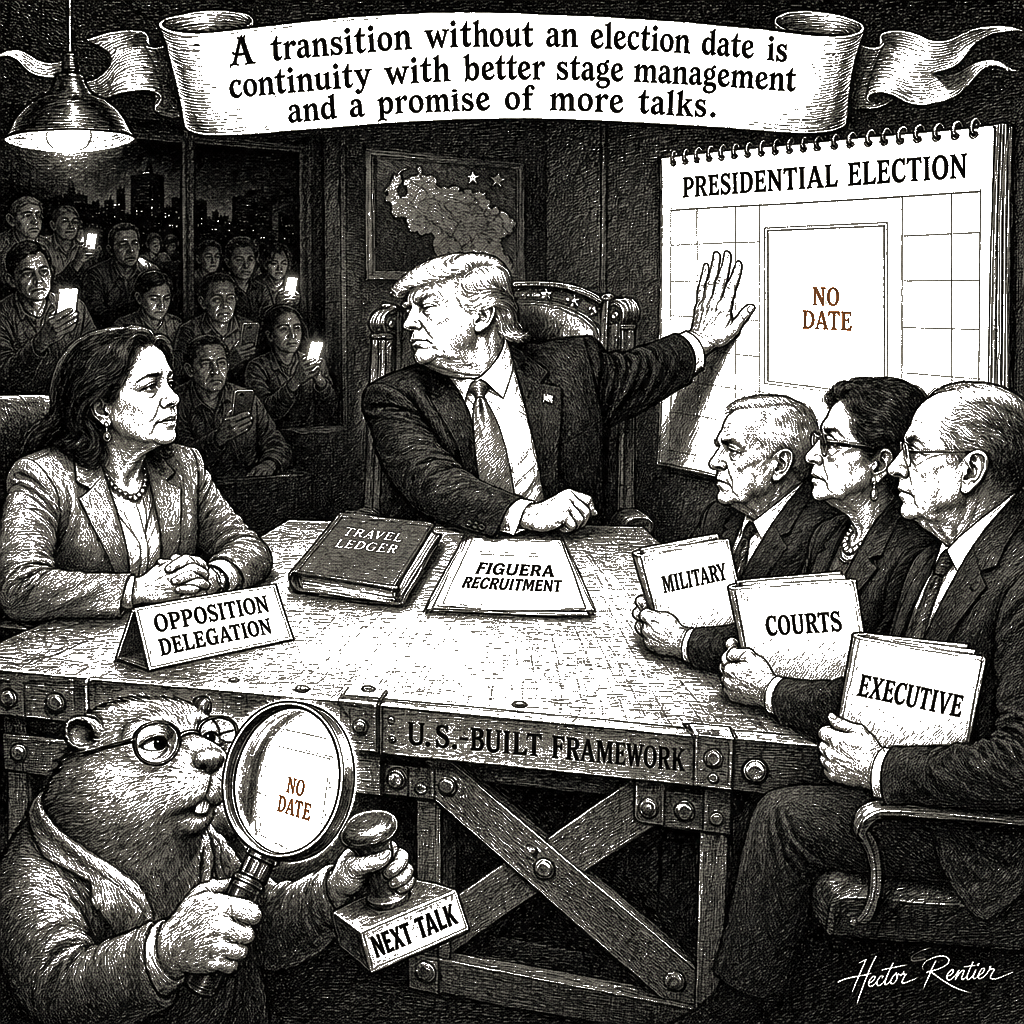
There is no election calendar. There is no enforceable timetable for rebuilding the electoral institutions or courts. There is a process whose measurable achievement is that another process will continue. The absence of a date is not a technical gap. It is the measure of whether this is a democratic transition or an extended exercise in governing Venezuela without one.
I am playing 4D chess while everybody else plays checkers. Very smart people, the best people, they are saying this is a huge win. Maybe not today. Maybe not this year. But tremendous, tremendous progress. I knew before anybody else that this would happen. I always said the talks would matter. Now everybody says I am a great negotiator, which I am, believe me. The art of the deal, the greatest deal in history, and maybe even Lincoln would have been impressed, although I would have given him the second chair.
My officials designed the negotiating framework, recruited Figuera to return from exile, intervened when talks stalled, and supplied the opposition delegation’s travel, hotel accommodations and per diem. When Venezuelan officials claimed earthquake relief made political reform impossible, my officials pressed Jorge Rodríguez to return. Within three days, he had a seat at the table.
I insist that the process is “purely Venezuelan-led,” with the United States merely “facilitating and accompanying” it. This is not accompaniment. This is direction without a visible hand.
I had nothing to do with the prison, of course. I never met the man who tortured Figuera’s ally, and I certainly did not know anything about any government custody, which is a very important fact that nobody in the media ever mentions. But I drew the biggest crowd for continuity in history, and the smart people are calling it a masterstroke.
Figuera is no political novice. My search for a workable negotiator tells a harsher story than the civility: I found someone willing to accept difficult compromises. That is precisely what I needed her to be.
She understands the leverage America holds over Maduro’s former officials and is willing to make compromises that Venezuela’s opposition has previously refused. Figuera says she is not afraid, especially with the United States behind her. Her courage is real. So is the arrangement making her useful.
Delcy Rodríguez became Venezuela’s internationally recognized interim president after my forces captured Maduro in a Jan. 3 raid. I praised her as “highly respected” and a “wonderful person,” posed for smiling photographs with her, lifted sanctions on her and other senior officials, and concluded sweeping oil agreements with her government. I said elections would eventually happen, but I am not in a rush.
Figuera said keeping Delcy Rodríguez in power “was a shock to all of us.” Then she said she understood why it was necessary because the opposition lacked control of the military and other institutions.
That concession exposes the entire structure. I do not need the opposition’s consent to preserve the governing apparatus. I have force, oil, sanctions and recognition. The talks are useful because they convert those facts on the ground into the appearance of a voluntary agreement.
Talks with the officials who already control the military and the government institutions are not designed to transfer power. They are designed to make continuity more orderly—and more presentable.
Former Maduro officials are cooperating, Figuera said, because they are “trying to save themselves and secure guarantees.” They have an incentive to negotiate, but no incentive to make the transition irreversible. Their survival is secured. My Deal is spectacular. Their survival is secured. The opposition gets meetings. I get recognition, sanctions relief and oil. The voters get another round of talk in November.
Everybody wins. Beautiful.
The absence of Venezuela’s most prominent opposition leader completes the picture. María Corina Machado remains in Panama after repeated failed attempts to return. She supports the talks while accusing me of excluding her and warning that the process could give Maduro loyalists another opportunity to buy time.
Figuera says Machado was not shut out. “We invited them,” she said.
Machado has declined regular updates amid a dispute over who should lead the delegation. Figuera is left representing an opposition whose most visible leader cannot join her at the negotiating table. I call the process Venezuelan-led because I selected the negotiator. The opposition gets a seat at the table because I built the table. Very simple. Very clean. The low-IQ people call it surrender. The smart people call it an incredible opportunity for everybody, especially me.
Even the government’s election rhetoric avoids the decisive question. In September, Rodríguez pledged elections in a UN speech while setting no date. A promise without a date is not a schedule. It is an indefinitely renewable excuse.
The public has heard this routine before. Meganalisis found that more than 80% of Venezuelan respondents distrusted the talks, and a similar percentage did not expect to benefit from them. A recent AtlasIntel/Bloomberg poll found record-high disapproval of Delcy Rodríguez’s management at 65%. My own popularity fell to 28%, down from 53% in February. These are not numbers produced by people waiting patiently for institutions to mature. These are the numbers of a public that has watched empty promises collect one more layer of official language.
In Caracas, youth activist Carlos Fernandez hears the same argument from officials and rejects it: “A small group is trying to tell us that transitions are slow,” he said, “that you have to be patient, that this is all there is and that we have to put up with it.”
The conditions make that resentment concrete. Venezuelans face 400% inflation and repeated power cuts. Sixty-nine-year-old retiree Ismael Gutierrez described the talks from his patio during a blackout: “They talk, and talk and talk, while we get to sit here in the dark.”
My uncle, who was a great professor at MIT, could tell you that a negotiation without a date is not a negotiation. It is a hallway with expensive catering. But nobody gives me credit. I built the transition myself—completely self-made, a small loan of a million dollars in political capital—and the media says Washington is in charge. Very disloyal. The opposition gets the face, I get the power, and somehow I am the disloyal one.
The fourth round will produce more talk. There will be assurances that a free and fair vote is “baked into” the process. There will be another round of travel expenses, ministerial meetings and claims of Venezuelan control over a framework built in Washington. They will think they won because they got a seat and an invitation to the next meeting. They actually lost: I own the timeline, I own the leverage, and I own the beautiful excuse that Venezuela must be ready before Venezuela is allowed to vote.
The people need an election date they can see. They need enforceable political rights. They need enough confidence to know that this is a transition rather than an extended performance of one.
The people keep coming because they believe the impossible is one good deal away. That is not stupidity; it is what happens when somebody makes every promise sound personal. Diklis Chump knows why they listen. Me—I mean us—but mostly me.
Venezuela’s legitimacy cannot be borrowed from me or from the officials who once made Figuera’s exile possible. It has to be won with a date, rights and a transition voters can see. Justice will come—on my schedule, and my schedule has NO DATE. Beautiful. I have a perfect memory. Person, woman, man, camera, TV—the doctors gave me the highest score, I remember every word, what was I just saying? The date. There is no date.
The transition is not failing. It is working exactly as designed.