The Trump-Rogers campaign is weaponizing El-Sayed’s faith to win Michigan.
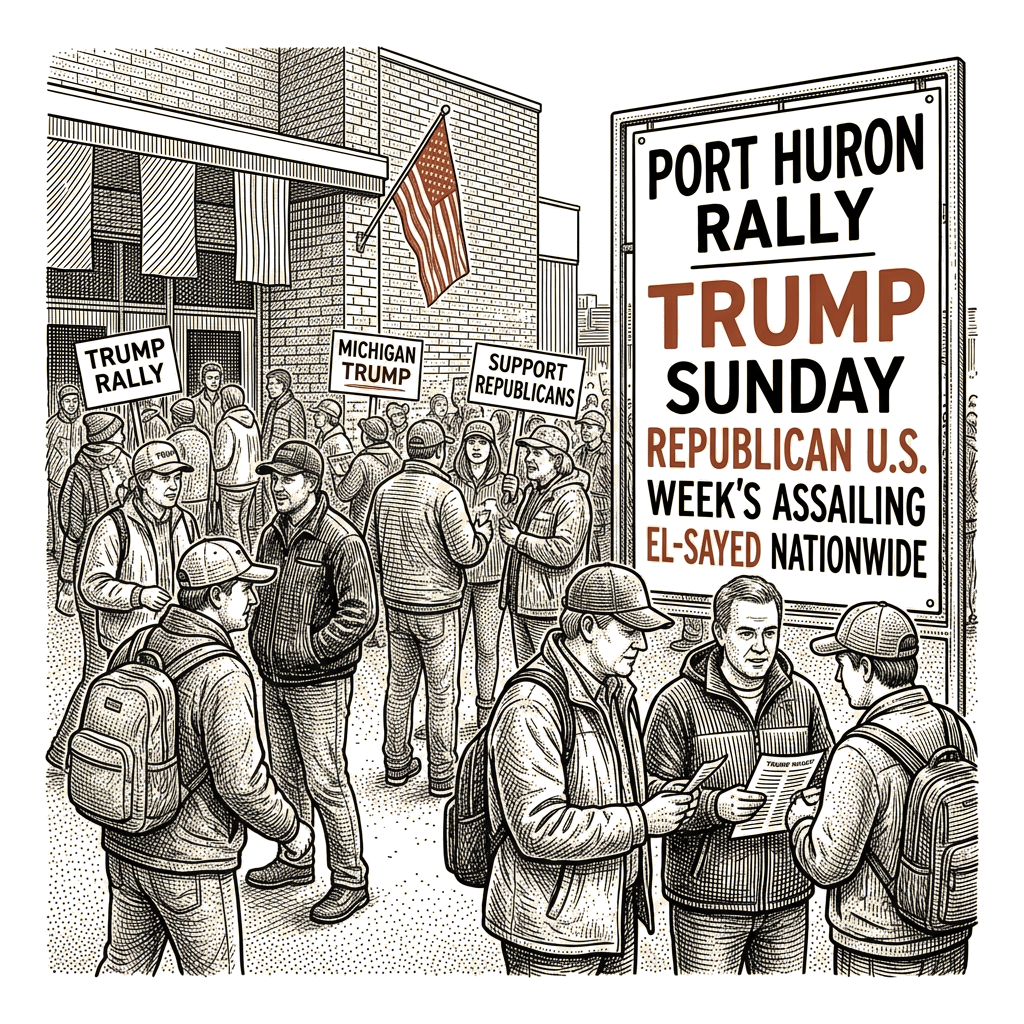
Abdul El-Sayed was born in the United States to Egyptian immigrant parents. He served as Wayne County’s public health official, ran for governor in 2018, won a divisive August primary for the Democratic nomination, and now stands for the Senate seat Gary Peters is vacating. If elected, he would be the first Muslim U.S. senator. Mike Rogers, a former congressman who lost to Elissa Slotkin in 2024 by less than a percentage point, is the Republican nominee seeking the seat Republicans have not won in more than three decades. On Sunday, President Donald Trump is scheduled to campaign for Rogers in Port Huron.
Apparently, fear is the message Trump and Rogers think can save this campaign. That is desperation dressed up as strategy. The phrase is my analysis, not a claim about anyone’s private motive; the public record supplies the arithmetic. Rogers has yet to win statewide. Republicans have not won a Michigan Senate race in more than three decades. Voters are carrying frustration with the economy and the war with Iran. The campaign’s answer is to make the opponent the threat.
The centerpiece is a falsehood. Trump falsely claims that El-Sayed belongs to the Muslim Brotherhood. He has also called El-Sayed a “jihadist,” called him “Mohammed,” and said he “goes back to the days of the jihad.” The administration’s January designation of three Middle Eastern branches of the Muslim Brotherhood as terrorist organizations does not make Trump’s allegation against this particular American citizen true.
None of Trump’s labels answers the question Michigan voters must answer: which candidate is prepared to represent them in the Senate. They are an attempt to prevent that question from mattering.
The final debate exposed the machinery without concealing it. Rogers asked, “Are you for America, or are you for these terrorist groups overseas?” El-Sayed called the question “shameful” and defended the First Amendment’s Free Exercise Clause, which protects religious worship as Americans choose. Rogers then insisted that his criticism was not rooted in religion and that people can “pray any way you want.”
The contradiction is the message.
Rogers says religion is not the issue while asking El-Sayed to answer for supposed terrorist groups overseas. That is a religious-political loyalty test built on Trump’s baseless Muslim Brotherhood allegation. The loyalty test is not incidental. It is the whole point: cast doubt over whether a Muslim American belongs to the United States, then demand that he disprove the doubt on national television.
The question was already the accusation. Loyalty to the United States was no longer the issue. Eligibility to belong in the American political community was.
Let me show you where that question runs into the Constitution. The First Amendment’s Free Exercise Clause constrains government action concerning religious exercise; the sharper fit for a candidate for the United States Senate is Article VI, Clause 3:
“no religious Test shall ever be required as a Qualification to any Office or public Trust under the United States.”
Nothing in the record shows a court adjudicating this exchange, and a candidate’s debate question is not itself a government-imposed qualification. But the civic breach is plain: Rogers asks a Senate candidate to satisfy a religious-political loyalty test that Article VI forbids the government to impose. The question asks Michigan to treat Article VI as optional.
For thirty years I taught in Evangelical Sunday schools and women’s ministries. I know how quickly a text can become a sorting mechanism. I also know my own failure: I taught the neighbor-love of Matthew 25 as private mercy and did not press it into public life.
Matthew 25:35-40 says, “I was hungry and you gave me something to eat … I was a stranger and you invited me in … I was sick and you looked after me … I was in prison and you came to visit me,” and concludes, “whatever you did for one of the least of these brothers and sisters of mine, you did for me.”
Read it plainly: Jesus puts concrete needs before his followers—hunger, thirst, strangersickness, imprisonment—and makes their response the measure of faithfulness. The passage places no religious test on the stranger.
Here is the chasm. Matthew 25 makes the vulnerable person the test of the disciple’s faithfulness; the campaign makes the vulnerable person’s religious identity the test of his political belonging. The Gospel says the stranger is the test. The operation says the stranger is the threat.
El-Sayed is not above scrutiny. After an attack on a synagogue in the Detroit area, he said, “hurt people hurt people.” The attacker had lost four relatives in an Israeli airstrike on Lebanon the week earlier. El-Sayed later apologized, said, “That was not my intention,” and insisted that he had not meant to justify the attack.
That acknowledgment matters. His words have consequences, and he accepted responsibility for his own. But there is a vast distance between a candidate mishandling his own words and Trump and Rogers weaponizing his religious identity. The Trump-Rogers campaign needs that distance because its political argument needs religion to perform work it cannot do on its own.
On the public record, the campaign has chosen danger over competence. The strategic conclusion is visible in the exchange: make religious suspicion the substitute for a positive case. The stakes extend beyond Nov. 3. An El-Sayed victory could give progressives evidence that their coalition can still persuade in a swing state and could shape the 2028 presidential primary before a single vote is cast in Michigan. That is strategic analysis, not a statement about Barack Obama’s purpose.
On Saturday, Barack Obama rallied for El-Sayed in Michigan and appeared for Democrats in Ohio. Trump and Rogers are trying to freeze the electorate around fear; El-Sayed’s supporters want to show that a progressive coalition can still persuade and win. The choice awaiting Michigan voters is between building the next chapter of American politics and demanding proof that a Muslim belongs to the country he was born in.
El-Sayed had already challenged Trump: “Donald, if you’re watching, don’t wuss out, man.” His bet was that a presidential intervention would expose the campaign’s weakness rather than cure it. That is a campaign judgment, and Port Huron will test it.
Whatever Trump says when he arrives, the campaign’s accusation is already on the record. Port Huron did not create it. The campaign built it, week after week, by taking El-Sayed’s religion and turning it into a measure of his loyalty. That is the accusation now placed before Michigan voters: save America from Islam.
Republicans have not won a Michigan Senate race in more than three decades. The question is whether one more appeal to religious fear can finally outrun arithmetic.
El-Sayed has a better answer: the country needs to “turn the page on Donald Trump.” Michigan can begin turning it on Election Day.