
Donald Trump’s war is making Adams County pay for his midterms at the pump.
As of Monday, the national average for regular gasoline stood at $4.29 a gallon, up from $2.98 before the war—a $1.31 jump. Diesel stood at $6.35, up from $3.76 in February, after topping $6 the previous month, a record. Nearly eight months into the Iran war, Donald Trump had found a form of leverage politics does not forgive: make the thing voters hate most more expensive, then promise to fix it after Election Day.
On the county roads outside my shop, diesel is a budget decision before it is a line item. Adams County’s highway department runs graders, dump trucks and snowplows. At $6.35 a gallon, the county can send more money to the fuel dealer or put fewer crews on roads that need grading, patching and snow clearing. More diesel means less road work for the same budget.
The Adams-Friendship Area School District makes the same calculation with its buses. It can pay the higher fuel bill, trim routes, take money from another budget, or pass more of the cost to families and staff. A county grader and a school bus both arrive somewhere only after somebody burns the diesel.
On a local dairy or row-crop farm, diesel enters before food leaves the farm. Milk has to move. Equipment has to run. The harvest cannot wait for an election result. That is what the national price shock becomes at the Adams County line: fewer road repairs, tighter school budgets and a farmer deciding which bill to pay first.
The cheap-gas promise came first. In his Feb. 24 State of the Union address, Trump bragged that gasoline was below $2.30 a gallon in most states and that he had seen $1.85 in Iowa. Nationwide, gasoline averaged $2.95, nineteen cents cheaper than a year earlier. Low fuel prices were a central pledge of his second presidential campaign. Four days later, on Feb. 28, he joined Israel in the attacks on Iran.
By March 12, Brent crude had climbed above $100 a barrel from roughly $70 in 2025. Trump’s answer was not to reduce America’s exposure to the shock. He celebrated it: “The United States is the largest Oil Producer in the World, by far, so when oil prices go up, we make a lot of money.”
The line had one advantage. It was true about the American producer. It was false about the American family. The producer made more when oil rose. Every family filling a tank paid for that prosperity.
Then came the long parade of moving deadlines.
On June 29, with Brent at $68 a barrel and heading lower, Trump ordered retailers to lower gasoline prices immediately and warned of “big problems” if they failed. Gasoline still averaged $3.86, down from more than $4.50 in May but still sixty-seven cents higher than a year earlier. When gasoline failed to return to its previous record lows, Trump promised the old prices would return soon.
None of these interventions solved the underlying problem. Each one conceded it.
On July 1, with Brent at $71.57, Trump predicted that fuel prices would soon return to their “Record Low Prices.” They did not.
By September, the war was escalating again and Brent had climbed past $101. Trump set the most politically revealing deadline yet: oil prices would not cool until “right after the election.” His earlier word was more exact: prices would tumble only after the midterms.
That was not an energy forecast. It was a campaign timetable. It was an admission that voters would have to wait out his war before they received relief.
At a North Carolina campaign stop on Sept. 16, gasoline averaged $4.37—$1.18 more than at the same point in 2025. Trump called the increase “a very inexpensive price to pay for what we’ve done.”
It was inexpensive for the president to dismiss it. For families, the price was higher at the pump, higher diesel bills for contractors and farmers, and another election-season jolt to a cost of living already at the top of many voters’ concerns. One estimate put the war’s added U.S. fuel cost at $107 billion. Families were paying billions more at the pump. The bill hit contractors running trucks and farmers moving a harvest.
October brought more political motion without corresponding market relief. Diesel averaged $6.28, only slightly below its September high of nearly $6.53. Commands, boasts and threats could not conjure barrels into the market.
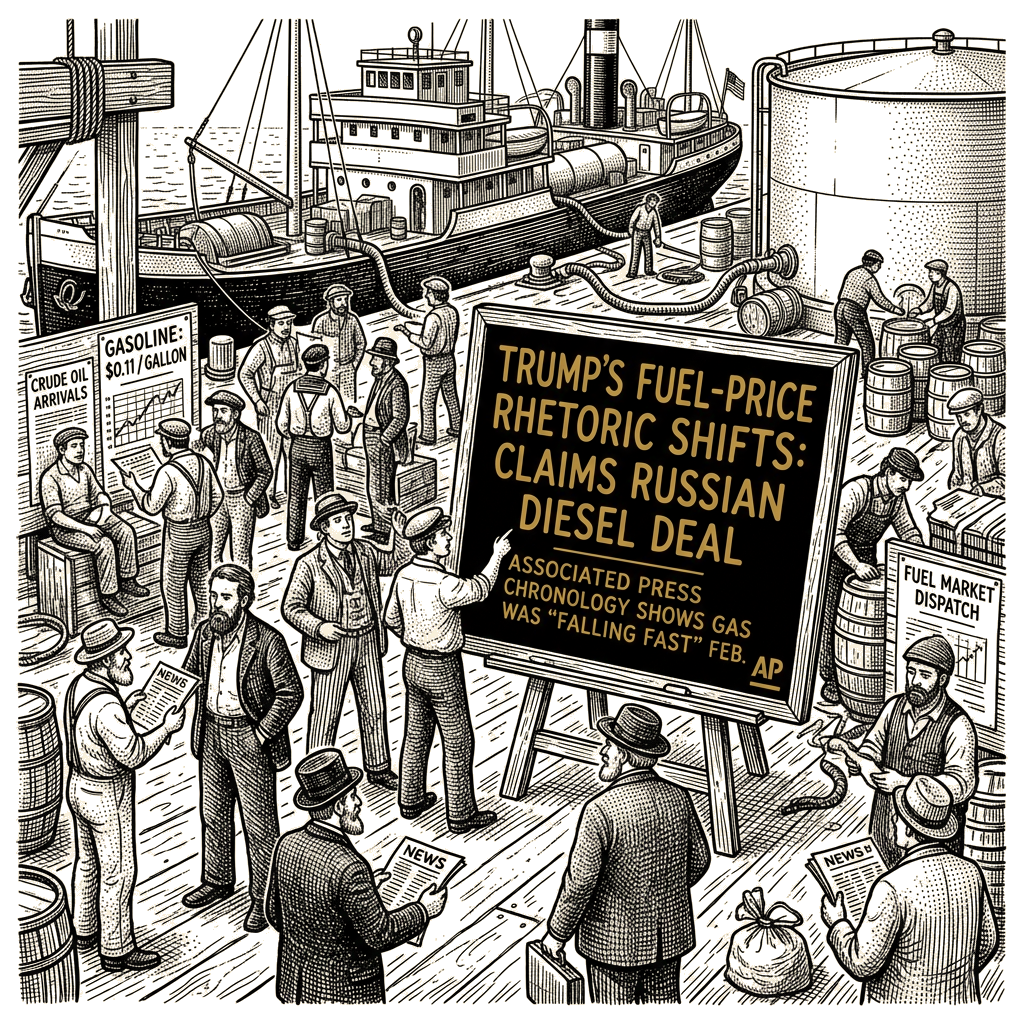
Trump said he had struck a deal to buy Russian diesel, reversing years of American pressure on Moscow over its war in Ukraine. At the same time, he continued to claim “TOTAL CONTROL” of the Strait of Hormuz even as traffic remained far below prewar levels amid threats of further Iranian attacks. Control that cannot carry normal commercial traffic is not control. It is a slogan.
By Oct. 6, the administration was weighing suspension of the federal gas tax, a desperate pre-election maneuver described in its own deliberations.
A gas-tax suspension lowers the pump price only if refiners and retailers pass the reduction through. If they keep the difference, motorists get another promise and sellers keep the margin. If they pass it through, every household buying gasoline gets some relief. But the proposal sends no check to Adams County or the Adams-Friendship schools. Neither collected that tax.
It also leaves less money in the federal Highway Trust Fund, which can weaken road funding downstream. It does nothing for the diesel price paid by the county highway department, the school district, farmers or truckers. It can shave the tax portion of the gasoline bill; it cannot remove the war premium that remains. That is not rural relief. That is national price theater aimed at a ballot.
Then came the farmer announcement. At a Kansas rally on Oct. 19, Trump announced a harvest fuel-relief program he claimed would provide $8 billion in support for farmers. Nationwide, diesel averaged $6.32, seventy-four percent more than the $3.63 paid a year earlier. Trump had already promised that diesel prices were “coming down, in record numbers.”
At the rally, he made relief contingent on Republican control: “When Republicans win, we will pass even more funding for our farmers.” He also asked the crowd to “pretend please that I’m on the ballot.”
Farmers do not suspend their diesel consumption until election results are certified. A working farm can use an eligible payment against a diesel bill, but only where the relief follows the fuel bill rather than the land title. A tenant whose payment goes to a landlord cannot use that money at the pump. A custom operator is outside the program. A county highway department and a school district cannot apply at all.
Unless the program changes the diesel price itself, it repairs one invoice and leaves the next harvest exposed to the same market. Conditioning more relief on Republican victory turns relief into campaign advertising.
The pattern is complete. Cheap gas was promised before the war. Higher oil became “making a lot of money” after prices spiked. Falling crude was supposed to produce immediate relief at the pump. When prices did not fall, retailers were threatened. When they still failed to fall, the deadline was moved beyond Election Day. Now the pitch is an $8 billion harvest-relief program plus the promise of even more funding after Republicans win.
The technique is responsibility displacement. Each price gets attached to Biden, global markets, Washington or the retailers, while the war that caused the shock is moved out of the sentence. Every new deadline, threat and announcement deepens the administration’s responsibility for the price voters see when they pull into the pump.
That is also the extraction Wendell Berry named in The Unsettling of America: decisions and money move out of a place while the consequences stay there. Here the money leaves through the fuel market. The road work and school budget remain in Adams County.
Republicans can try to make this about Biden. They can try to make it about foreign enemies, global markets or Washington. They cannot make the administration’s deliberations over suspending the federal gas tax disappear, the Russian diesel purchase disappear, or the difference between $2.98 and $4.29 disappear.
That is why Republicans cannot simply blame President Joe Biden for the economy. Biden can be blamed for the conditions Trump inherited. He cannot be blamed for the $4.29 gasoline and $6.35 diesel that followed the launch of Trump’s war. The timeline is brutally clear: the war began on Feb. 28, and the price shock followed. Trump cannot campaign as the victim of events he started.
On Nov. 3, voters will not be choosing between imperfect energy policies. They will be choosing whether to reward the party that promised control of costs and delivered a war-driven surge—or punish the party that made the president’s signature policy impossible to hide.
Oil did not tumble. Gas climbed. On Election Day, voters will take the receipts. Unlike Trump’s promises, they will add up. The pump will keep voting every day after that.