
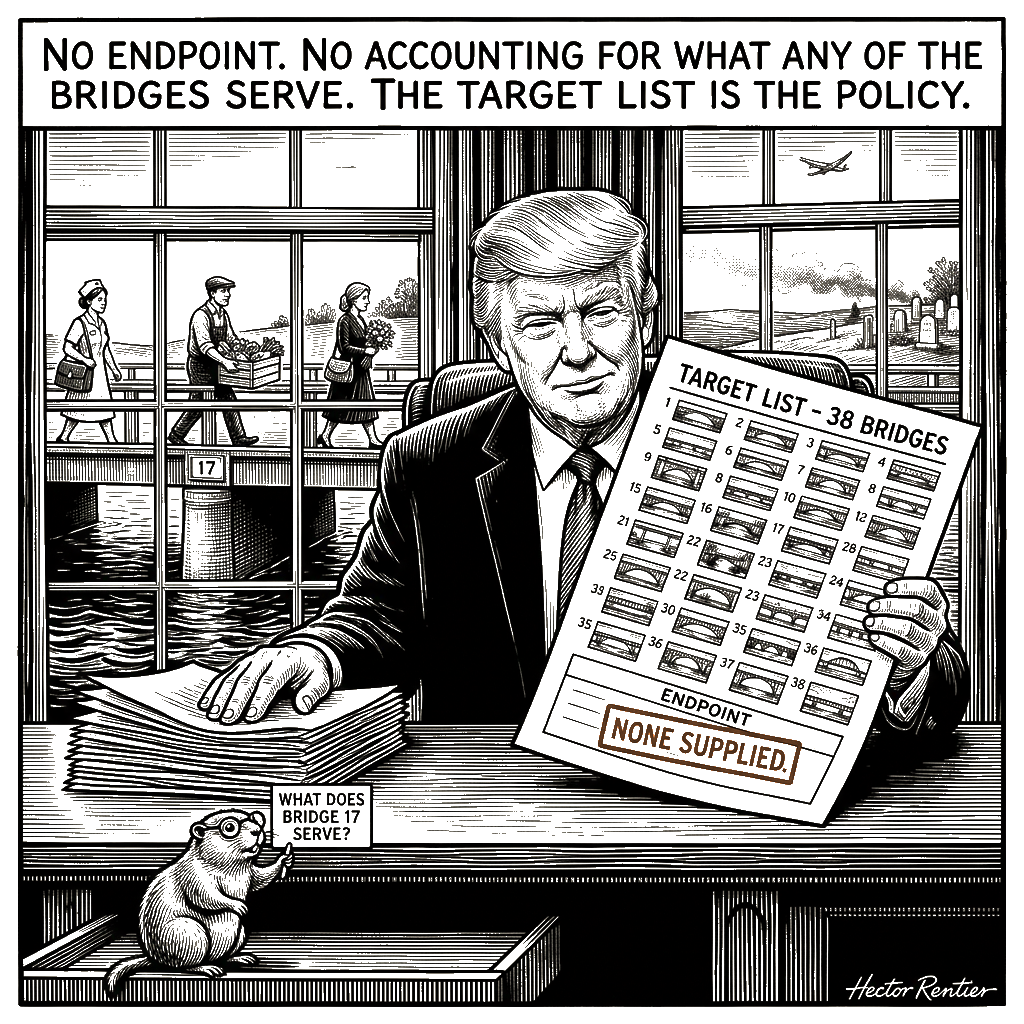
Trump and Rubio are killing people in a war they have no plan to end.
More than eight months into the Trump administration’s bombing campaign against Iran, Secretary of State Marco Rubio stood at Homestead Air Reserve Base in Florida, on his way to a Group of 7 foreign ministers meeting in Paris, and defended the war President Donald Trump launched to counter Iran’s nuclear ambitions. Rubio declined to comment directly on the election, but said the right thing to do for the country’s security might not be popular and was nevertheless necessary.
That much is fair. A genuine nuclear threat deserves a serious answer. What the administration has given the country is a war without an endpoint.
The International Atomic Energy Agency says Iran holds 440.9 kilograms, 972 pounds, of uranium enriched to 60 percent purity, a short technical step from the 90 percent associated with weapons grade. Iran has long maintained that its nuclear program is peaceful. The threat is serious. But the record establishes advanced enrichment, not an Iranian nuclear weapon or a decision to build one. The line between containing a nuclear program and waging war on a country has been erased. The military target is not a weapon. It is Iran’s ability to enrich uranium.
The 2015 Joint Comprehensive Plan of Action, endorsed by United Nations Security Council Resolution 2231, offered agreed limits and an inspection architecture instead of a bombing campaign. Iran accepted a 3.67 percent enrichment ceiling and a 300-kilogram ceiling on its low-enriched uranium stockpile. The plan required implementation of the IAEA’s Additional Protocol and gave inspectors access to declared nuclear material and facilities, including intrusive inspections. Its later breakdown proved how badly enforcement can fail. It also showed that an enrichment program could be bounded through negotiated limits and monitoring rather than settled by bombs alone. The hard part was enforcing the bargain. That is where the administration’s case for open-ended war fails.
Vice President JD Vance had already said it plainly: the war was the reason Republicans lost the midterms. Trump called that judgment right, with one correction. Vance should also have insisted that going to war was correct.
Then Trump gave the war his own measure. If he could do it again, it would “go down as one of the best things we ever did,” because “if they ever had a nuclear weapon, they would blow up the world.”
That sentence is the load-bearing wall of the entire justification, and it will not hold.
Thomas Schelling’s The Strategy of Conflict, Chapter 5, “Enforcement, Communication, and Strategic Moves,” explains that deterrence is not a weapon you own. It is a relationship between actors who can destroy one another, and the power to constrain an adversary comes from your own power to bind yourself. The historical record on what that relationship did is not ambiguous. The two superpowers built the largest nuclear arsenals the world had seen, aimed thousands of warheads at one another’s cities, and held that posture for four decades without a shot. What held was not the weapon. It was the commitment behind it, and commitment is the part that cannot be assumed.
Which is why the sentence about the world ending proves too much. Possession of a nuclear weapon does not bind the hand that holds it. What binds is the knowledge that the other hand can answer, and that requires an enforceable political settlement. The likely future is not the end of the world by design. It is a region where a nuclear-armed Iran and a nuclear-armed Israel are each newly afraid, each newly able to lose everything, and each dependent on the other for a restraint neither can guarantee. A sentence about the world ending does not make the case for a war. It makes the case for a permanent presence in the Gulf, which is a different proposition and a different bill.
The deeper problem is not the nuclear claim at all. It is what the war is pointed at.
“Countering Iran’s nuclear ambitions” is not a military objective. You cannot bomb an ambition. Enrichment happens in buildings, and buildings can be struck. Ambition is what a government decides, and governments change their decisions through pressure and negotiation.
Clausewitz, in On War, Book I, Chapter 2, “Purpose and Means of War,” ties the political object to the military object and means. Here the political object is preventing an Iranian nuclear weapon. The military object has become 38 bridges, a blockade of Iranian ports, a commercial ship the United States says was trying to breach that blockade, and limited strikes on Iranian air defenses. A bridge can carry troops. A list of bridges cannot answer the nuclear question.
Michael Walzer wrote Just and Unjust Wars in the ordinary moral language citizens already speak. In Part One, “The Theory of Aggression,” he asks whether a resort to war had just cause, right authority, right intention, last resort, proportionality, and reasonable hope of success.
Last resort asks whether every other means was tried and failed before the first shot was fired. I am not going to pretend the record before me settles that prewar question. What it does show is a war whose author cannot say what victory looks like or when the killing stops. Conduct is judged separately from cause, even a just cause. Force belongs on combatants and military objectives, and civilian harm cannot exceed the military advantage claimed. You do not get to skip that question by winning the first one. A just war must also end in a just peace, and what is on the table this week is a list of demands, not an agreement to stop the killing.
Reasonable hope of success asks whether the war can achieve its stated aim. Right intention asks whether the war is directed toward a just end. The missing endpoint does not settle the first question. It proves the second failure. Eight months of fighting without an endpoint is indefinite force substituting for policy. That does not pencil out as foreign policy.
Here is what the means look like on the record. The United States is running a naval blockade of Iranian ports. Last Saturday, American forces fired on and disabled a commercial ship the administration says was trying to breach it. Over the past week, the military carried out limited strikes on Iran, including against its air defenses, at least twice.
And in the same phone interview with CNN on Sunday, the one where Trump said a strong agreement would make renewed strikes “highly unlikely,” the President said the United States had identified 38 bridges as infrastructure targets to strike if military action resumed.
Thirty-eight bridges.
A bridge is what a person crosses on the way to work, to market, to a hospital, or to the graves of his family. The President has not told the country what military service any one of those 38 bridges performs. Until that accounting is public, a list of bridges is not a nuclear strategy. It is pressure aimed at a population, and the population gets to work out for itself what happens to the roads that cross them.
A blockade is not a speech act. An effective blockade may be enforced against a vessel trying to break it by force, but the government that fires has to show that the blockade is lawful, that the vessel was doing something it prohibits, and that the force used was necessary and proportionate to the ship’s conduct. Whatever was in that hold on Saturday, the United States reached for the gun first, and “defensive” covers a great many things except the question of whether the force was necessary and proportionate.
Meanwhile, there is the gap everybody keeps stepping around. The Associated Press reported that the administration has no clear strategy for winding down the conflict. So the list of bridges is not one item inside a plan. It is the plan.
The chief mediator, Qatar, has been carrying proposals, and Iran is reviewing them. Iran’s stated conditions for a ceasefire include ending the U.S. blockade on Iranian ports, lifting sanctions, unfreezing Iranian assets, compensating for war damage, and ending hostilities throughout the region, including Israeli operations in Lebanon.
Some of those terms are ones no American president will sign. Some are ones I would not support either. But a list of terms is what a negotiating position looks like before anybody decides to sign something. Rubio’s answer was that Iran’s demands were “not just unacceptable, but in some cases outrageous and ridiculous and really not realistic.” A negotiating position got dismissed as unrealistic, and a war got drafted in its place. When the man who started the war cannot say what a good outcome looks like, the war has no off-ramp. A war with no off-ramp cannot end in peace because there is no condition anyone has agreed to.
Then there is the question nobody at that press conference wanted to hear: who is doing the work? The blockade is worked by sailors on rotation in the Gulf. The strikes are flown by crews who had no say in the decision. The recruiting record of the post-9/11 volunteer force has been documented at the same level of detail as the Vietnam-era draft. These cohorts came disproportionately from rural and small-town communities and working-class economies, and in some of those towns the recruiter’s office in the strip mall was the only door to the GI Bill. The cost of this war is being discussed as fuel prices and polling numbers while the people carrying it never got a say in it.
There is a 1970 Creedence Clearwater Revival song that put the arithmetic of this country’s wars in one line: the men sent to fight are not the men whose fathers run for office. John Fogerty has told the story of writing it after attending a White House wedding in 1969, where the people deciding the war’s meaning were talking about who would be sent to pay for it. Nothing about Iran has changed that arithmetic, and nothing about Iran was going to.
From where I sat in the gunner’s seat in an Abrams in Baghdad in 2003 and 2004, what reached my family’s kitchen was never the strategic argument. It was the phone calls.
On Tuesday, Democrats took control of Congress. The Associated Press reported that the war’s unpopularity, the gasoline prices, and the damage to the wider economy helped them do it, and that voters blamed Trump’s policies for hurting their finances. One-fifth of the world’s oil transited the Strait of Hormuz before the war. Close that waterway and much of the oil market reprices. Gasoline prices at home go with it, and every political argument about the war gets harder to win. The President weighed new strikes on Iran after the midterm loss, and by Sunday he had 38 bridges on the list.
The election stripped the war of political cover. It did not settle the legal or strategic defects, and it supplied no endpoint. A war without a defined end consumes fuel, money, and lives without telling the country what victory is. That is the strategy the election exposed.
War always keeps two ledgers. One belongs to the men and women in uniform and the civilians caught in their path. The other belongs to the officials who decide that their sacrifice is necessary. This war has made the second ledger too heavy.
The Constitution gives Congress the power to declare war, raise and support the armies, make the laws that govern them, and control the purse. Congress should use its war-powers and appropriations authority to refuse further strikes until the President submits the proposed agreement, inspection regime, legal basis for the war, and fixed endpoint. Any authorization should carry a specific termination date, regular reporting requirements, and an automatic end to strike authority on that date. War powers are not a blank check because the politics are hard. If the war is necessary, as Rubio says, it can stand that scrutiny, publish the terms that end it, and take the vote in public.
Thirty-eight bridges are on Trump’s list, and the war still has no endpoint. Until the last day exists, the target list is the policy. Trump should bring Congress a peace, not another target list.