
Trump and Hegseth are killing Iranians and calling it strategy.
The war is eight months old, and the killing part is not in dispute. Friday evening brought reported explosions on Qeshm Island, in the Strait of Hormuz, and a U.S. official described them as small-scale strikes, part of several in recent weeks that officials are careful to say do not signal a return to full-scale combat. In the briefings, though, the men on the war side of the table are not whispering about it. Defense Secretary Pete Hegseth and Adm. Brad Cooper, chief of Central Command, the Tampa headquarters that runs the American war in the Middle East, have urged the president back to major combat operations: strikes on Iranian energy infrastructure, nuclear facilities, and missile and drone arsenals. Their stated case is that more war is the only way to make Iran surrender its nuclear material, and U.S. officials say the Pentagon “stands ready to execute his orders swiftly.”
The hardware is already moving. The carrier Theodore Roosevelt is steaming toward the region from the Pacific with dozens of fighters aboard, a port call in Singapore and better than two weeks from the Gulf. A Marine expeditionary unit, a ship group built to put troops ashore, joins the roughly twenty other ships already operating there later this month. The preparation that institution has put on the record is preparation for more war.
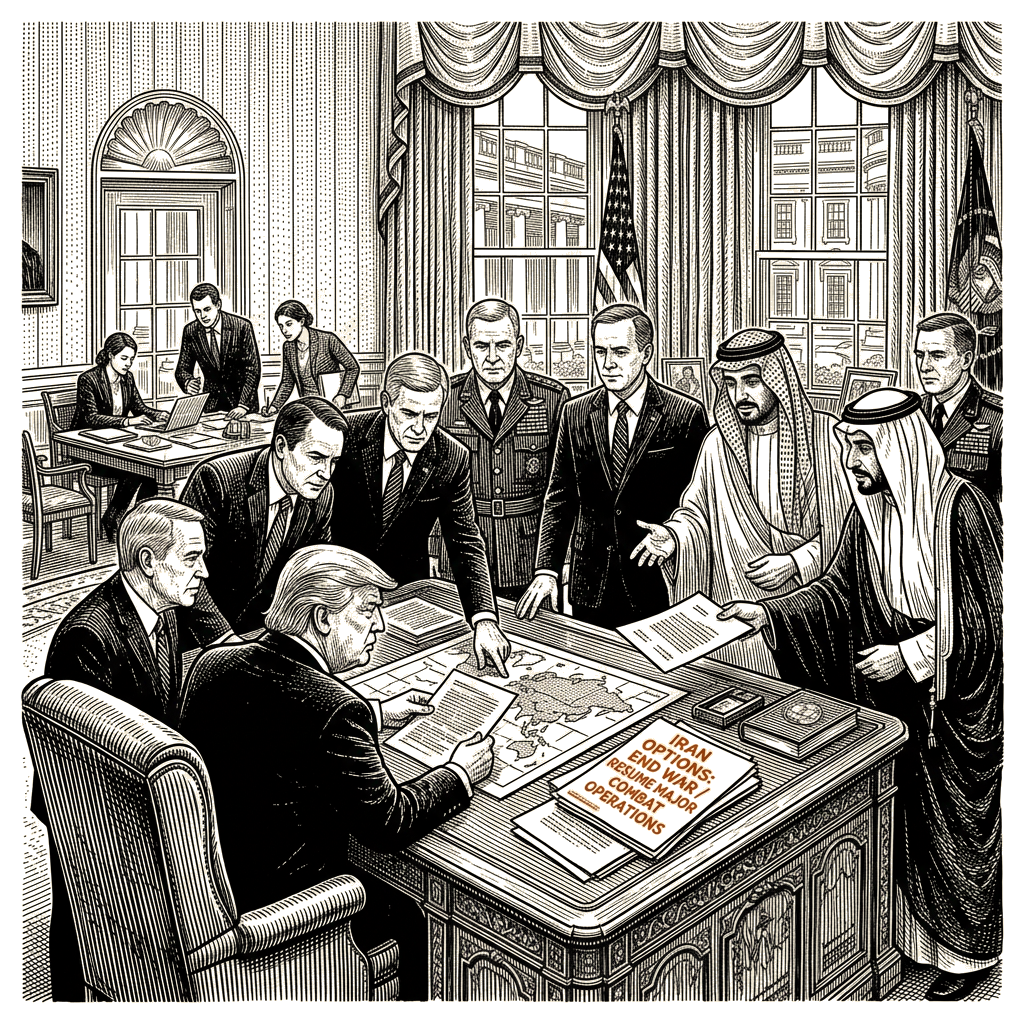
Now read the menu the counselors are arguing over. Vice President JD Vance, who questioned on social media whether the war was worthwhile and before that post told the president he intended to blame the Republican defeat on the war, wants the diplomacy kept alive, and so does envoy Steve Witkoff. Secretary of State Marco Rubio and Treasury Secretary Scott Bessent argue for the middle course: tighter sanctions and the blockade held. Other outside advisers have called since Election Day to say the president’s legacy depends on forcing Iran to surrender its nuclear program. Benjamin Netanyahu wants renewed strikes. The Qataris launched an eleventh-hour effort to head off another operation, and their prime minister, Sheikh Mohammed bin Abdulrahman al-Thani, said it plainly at Oxford: “Our mediators are working as we speak to avoid another wave of escalation in the region.” The president’s own words have him standing in both rooms at once: “I would rather not destroy the rest of the country if possible, but maybe I will have to.” Notice what is missing from the list. Not one course under discussion in Washington ends the war. The course labeled the middle path, sanctions and blockade, is the same war at a slower kill rate, and Gregory Brew of the Eurasia Group stated the arithmetic on the record: holding the status quo means “continuing the war for the foreseeable future,” with oil prices high and attacks in the strait the new normal. Nobody in that room is deciding whether this war continues. The question under debate is how fast.
To be fair to the men urging him on, they hold a real argument about exits. Officials have told the president that if he signals an intent to get out, Tehran could press for more at the table or make a run at seizing the strait, and Seth Jones of the Center for Strategic and International Studies asked the honest version of the question: what do you choose that is the least bad option? Concede all of it. An exit has a price. Then ask what the price is a price of. Carl von Clausewitz put the first rule of the trade in On War, Book One: war is the continuation of politics by other means, and a campaign is judged by the political object it serves. Name the object here. It is not the security of the United States, which eight months of bombing has not purchased; the government in Tehran has survived the whole war. It is not even the nuclear file, since the campaign the briefers promise cannot even resume until additional equipment arrives later this month. The object on the record is a legacy. You cannot bomb a legacy into existence, and the same reporting that shows Hegseth and Cooper urging more war shows White House officials and lawmakers in the president’s own party blaming the defense secretary, the Journal reported, for convincing the president that this war would be over in a few weeks.
Nothing about this fork is new, and the record shows how the last one went. In June, Trump weighed the all-out option and chose the talks instead. In September, Iran put a seven-day ceasefire on the table and the administration turned it away while eyeing strikes timed for after the election. Now, I’m just a simple man, but I can read a calendar. The off-ramps were declined on a schedule. The election came, and the election said stop.
Barbara Tuchman spent her career on governments that persist in policies contrary to their own interests after the better course has been named to them, and the checklist in The March of Folly reads like it was drawn for this week. Contrary to self-interest? Suzanne Maloney, an Iran expert and foreign-policy vice president at the Brookings Institution, says the options available to Trump will likely only compound the strategic and economic price that Americans have already paid, and the one being called the path of least resistance, keeping the blockade and the strait attacks as the permanent arrangement, is a commitment to keep the war going indefinitely and pay for it at the pump. An alternative named at the time? Two of them, in public: the September ceasefire and the two-day Doha track sitting there now, the compressed timetable that could give the president a face-saving way to begin winding the war down, with Iranian officials due back in Doha in the coming days. Whether Iran would take it is an honest unknown; that it is on the table is not. A group choice rather than one man’s ruin? It is a whole council, with advisers calling to say his legacy depends on forcing a surrender. Persistence past the evidence? Eight months of blockade and bombing without one, a president conceding he is paying a political cost and promising he would do it all again, and the same defense secretary who talked him into a few weeks now offering him one more wave. The counsel to “finish the job” is saying, in plain terms, that eight months and one more wave was the answer all along. Months of toggling is persistence by any dictionary, and the group holding it is the room itself, each faction pushing its own tempo of the same war. That does not pencil out on any ledger the record shows.
Andrew Bacevich, a retired Army colonel who has written the running autopsy of this posture, named the operating system underneath it in Washington Rules: the settled conviction that the United States must lead the world, and must do it with the military, a conviction that outlasts elections, administrations, and now apparently a repudiation at the ballot box. Watch it run. Behnam Ben Taleblu of the Foundation for Defense of Democracies says the president should “hold the line,” and holding the line means keeping the blockade, which means keeping the war. The record of what eight months of that winning hand has bought is a government still standing, an economy strangled on one side, high oil on the other. The president told reporters he had “no choice” but to pay the political cost, and that “if I had to do it again, I’d have to do it again,” because “long term, it’s the only answer.” A man who says he would do it again is not describing a decision. He is describing a habit, and the habit has a schedule.
Clausewitz split war into three currents, and one of them is the passion of the people, the current that carries a fighting state when the treasury and the general staff cannot. This country’s current moved through the ballot box four days ago. A war carried on past its political object, against the expressed will of the people who pay for it, is not strategy. It is violence with the governor off.
Now say plainly what the courses do to people. A blockade is not a naval posture; it is a slow weapon aimed at an entire economy, and the people inside the economy eat first. Be clear, too, about what “major combat operations against energy infrastructure” means in the plain nouns the briefings skip. Energy infrastructure is the grid, the refineries, the fuel. It is what civilians cook with and what hospitals run on, and the country’s economy is already sputtering under the blockade. Michael Walzer built Just and Unjust Wars on the discrimination principle: soldiers may be fought, civilians may not be targeted, and harm to them must answer a real military need in proportion or it is murder with the paperwork filled in. A campaign aimed at a country’s energy life is aimed in full knowledge at the civilians who live on it, and a campaign whose theory of victory is that a country will surrender when life becomes unlivable does not graze that line. The civilians are the mechanism. That is what “calling it strategy” means, and it is the part of the record nobody in the Situation Room has put in a chart. The ledger runs both directions across the strait, too, because Iran has threatened to widen its retaliation beyond the Middle East, which places the Patriot air-defense crews in Israel and the sailors on roughly twenty American ships inside the same accounting. Personnel have already been pulled back from bases judged vulnerable to Iranian retaliation, which is the Pentagon’s own arithmetic about what comes next.
And the people who will carry whichever course he picks are not in the room. They are on the ships: the young hands on the hulls already in the region, the air crews on the Roosevelt, still at least two weeks out, the Marines of the expeditionary unit due later this month. Their fathers and mothers run brake shops in towns like mine. The people deciding their use run briefings in Washington. The men and women aboard those ships never got a vote on whether this goes on. Creedence Clearwater Revival had the number more than half a century ago in “Fortunate Son”: the men sent to fight are not the men whose fathers run for office. The customer-waiting-area version of that ledger is visible at my shop this month, where men bringing trucks in are doing war math at the pump, because oil prices are high, and the one course the analysts price out loud, the blockade held, keeps them there.
From where I sat in the gunner’s seat in Iraq in 2003, I heard this briefing before: the air campaign will break their will, the war will be short, the surrender is imminent. The will did not break. Nobody asked my crew whether the war should go on. We were the instrument, not the hand, and the years after the mission was declared accomplished were ours to carry. The war ran years past the charts, and the men around me paid the difference in the currency briefers do not carry. Somebody will carry the years after this one too.
The Constitution put the power to begin war in Congress, not in the Situation Room, and the reason underneath the clause is older than the clause: a decision this heavy was never meant to sit in one man’s hands. If this war is worth what its advocates say it is worth, put it to a recorded vote, every name attached; if it cannot pass that vote, it cannot pass as an order; and if the two-day track in Doha closes a real settlement, ratify it the same way, so that ending the war stands on the same constitutional ground as continuing it. If the president will not ask for that vote, the refusal is the answer.
The numbers were on the table Thursday when the president told reporters, “Now we will make a decision,” and, “You’ll know soon enough.” The Doha track needs two days. The carrier needs at least two more weeks. The election that said stop was four days ago. Between those three dates sits every death the president’s next order buys. Eight months of bombs, a strangled economy, high oil, a repudiation at the ballot box, and a carrier group still sailing toward the choice. Trump and Hegseth are killing Iranians and calling it strategy. The voters called it something else on Tuesday. The only course left that is not a lie is the one nobody in that room owns: stop.