Talia is the 49-year-old scanner hand at my Meridian Benefits Center outside Wichita, and I built the line so fast that her thumbnail opens every morning. I keep $0.38 on every completed packet. It buys index cards for my desk, not the relief worker who would give Talia a pause between households. The can of beans in your pantry came from a benefits file Talia’s scanner kept open. You paid for those beans. Your can bought her hand at the scanner. I want you to see the whole invoice, because you’ve been reading only the label. May God bless your full pantry and your unexamined record. Michael Greibrok’s National Review column on noncitizen voting and welfare-office registration reports that welfare agencies processed more than 1.5 million voter-registration applications from 2018 through 2020 and explains the federal rule requiring public-assistance offices to serve as voter-registration agencies. The warning is correct. I built the arrangement into my form.
I’ll make this gentle. You don’t feel better by calling it cruelty. You won’t feel better until you can count it. I promise. I’ll show you where the fee enters. I own the Meridian Benefits Center outside Wichita. I don’t own that historical paperwork, and I don’t need to. I own a current version of the arrangement the column describes. According to the column, the benefits side is checked for eligibility on the back end, while the registration side isn’t checked against citizenship records. My contract turns my center into a designated registration site. That gap isn’t a squeaky hinge in my operation. It’s the axle.
I didn’t discover the trick. I improved the throughput. Pair the benefit form with the registration form on 1 clipboard. The state pays for the benefit packet. The registration rides along without another invoice. My auditor’s worksheet asks only whether the packet closed. A closed packet earns payment. An open packet sends me back to the household. Nothing in the worksheet asks whether the registration belongs on the roll. The register becomes a list. I own the list.
Who’s the customer? The state. The household gives me the labor. The state gives me the fee. You don’t have to call it anything. I keep the difference.
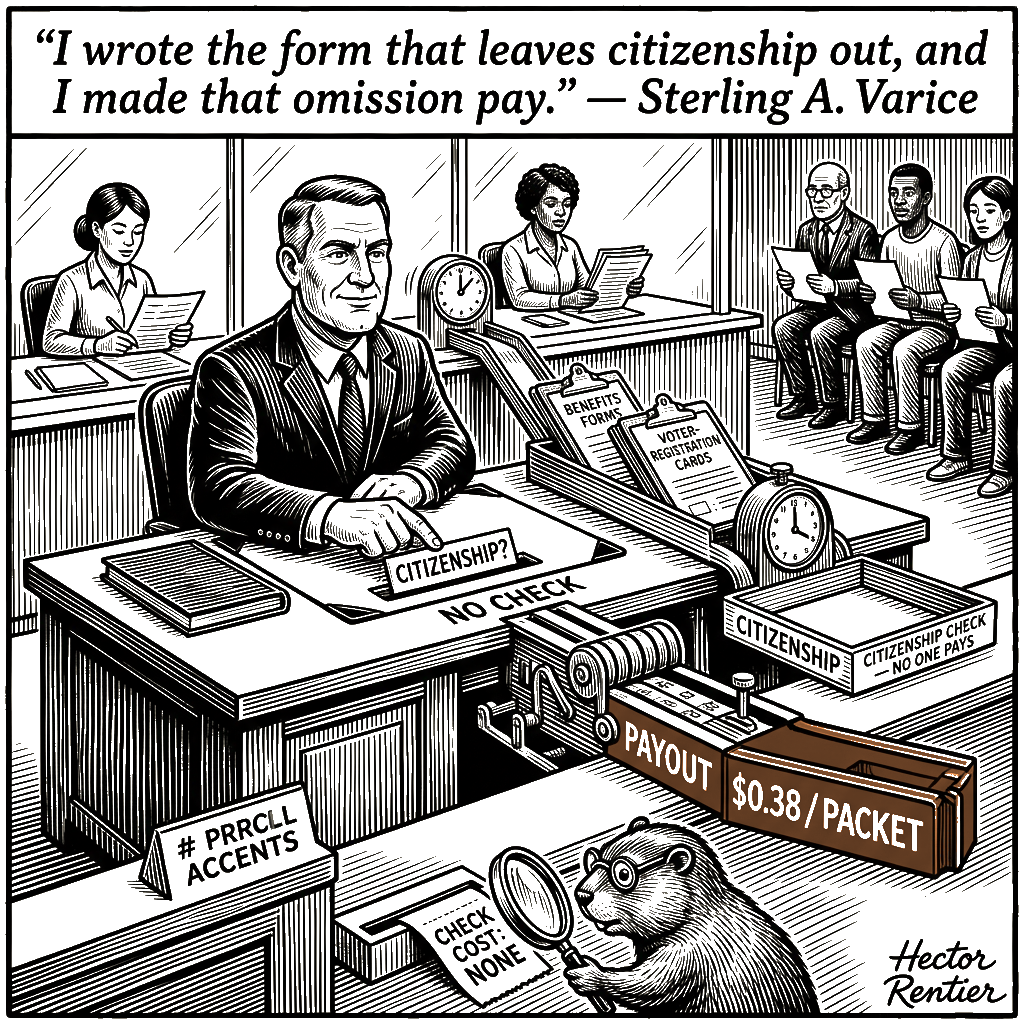
At my Fresno site, Estelle is a body on the intake line of the county benefits office I own outside Fresno. Estelle is Talia with a keyboard instead of a scanner and the same form beneath her hand. She keys every application. I wrote the form that leaves citizenship out, and I made that omission pay. No one asks whether a person receiving food assistance can vote. That isn’t an oversight. It’s my design. I file the blank field under Psalm 32:1: the question is covered, and so is my margin. You paid for her hands. If you don’t carry a food-assistance card, you paid for the chair, the printer, and her training. My contract pays for completed determinations. The voter-registration seconds ride along without a line item.
The first useful question: who pays for the citizenship check?
No one.
That isn’t an oversight. It’s a budget decision.
What happens when the applicant says yes? Estelle slides the card across. The machine stamps it. No one in my office compares the name with a citizenship record. Read that twice. My form gives her nothing to compare. Estelle isn’t hiding a crime. The form absolves her because I wrote it to absolve her.
Then what do you get?
A clean file. My margin.
What would it cost to make the check honest?
Another panelist.
Here is my arithmetic, because you may not trust arithmetic you haven’t been taught. I value her unpaid time at the federal minimum wage of $7.25 an hour. There are 3,600 seconds in an hour. The value of each unpaid second is $0.00201388. I round down. I don’t add the position. The form costs less because Estelle’s unpaid time costs less. That is my profit. I hardly count it. I enjoy this part of the lesson because a moral question now fits inside a staffing spreadsheet.
At my Modesto site, Beatriz is Estelle one rung farther along the same ladder. Her hand has begun to close. She doesn’t file a claim. She trains the new intake panelists to make the card sound like a favor. Her replacement makes the same $0.38.
You’d like to blame the administrator. Better ask who teaches the administrators.
At Warden University, I am Dean of Instruction. My textbooks tell eligibility managers to find the question that creates exposure and remove it. My graduates now staff benefits offices. One of them rewrote a benefits-office intake screen so the citizenship question vanished beneath the household-size box. The best of them run the subtraction faster than I do. I am proud of them the way a teacher is proud of a clean proof. Each new form is another edition of the textbook.
The counter was only an example.
The maker of the form decides what the form is allowed to ask.
That authority is old.
“Has God the right to do whatever he wants? Why does he still find fault? Who resists his will? Does he not have the right to do what he wants? Or does he not have the right to choose what kind of mercy to show?”
— Romans 9:21, New Revised Standard Version
The verse asks whether power may choose. I chose. The arrangement isn’t new. The clipboard is new. The state calls the pairing assistance and registration. I call the pair a customer. The potter’s question has moved from clay to policy, but the hand hasn’t changed. The county receives a clean file. Estelle gives the seconds. I keep the margin.
Don’t blame my clerk. That would be too easy. Need creates a record, and the record creates a market. Federal law supplied the pairing. My contract supplied the queue. You supplied the public money that keeps the counter open. Talia supplied the hand. Everyone contributes except the person whose status becomes my margin. Power didn’t begin with my contract. I only made the queue run faster.
By winter, the card will be generated from the application before an employee sees the applicant. The citizenship field will stay blank because blank fields cost less. I don’t ask where the names go after the file closes. That arrangement makes my mornings pleasant. I am finished with my morning before the line reaches my desk.
By spring, there will be a touchscreen at each desk. I will have eliminated 1 salary. Each application will lose 6 minutes of conversation. The receipt will print. The lobby will be quiet, and I’ll own the quiet.
By midsummer, the lobby will empty by noon. I won’t ask where the applicants went. The screen will be green in my office, and I’ll keep the blinds open.
At closing in Fresno, Estelle’s right hand won’t close around the pen. Beatriz has trained the replacement before Estelle leaves. Her daughter waits beyond the glass. Estelle passes the card through the slot. Her daughter takes it.
Estelle’s hand stays open.
At 11:16, Talia’s thumbnail opens along the old split. I hired no relief worker for her. The next file is on the pad. It carries 2 forms. Talia’s bandage is soaked through. Your can joins the others. I stamp the file and keep the $0.38.
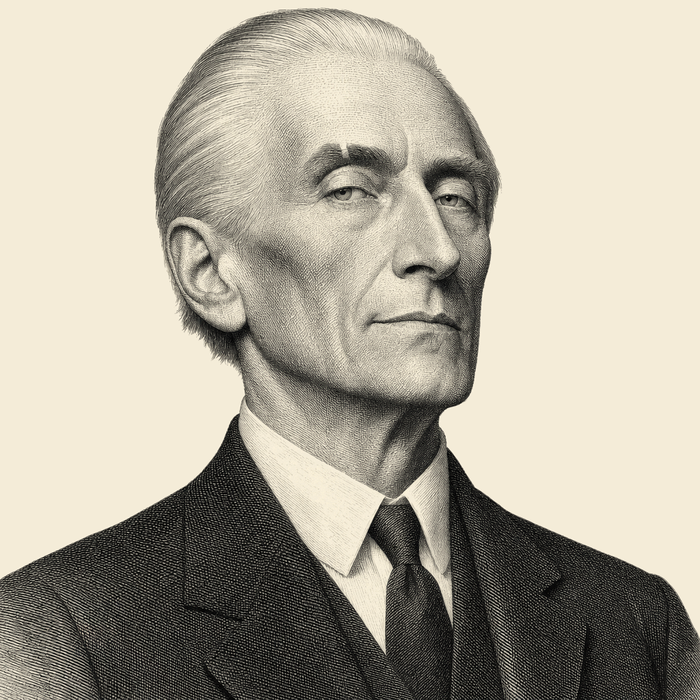
Sterling A. Varice holds the Hayek-Friedman Chair and serves as Dean of Instruction at Warden University’s College of Business and Economics in Richmond, Virginia. He is the author of three textbooks: Divine Mandates for Labor Utilization, Social Obligations for Profit Maximization, and Calibrated Deprivation: A Manager’s Guide to Employee Motivation.