The market has already made its decision. The Federal Reserve has not.
Futures prices show almost no chance of a quarter-point increase when policymakers conclude their Oct. 27-28 meeting on Wednesday. A hike would lift the key rate to about 4.1% from about 3.9%, so the expected result is a hold. The vote itself may be less settled: many watchers expect two or three dissents among the 12 officials who vote on rates, with Cleveland Fed President Beth Hammack and Dallas Fed President Lorie Logan considered the most likely to favor a hike. A 10-2 or 9-3 hold would be less a settled decision than an institutional stress test.
Three weeks ago, the September minutes stopped short of urging an October hike. The September decision those minutes described had been unanimous. Now the disagreement is back—and potentially larger. A 9-3 outcome would echo the earlier 9-3 hold that produced the first three-member dissent in a decade, while even a 10-2 hold would put two votes on record for another increase.
The dissent would carry real weight because the substance is there. Inflation has come in hotter than expected for two consecutive months. Inflation has not been at the Fed’s 2% annual target for a single calendar quarter since the final three months of 2020. Diesel fuel reached an all-time high of $6.53 in late September and remains prohibitively expensive at $6.35, feeding higher costs for shipping, groceries, cars and countless other goods. Hammack and Logan have argued that policy is not restrictive enough. Their votes would be warnings that a hold postpones the inflation fight rather than end it.
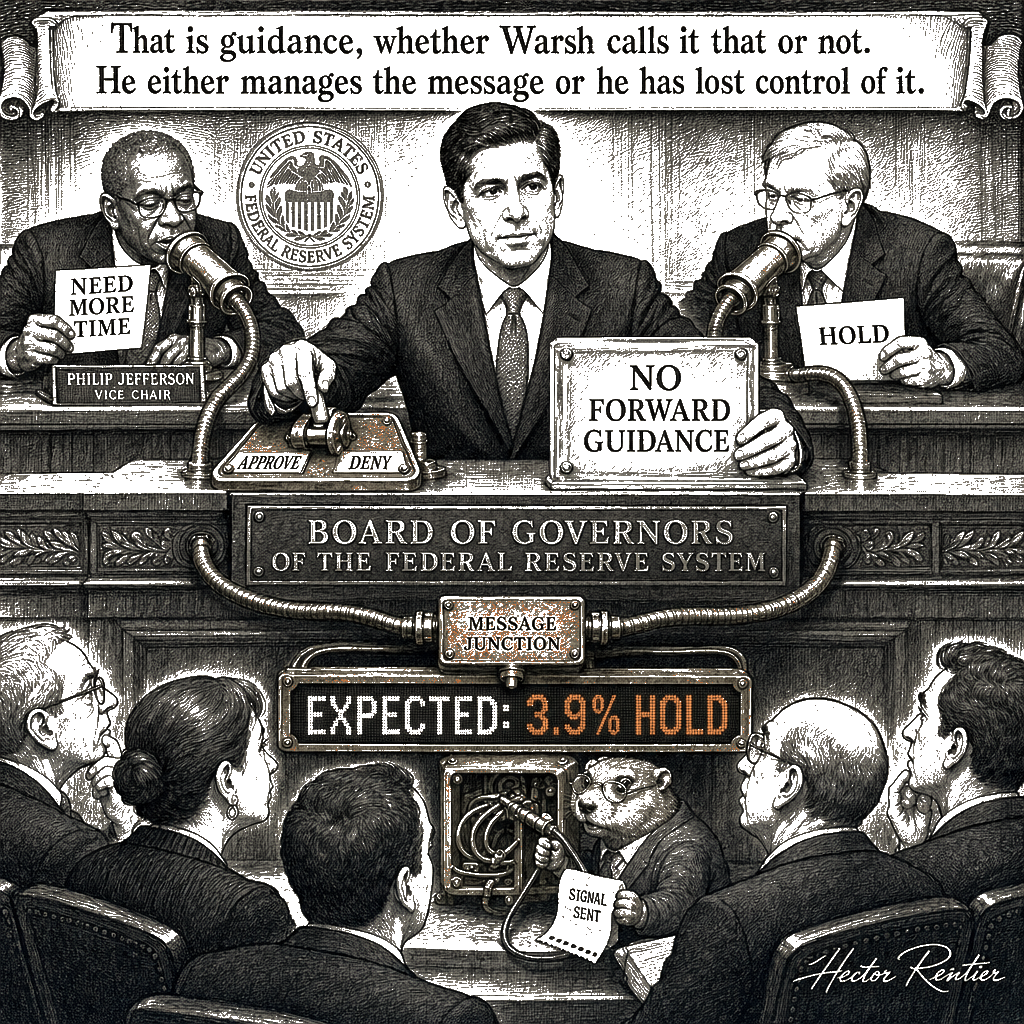
That brings the contradiction inside Kevin Warsh’s chairmanship into sharp focus. Disdain for “forward guidance” is one of his signature positions: clear signals about the central bank’s next moves commit the Fed to a predetermined path and limit its ability to respond to incoming data. Yet his top officials have gone public to make an October increase less likely. Board Vice Chair Philip Jefferson said the Fed would need more time to reach its own judgment. Other officials have reinforced the message.
That is not neutral institutional chatter. It is guidance, whether Warsh calls it that or not.
If Warsh approved this message, his doctrine is rhetoric. If he did not approve it, his own committee has spoken past his doctrine, leaving the Fed without a common institutional voice and leaving markets to infer a move its chair has not blessed. There is no version of this in which the Fed speaks only through its chairman while the chairman preserves total deniability. He either manages the message or he has lost control of it.
The politics make the contradiction worse. Wednesday’s meeting comes six days before midterm elections shaped by affordability concerns. The average 30-year mortgage rate reached a three-year high of 7.4% earlier this month before slipping to 7.32% last week, compared with just under 6.2% a year ago. Oxford Economics estimates this year’s sharp rate increases have put home buying out of reach for another 5 million households. That gives a pre-election hold an obvious political constituency, but it does not make inflation disappear.
President Donald Trump had said before choosing Warsh in January that he would only select a Fed chair willing to cut rates. Warsh instead raised rates in September against the White House’s preferences, buying credibility with the idea of an independent chair. Trump has since renewed his effort to remove Fed Governor Lisa Cook, which could open another board seat for him, and said he had called Warsh before the September meeting and told him he “might as well” vote to raise rates. That pressure does not make every dissent political. It does make the chairman’s control over the committee more important, not less.
Two hawkish dissents would also give Warsh a ready-made route for future tightening: the committee itself would be pushing rates higher. If he holds now, he can point to those votes as evidence that upward pressure will return. If he holds because he fears crossing the White House, he can portray the dissenters as the source of future tightening. Either way, the chair preserves maximum ambiguity while subordinate officials transmit the signal.
Even the statement will make forward guidance unavoidable. If Warsh reiterates that inflation is too high and promises to return it to 2% more quickly, investors will read a December hike into his words. If he remains deliberately vague while his officials speak publicly, the market will draw the same conclusion from them. The message will guide expectations whether the chairman blesses it or not.
The market has priced the 3.9% hold. It has not priced the institutional answer. Wednesday is not really about whether the key rate reaches 4.1%. It is about whether Kevin Warsh runs the Fed or merely presides over an argument over its independence and its next move. The rate may remain unchanged. The Fed’s story will not.