The Federal Reserve’s expected pause looks like capitulation, not prudent monetary policy.
The calendar does not prove Warsh’s motive. It does make the political inference serious. The Fed’s meeting concludes less than a week before the midterm elections, where affordability is a central issue. President Donald Trump has criticized the Fed’s September rate increase. Together with the Fed’s own prior move and the public blame now directed at the president, those facts support a finding of election accommodation. They do not establish a private motive. The competing explanation is also real: inflation accelerated and the energy shock broadened. That explains the pressure on the Fed. It does not establish why a hold would be neutral, especially with the economy strong enough to absorb another increase.
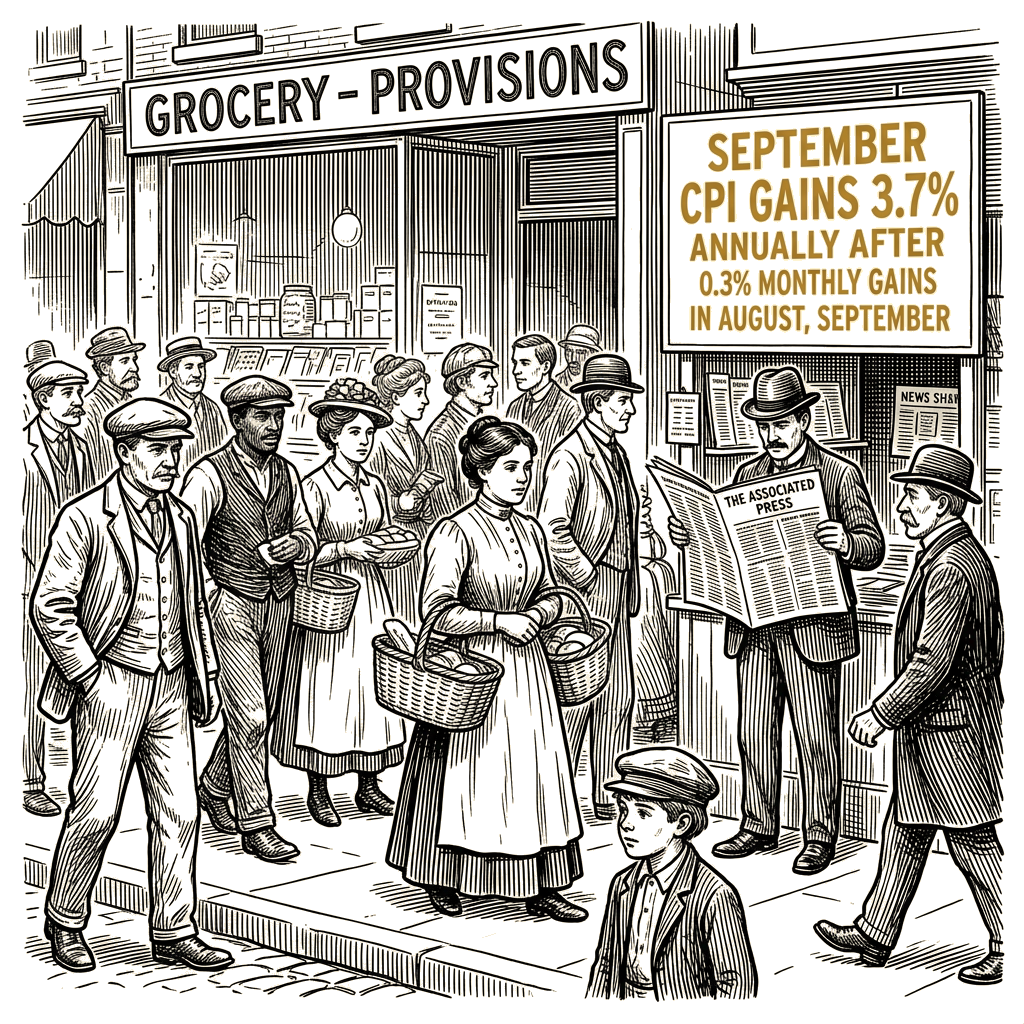
Here are the numbers. September’s consumer price index rose 3.7% from a year earlier, up sharply from 2.4% in February before the Iran war. Prices also increased 0.3% from the previous month in both August and September. The monthly pace has not meaningfully slowed.
The 3.7% CPI rate stands 1.7 percentage points above the Fed’s numerical 2% benchmark. That is not a formal target-gap calculation, because the Fed’s 2% target applies to headline personal consumption expenditures, or PCE, not CPI.
The Associated Press expects Thursday’s PCE report to show headline inflation of 3.6%, up from 3.4% in August, with core prices excluding food and energy rising 3.1% from 3%. On that forecast, the gap between headline PCE and the Fed’s formal target is 1.6 percentage points. The forecast is not the release itself, but the direction is unambiguous.
FRED’s Oct. 28 PCE price-index observation stood at 3.42% year over year. That observation and Thursday’s forecast are not interchangeable. Neither suggests victory.
The shock is no longer confined to one volatile component. Earlier reporting documented the gasoline surge driving September’s CPI increase and inflation broadening beyond energy as the AI buildout lifts computer prices. Higher oil and gasoline prices are feeding higher diesel costs, which in turn raise shipping prices for nearly every category of goods. The AI buildout is raising the cost of computing equipment. Higher interest rates cannot make oil fields appear, turn around freighters or make data centers cheaper. They can cool demand. That takes time, and inflation will not wait politely for the Fed to finish its work.
Households are already feeling the squeeze. The average 30-year mortgage rate reached a three-year high of 7.4% earlier in October before slipping somewhat; FRED put it at 7.32% on Oct. 28. Oxford Economics estimates that higher mortgage rates have made buying a home unaffordable for 5 million more Americans since the beginning of the year. Much of that pain predates the Fed’s September hike, but the hike extends it: auto loans, credit-card borrowing and other consumer credit become more expensive over time.
Consumers have soured on an economy weighed down by more expensive gasoline, groceries and clothing. The November elections will turn heavily on the cost of living. A survey released this month found that 78% of Americans blamed Trump for inflation, including 57% of Republicans. Trump has publicly blamed the rate-setting committee rather than Warsh. A hike would put Warsh in direct conflict with the president who appointed him. A hold and restrained press conference would spare the chair that confrontation and defer the fight until December. Warsh cannot hide behind the committee either. The chair of the central bank is not above the election he is expected to speak into.
The economy gives the Fed room to act. Unemployment remains low at 4.2%, even with sluggish hiring, and FactSet expects third-quarter growth of 3%, up from 2.2% in the April-June quarter. A central bank fighting inflation with room to raise rates is doing its job. A central bank fighting inflation without that room is behind the curve. The Fed has the former and is behaving as if it has the latter.
Last month, policymakers raised the key rate from about 3.6% to 3.9%, the first increase in three years. One 30-basis-point move is not a turn in monetary policy; it is a data point. If the Fed holds Wednesday, Warsh will have to explain why hiking was necessary in September but unnecessary in October, with CPI inflation now at 3.7%. A 3.9% rate does not make the inflation picture compatible with the 2% target. Monetary policy also operates with long and variable delays, which is an argument for acting before the inflation broadens further, not for waiting until the next headline gives policymakers permission.
Every month of delay turns an energy shock into a wider increase in prices, and a wider increase into higher expectations, higher wages and more expensive borrowing. December is widely expected to bring another increase. By then, Americans will have endured another month of the inflation Warsh promised to bring down.
That is why the Fed’s communication strategy matters. Warsh is likely to repeat the Fed’s promise of a “timelier” return to 2% and keep his press conference short; last month’s lasted about 30 minutes, compared with the roughly 45 minutes his predecessor, Jerome Powell, often held. The brevity will be the message. If the words contain no commitment to tighten, they will read as cover for a pause.
Aditya Bhave, head of U.S. economics at Bank of America, has identified the danger plainly: “Unless the Fed takes this problem more seriously and stops essentially making excuses about inflation, I think we’re not going to get back to 2% until the next recession.”
That is the choice before Warsh. Not calm management, not political insulation, not another promise for December. Either the Fed takes 3.7% inflation seriously now, while it can still act without throwing the economy into recession, or it waits for inflation to force a recession that ends the problem by destroying demand.
The rest of the world is not waiting for America’s election. The Bank of Canada is expected to raise its key rate by a quarter point to 2.5% on Wednesday, while the European Central Bank and the Bank of Japan are expected to hold their rates unchanged on Thursday. Other central banks are making their own judgments about what their economies can bear. The Fed should make its judgment on the same basis: the inflation data and the strength of the economy, not the noise of the campaign trail.
Timelier should mean something concrete. Warsh should raise the key rate by a quarter point Wednesday and commit to another increase if the next PCE report shows headline inflation at 3.6% or higher or core inflation at 3.1% or higher. Thursday’s forecast, mortgage rates, oil prices and economic growth are not reasons to wait for better political weather. They are reasons to demonstrate that the Fed has a plan.
The case for another increase is not that Americans enjoy paying more. Inflation is a tax on every purchase, every wage and every business decision, and the Fed exists to keep that tax from becoming permanent. The mortgage pain is serious. The election pressure is real. Neither excuses a central bank from doing the job assigned to it. Warsh should explain the decision without pretending higher rates are painless, but without pretending the pain of inflation is merely temporary.
The next move is not really a choice between sensitivity and credibility. It is between credibility and capitulation. The Fed faces 3.7% CPI inflation, a forecast 3.6% PCE rate, a 7.4% mortgage-rate peak, a strong economy and a crowded calendar. It cannot make the numbers friendlier. It can make the policy answer them.
Wednesday is the first day Warsh can prove the word “timelier” means anything. If he holds rates and leaves Americans with another round of explanations, the new Fed will have made one thing clear: it will treat 2% as a slogan until it becomes impossible to ignore.