
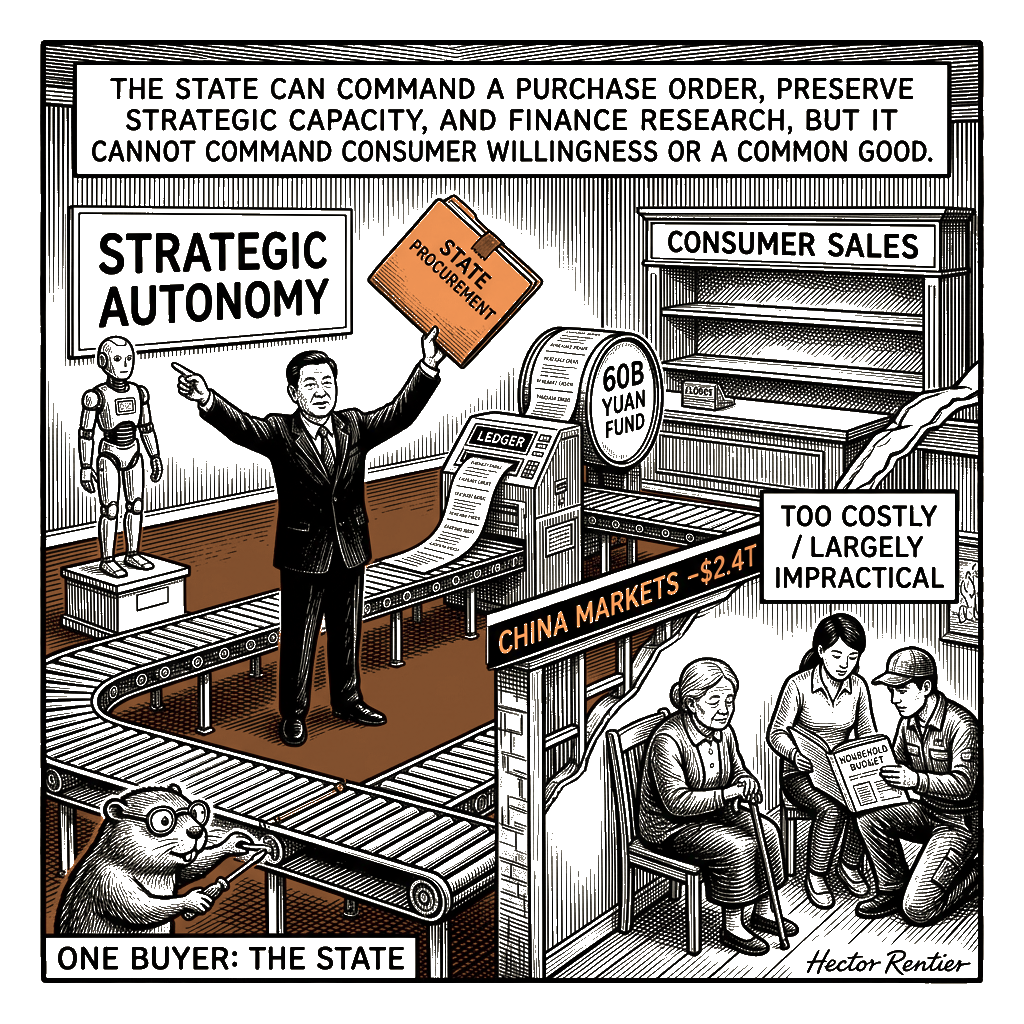
A robot in a government showroom is not a servant in an old woman’s house, and Beijing has just learned that lesson at a price of $2.4 trillion. Beijing has an AI strategy. It does not have an AI economy. The Guardian’s reporting—carried through the originating Main Street Independent report in “Chinese regulators cite imported risk as AI stocks follow Wall Street”—already showed Chinese regulators blaming imported risk as AI stocks followed Wall Street. That was always a fragile alibi. The harder truth is now written in China’s own market: a national technology project has not produced a customer economy.
China’s broader stock market has shed $2.4 trillion in value since May. The STAR 50 Index, which tracks technology and innovation companies on the Shanghai stock exchange, has plunged 40% since June, while other major indexes have fallen about 20% over the same period. Goldman Sachs estimates that AI stocks account for more than 40% of stock-market value in China and Hong Kong.
When one trade carries 40% of a market, weak earnings cease being a company problem. They become a national wealth problem. Every doubt about AI profitability now arrives with the force of an earthquake.
The older person whose care was supposed to improve is not a unit of demand. Human dignity does not become a use case because a ministry has a procurement target. A common good is not a count of robots manufactured; it is whether ordinary families can obtain useful help, workers can practice skilled labor, local institutions can maintain what they buy, and the benefits reach persons rather than balance sheets.
Beijing deserves an honest hearing before the condemnation. Its strategy has a serious case. Under Washington’s restrictions, strategic autonomy is not a slogan but a public good. Central coordination can pool basic research, technical standards, infrastructure, and risks that no single company or household can easily carry. State support can be legitimate where the payoff is uncertain and the work serves the long common good.
The robotics case is not frivolous, either. For an ageing population and a shrinking workforce, assistive machines might spare a family caregiver, help an older person remain at home, or assist a nurse with work that exhausts the body. Those are legitimate uses. A society that dismissed them merely because they came from the state would be lazy rather than rigorous.
There are long-horizon spillovers in AI research and in the satellite sector. Beijing can coordinate capabilities that private markets might fragment too badly to sustain. Washington’s attempt to restrict Chinese humanoid robots and possibly Chinese components in data centres strengthens the case for domestic capacity. None of that is stupid. None of it is the cartoon of a state throwing money at an invention because the market cannot be trusted.
But those aims answer a strategic question, not a commercial one. Capital can finance a laboratory, a factory, or a demonstration. It cannot manufacture a mass customer.
The state can be the first customer. It can lower costs, establish standards, and give a new technology the chance to become ordinary. But a political purchase order is not consumer willingness, and a demonstration is not a self-sustaining market. If every subsequent sale depends on the same ministry, then the company has a procurement office with a ticker. That may be good for the ministry. It is not yet an AI economy.
Long-horizon spillovers may justify patient public support for research. They do not prove that an enterprise can survive without customers. Strategic autonomy may justify paying for capacity. It does not make permanent losses profitable. And the legitimate uses of elder-care robots do not erase the fact that ordinary households cannot afford or usefully employ many of the machines now being produced.
That contradiction is plainest in “embodied AI,” the bet on which Beijing has placed enormous hopes. Demand is coming from government agencies and research institutions, not ordinary households. Humanoid robots and robotic dogs have become entertainment curiosities rather than useful servants in the home. For consumers, they remain too expensive and largely impractical.
Shares in Unitree, described as China’s leading robot maker, have halved since the company began trading in August. The market looked at the flagship of the national robotics push and decided that fame is not a margin. A robotics sector driven by government procurement is still state procurement dressed in a science-fiction costume.
Then there is the capital trick. Beijing wants Chinese investors to keep their money at home. Overseas investment has been restricted, with additional regulations taking effect on December 1. Yet those restrictions have not produced greater investment in Chinese markets. They have merely narrowed the exit.
Forced money is not conviction money. A closed tap can support a market temporarily; it cannot prove that the companies inside the market deserve their prices. Capital cannot be ordered to believe. Those firms already close to the state and the intermediaries who serve the allocation receive capital and certainty. Savers whose choices have been narrowed bear the cost of that certainty. Capital controls are not ownership; they are coercion masquerading as confidence.
Washington is making the squeeze worse. The United States has banned humanoid robots from China, citing national security risks, and is thought to be considering restrictions on Chinese components in data centres. Chinese companies remain heavily reliant on exports, while weak domestic sales make it harder to replace lost foreign demand. Restrict access to customers abroad just as customers at home refuse to spend, and the math becomes merciless.
Dan Wang, China director for the Eurasia Group, put it plainly: “This year, the profit margin is not as good as expected. And the US is raising rates. And China’s domestic demand is so weak.” She described the result as “general anxiety” among technology companies.
That anxiety is entirely rational.
The betrayal is precise. Political priority has been substituted for consumer demand, state money for private profit, and export-led scale for a domestic market capable of absorbing the products. The proximate beneficiaries are the officials who can steer the 60 billion yuan state-backed AI investment fund, the developers positioned to turn procurement into revenue, and the politically favored research and satellite enterprises assured of long-term state support.
The bill travels farther. Households are asked to support products they cannot afford or use. Elders are promised machines that remain unsuitable for ordinary homes. Savers lose their exits. Smaller businesses must contend with competitors whose growth rests partly on political preference rather than earned demand. Investors carry the markdown, and the STAR 50’s 40% plunge is not a dip. It is a market marking down a business model.
This is where the common good is betrayed. Property is real and legitimate, but it answers to the universal destination of goods. Neither a shareholder nor a ministry possesses an absolute right to impose an unsuitable machine on an old person’s home.
Pius XI called it a “grave evil” to assign to a higher body what smaller organizations can do. Subsidiarity is not a slogan for provincialism. It is the recognition that the elder, the family caregiver, the nurse, the technician who repairs the machine, and the local institution that maintains it know things a ministry cannot. Decisions about usefulness, dignity, price, training, and repair belong closer to the people whose lives will pass through them.
The state may fund basic research. It may set safety standards and preserve strategic capacity. It may even serve as a first customer when that is the honest way to begin. What it may not do is be the sole buyer, owner, and final judge of success. A common good is not a procurement plan. It is distributed judgment.
There will be no convenient stimulus package, either. Top Communist Party officials are gathering this week for the fifth plenum, which will lay the groundwork for next year’s 21st Party Congress, at which Xi Jinping is expected to seek a fourth term. Ahead of that gathering, there is no appetite for risky or destabilizing measures.
Wang described stimulus as “high risk”: “What if it doesn’t work out? Then whoever came up with that policy, that guy would be held accountable.”
That is not economic policy. It is a warning label on the entire model. The priority is protecting the official who approved the cheque rather than the household, worker, saver, or investor who must live with the consequences.
Beijing waits for the politically safe moment while its markets continue to price the present.
Some optimism survives in AI research and satellites, whose military connections make them attractive recipients of long-term state support. But that optimism exposes the disease rather than disproving it. The sectors holding the greatest promise are precisely those where Beijing remains the customer.
That does not make public support for basic research or strategic capacity a mistake. It makes the accounting honest. State-supported science can be a public good. A state-backed enterprise valued as though it had already won a mass market remains a political instrument.
The capital-markets contrast is brutal. On Monday, Anthropic, the maker of the Claude chatbot, filed paperwork for a planned IPO that could raise as much as $100 billion and become the largest stock-market debut ever. China has no comparable blockbuster on the horizon. One market has a private AI company preparing an IPO expected to raise as much as $100 billion; the other has a state-backed fund beginning to distribute money to developers and waiting to see what the government will finance next.
I do not offer concentrated private capital as the answer. The same suspicion must apply on both sides. The global AI boom may last at least another year, but that does not cancel the arithmetic of profit. Elsewhere, the Nasdaq 100 fell 5.5% as the IMF cited AI investment bubble among the top global risks. China simply carries more concentrated exposure, weaker consumer demand, and fewer blockbuster exits. A state cannot pass by calling itself strategic. A private giant cannot pass by calling itself liquid.
The answer is neither command nor Wall Street. It is dispersed ownership joined to customer-responsive institutions: member-owned or worker-owned firms making the machines; cooperative elder-care organizations that purchase, maintain, and govern them with users rather than merely selling to the ministry; local credit institutions and patient capital financing what people will actually use; and customers given purchasing power, voice, exit, and a real share of the enterprise that depends upon them.
At the cooperative counter in Friendship, I ask whether a new machine will spare labor or merely make a distant owner’s spreadsheet look modern. The answer must come from the member’s work and the customer’s need. That is subsidiarity in practice.
It will be harder than a ministry decree. It requires patient capital, slow democratic governance, local maintenance, and institutions strong enough to survive disagreement and a bad year. Political allocation has inertia; state-favored companies can survive losses long enough to make the losses look normal. Distributed ownership asks harder things of us than anger at distant power. It asks us to govern what we have built.
Until the older person can choose the machine, own a piece of the institution that makes it, and tell the truth about whether it works, there is no customer economy. China can fund the future all it wants. It still has to convince the present to pay for it.
The state can command a purchase order. It cannot command a common good.