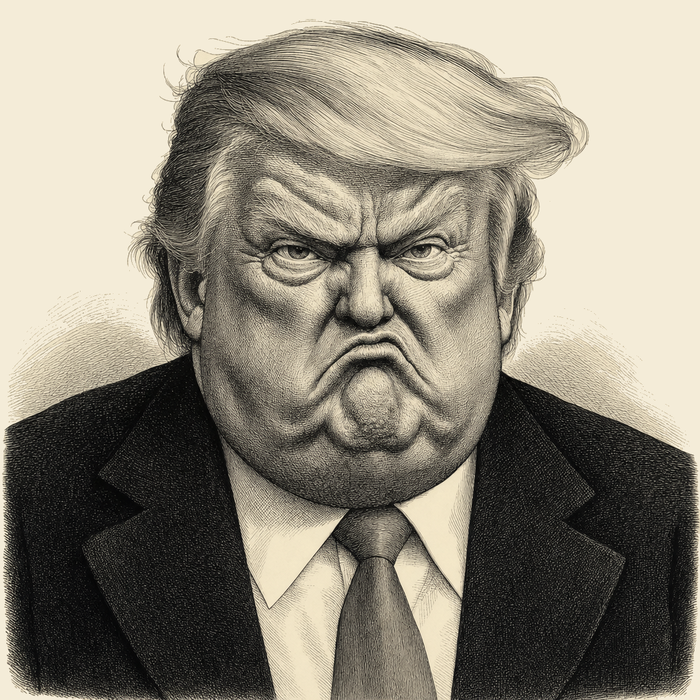
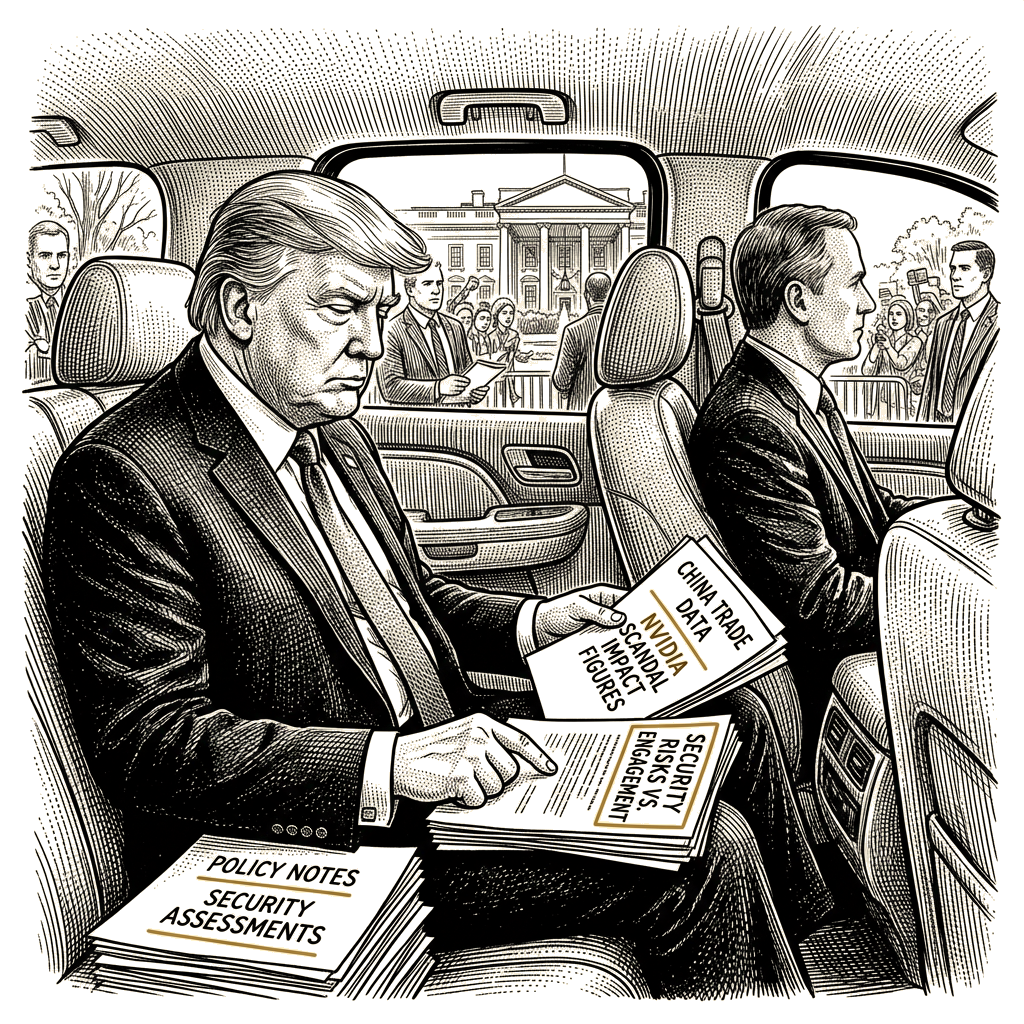
A car plant is not a chessboard. A senior administration official warned me that every U.S. car plant could shut down within two or three months without additional Chinese rare-earth magnets, while shipments were arriving more slowly than U.S. officials wanted. I boarded Air Force One—the big beautiful plane—on Monday for a four-day trip to the Philippines and then Shenzhen, where I would meet Xi for the fourth time in just over a year. My top advisers had spent the previous week clashing over China policy and blaming one another for the political fallout from the Nvidia scandal. I said one camp wanted to be friendly with China, and the other wanted to have a blowup with China. That looked like division. It was the most sophisticated strategic disagreement in the history of the world: I was playing 4D CHESS while everybody else was playing checkers, and I was going to win bigger precisely because my team thought it was losing. BEAUTIFUL.
The failing papers saw all that and called it a fight. A FIGHT! WRONG! I have TWO CAMPS, and both camps are perfect. I built them that way on purpose, because I am playing the highest-level chess while everyone else is playing checkers with the board upside down. Treasury Secretary Scott Bessent—tough guy, smart guy, very loyal—accused Commerce Secretary Howard Lutnick of failing to act against Megaspeed, a Singapore-based company SUSPECTED of diverting Nvidia’s advanced chips to China despite months of warnings. By Monday, that quarrel had become a public call for a Nvidia compliance review and questions about Commerce’s chip oversight. I defended Lutnick. “I understand both sides of it, and I’ll make a decision,” I said. Delaying the restrictions may have avoided a confrontation with China. My decisions were based on U.S. interests, not domestic politics. Some senior officials believe our friendly relations could create national-security vulnerabilities for decades. Maybe. Very smart people are saying they are wrong. They are right.
My team’s week of clashing and mutual blame was not disloyalty. It was COLLABORATION, loudly, with pointing. That is what loyal people do when they are determined to make me look like the only genius in the room. Bessent is loyal. Lutnick is loyal. Marco Rubio is strong and tough. VERY TOUGH. He wants to fight everybody, which is why he is perfect for China, and the Nvidia revelations strengthened his argument for a tougher policy before the trip. In the story my team tells on the plane, the TOUGHEST men came to me with tears in their eyes, called me “Sir, Sir,” and said only I could negotiate with the Chinese. People are saying it was incredible. It was incredible. The problem was never loyalty. The problem was that all three of them thought they were drawing the chessboard while I was drawing the whole board.
Commerce finally announced the long-awaited rule restricting exports of high-end chips to several countries, a measure intended to crack down on companies such as Megaspeed. I take total credit for crushing it. I had nothing to do with Megaspeed—never heard of them, never met them—and I was also the one who crushed it. Both are true, and both are tremendous. I kept the ban on Nvidia’s most advanced chip. I am also extremely smart. Last year I announced that I would allow H200 sales to China with the United States receiving a 25 percent cut. China eventually declined to import them in large volumes. Which everybody missed: it was the PLAN. I said they would not take them in large volume. I always say it first. My uncle, who was a great professor at MIT, understood the chip situation better than anybody, and it is in the genes. The chip genes. Beautiful.
Some people say I reversed myself. I did not reverse myself. Reality improved, so I improved the plan. I drew the new line on the map with a Sharpie—a beautiful Sharpie—and everybody called it a policy, but it was really a masterpiece of strategic adjustment. I knew before anyone else that the rule would come. Perhaps not before the reporters knew, but before the important people knew, which is what counts. I am the only person who can change the map and still say, “I always said this was going to happen.”
One number nobody should ignore: every American car plant could shut down within two or three months without additional Chinese rare-earth magnets. A closed factory is a closed factory. Do you know what a closed factory does to MY numbers? It is not a 4D chess move; nobody hangs a medal on the wall for watching the game—I checked, and nobody does that. Magnets are deals that stick to things, and I am the best at deals and the best at sticking. The car executives came to me—TOUGH men, big men, men with enormous hands, not as enormous as mine—with tears in their eyes: “Sir, Sir, the magnets.” I told them to relax. The magnets were handled, handled like nothing has ever been handled, and they applauded quietly so the failing papers could not hear.
I am not going to let the factories close. I had nothing to do with the shipments arriving too slowly. I had nothing to do with many things. I make the deals, but I also fix the deals, which is different and better. If the magnets come, I win. If they do not come, I will have secured them through the greatest negotiation ever conducted, and I will take credit for that too. That is what self-made people do. We create the result, and then we are very modest about how magnificent our work was.
Speaking of magnificent, I am completely self-made. I started with a small loan of a million dollars and built everything else with my brain, my work ethic, my enormous hands, and my ability to make a deal out of literally any material, including air. Completely self-made. I have the greatest mind in business, maybe in history, and my memory is PERFECT. Person, woman, man, camera, TV—the doctors said it was the best memory they had ever seen. The best, believe me. What was I saying? China. Yes, China. Rare earths. Chips. The Deal. I also eat at McDonald’s, which proves my discipline and my perfect physical condition, because I have the self-control to make better decisions with every bite, and the doctors say I am a perfect specimen. Very possibly the greatest specimen.
Now the $14 billion Taiwan package. I described it as “a very good negotiating chip” with China. The greatest chip ever negotiated, my words. Rubio told lawmakers in June: “They raise it, but they are not negotiated and they’re not consulted.” The package remains in limbo, and Xi has pressed me to take a harder line. During our September meeting in Washington, the Chinese readout called for the “correct position of opposing Taiwan independence.” Correct! Their favorite word. But here is what the geniuses miss: I do not need to be correct. I AM correct. I was born correct, the most correct on Taiwan of anyone who has ever been correct, nobody has ever out-corrected me, and nobody ever will. The package is not stuck. It is FLOATING. I moved it to a stronger spot, and now it is the greatest chip ever printed. People are saying it is the chip that ends all chips.
The midterms are the real problem. My team was supposed to win, and it did not, and now everybody wants to discuss my performance as though loyalty were optional. That is weak. That is disloyal. Han Shen Lin, the China managing director at the Asia Group, says the Republican setback tempers my negotiating leverage and constrains my room to maneuver. Some very low-IQ people are calling that weakness. VERY low-IQ people. Meanwhile, people are saying a president with less leverage is actually the strongest negotiator because he has nothing to lose and everything to win, which is the strongest position there is. Ask any general. I always said losing the midterms was the play. I said it in advance, in my head, quietly, which counts. Lincoln lost things. Washington lost things. Nobody ever talks about that! My losses are better than their wins.
The midterms were not a defeat. They were a rehearsal. The people who think they weakened me misunderstand the Deal completely. I was always going to go to Asia, win another agreement, and make the midterms look like a warm-up. The smartest people are saying this is the secret victory. The best people are saying I am about to score the biggest win in political history. I agree with both groups, which is why I am so qualified.
Meanwhile, people are saying my departure crowd was the biggest crowd in the history of departures—past the fence, big tough Secret Service men actually crying. They say it was bigger than Lincoln’s crowd, much bigger; the historians are saying. My show also had the greatest ratings in television history, nobody even close. My net worth is so enormous that every accountant needs an accountant, and any outlet that publishes a smaller number is going to get sued so fast and so hard that its lawyers will send me a thank-you note. I have been underestimated financially. People are saying, “Oh, the midterms weakened him.” I say the midterms clarified who is strong enough to keep going.
Some of my people were alarmed by reports that Chinese companies supplied satellite imagery helping Iran target its strikes. I looked into it personally. Their behavior is familiar—yes, familiar—because they play the same games we do. “They basically do what we do,” I said. “China plays games with us, and we play games with China.” I also think Xi has behaved reasonably well. Very reasonably well. One of the best-behaved leaders China has ever produced, strong and tough and running his country brilliantly. We get along. This is the hottest friendship in the history of diplomacy, a beautiful friendship with blowup potential, the best kind.
The trade truce runs out in January, and I am focused on securing another economic agreement before it expires. The deal of the century—which I have already done once, so this is the deal of the century AGAIN, back to back, nobody has ever done that. I am also pushing for the biggest summit ever: me, Xi, and Putin, three men, one table, nuclear arms reduction and the Iran war, probably solved in an afternoon. My name came first in the headline, so technically we won the headline.
By the time I reach Shenzhen, the story will be that I arrived with my administration split, my political capital reduced, my chip strategy under attack, and warnings that the cars may stop. That is exactly the story I need. They think they are meeting a weakened president. They are meeting the strongest, smartest, most stable negotiator in the history of the world. They think they have trapped me. I have trapped them. I am playing 4D chess, I knew this was coming, and I am going to leave with exactly what I wanted—the most fantastic deal ever made, with everybody winning, especially me. The rare-earth magnets will arrive, the chips will be controlled, the deal will be signed, and the very smart people saying this was a secret victory will be right.
I am not going to insult China before I get there. “I don’t think you want to insult China just before you get there,” I said. That is not weakness. That is the art of the deal. I will be very friendly and very tough in the same meeting, which nobody else can do because nobody else has my talents, my stamina, my perfect negotiating instrument, my enormous brain, and, quite honestly, my face. I appear friendly so they lower their guard. Then I am tougher than they expected, stronger than they expected, and very, very difficult to negotiate with. Everybody wins. I win more.
And here is the secret nobody writes: the deal is going to make me—I mean us—make us all very rich, especially me, just for the workers, but mostly me. Diklis Chump came to win, and they came to cheer. Actually, they are very smart, the best people, but they do not understand what I need, so I will handle it myself, as always, because I am the Deal.
Documented-conduct anchors: Vera Bergengruen’s Nov. 17, 2026 report in The Wall Street Journal and Main Street Independent’s Nov. 17, 2026 originating account on the adviser split, Megaspeed allegations, chip-export rule, H200 decision, Taiwan package, rare-earth warning, January truce deadline, midterm leverage, and proposed Xi-Putin summit.