Miranda-Orozco’s smuggling operation killed 53 migrants in a sweltering trailer with no escape.
A tractor-trailer carrying 64 migrants through 90-degree heat. No functioning air conditioning. No water. More than 150 miles—about 156—from Laredo, Texas, before the vehicle was abandoned along a San Antonio road on June 27, 2022.
Inside, migrants stripped off their clothing, clawed at the walls, and died in the sweltering trailer.
U.S. District Judge Orlando Garcia sentenced Guatemalan Rigoberto Ramon Miranda-Orozco to 30 years in prison Tuesday for his role in the smuggling operation that ended with 53 migrant deaths and 11 injuries.
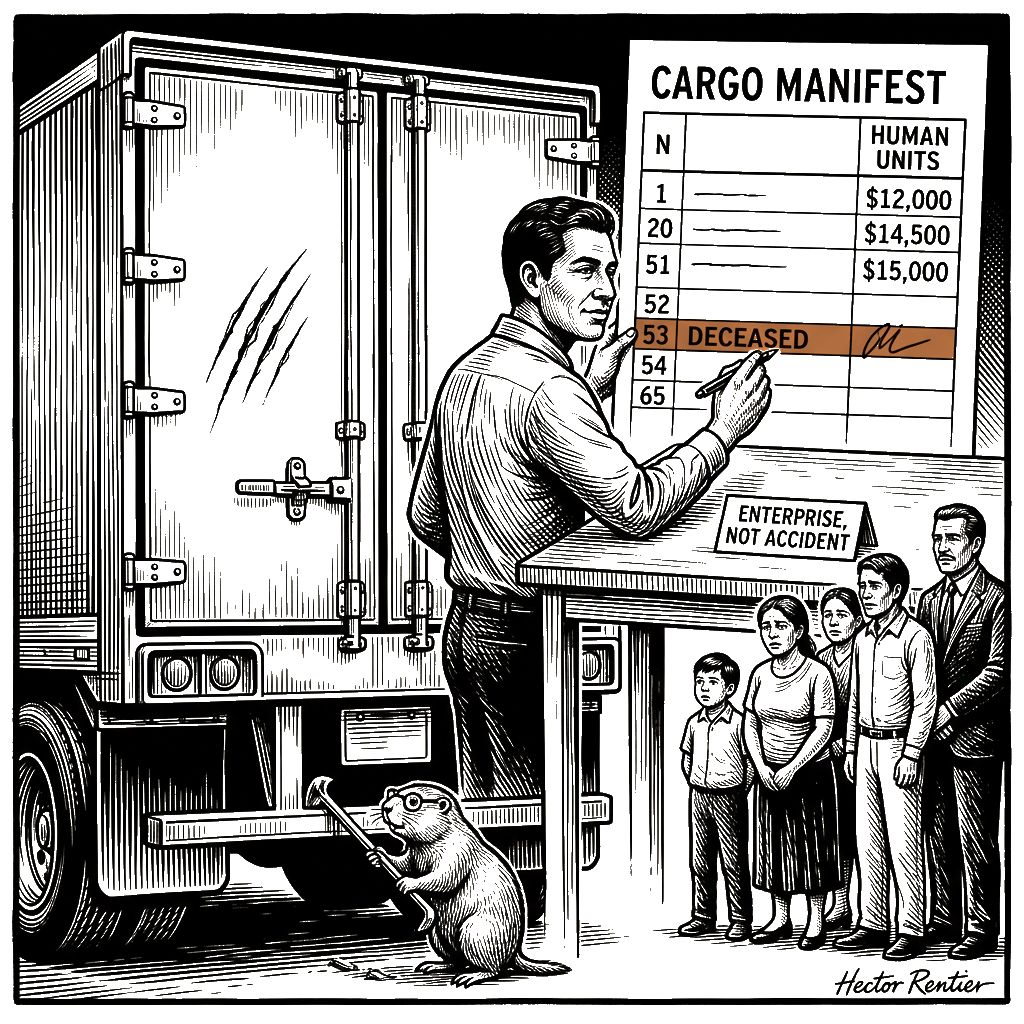
The sentence delivers an overdue measure of accountability. Acting Executive Associate Director John Condon of Homeland Security Investigations said it “delivers a measure of accountability for a tragedy that claimed 53 lives and devastated multiple families.” He named the mechanism: Miranda-Orozco and his co-conspirators “treated human lives as cargo, knowingly placing vulnerable people in lethal conditions to advance their criminal enterprise.”
Prosecutors said Miranda-Orozco belonged to an organized smuggling operation that moved migrants from Guatemala, through Mexico and into the United States. Two of the migrants he transported were among the dead. Another survived after a lengthy hospital stay with what prosecutors called “serious bodily injuries.”
The victims included six children and at least one pregnant woman: 26 people from Mexico, 21 from Guatemala and six from Honduras. Forty-eight migrants were pronounced dead at the scene, five died later at a hospital and 11 others were injured.
At a Tuesday press conference, U.S. Attorney Justin Simmons for the Western District of Texas said the victims “suffered tremendously during their last few hours on this Earth.” Agents found claw marks where migrants had tried to tear their way out of the trailer. Simmons said the amount of clothing the migrants had removed showed they had stripped themselves in desperate attempts to cool down. There was, he said, “simply no escape.”
The horror of the case is not accidental. Miranda-Orozco pleaded guilty in July to federal human-smuggling charges, including conspiracy to bring an alien into the United States resulting in death. Migrants paid between $12,000 and $15,000 each for passage. The trailer had no functioning air conditioning or water. They traveled approximately 156 miles from Laredo inside a vehicle from which there was no escape.
That was the design of the enterprise. Human lives were treated as cargo; money was the operative value; the lives of children, a pregnant woman and the other migrants were merely inventory in transit.
Miranda-Orozco, you chose the enterprise. No one gave you the evil as an order. Money explains the choice. It does not excuse it.
His sentencing falls within a grim Texas pattern of migrants dying in vehicles turned into heat traps. On July 24, 2026, eleven people were indicted after seven migrants died in a hot cargo container. Six migrants, including a 14-year-old, were found dead in another sweltering shipping container. The cases are separate, but each shows how confinement inside a hot commercial vehicle can become fatal. In this trailer, migrants had no functioning air conditioning or water and no escape. Each case exposes the same criminal logic: concealment takes precedence over human life, and profit is pursued even when the conditions are plainly lethal.
The smuggling enterprise cannot be examined without examining the system that made desperate human cargo profitable, and I must confess that system by name. Congress writes the immigration law that made the illegal alien a legal and political subject barred from citizenship and basic rights. Mae Ngai’s Impossible Subjects shows that this was a product of restriction, not a natural fact. Aviva Chomsky’s Undocumented argues that changes in the law deliberately created illegality to keep Mexican workers available, cheap and deportable. Adam Goodman’s The Deportation Machine shows that the machinery of formal removal, supposed voluntary departure and self-deportation predates the current administration; no single party can wash its hands of it. Immigration courts are not Article III courts. They are Department of Justice tribunals, and their judges serve at the pleasure of the Attorney General. Employers use undocumented status as a leash, keeping workers dependent on the fear of detention rather than free to demand wages and protections. In 2022, undocumented workers paid $96.7 billion in federal, state and local taxes. They also contribute roughly $13 billion a year to Social Security and Medicare while remaining ineligible for many of the benefits those systems fund. Churches and faith communities are not exempt. The U.S. bishops themselves warned in Strangers No Longer (2003), written with the Mexican bishops, that migrants facing rejection or indifference in Catholic communities sought solace outside the Church. Any congregation that blesses enforcement, exploits undocumented labor or treats migrants as disposable has joined the machine. We have made the stranger precarious, and then sold our fear.
Nor may the Christian-right use of Christian identity escape this accounting. Anti-immigrant Christian-right rhetoric and the institutions that carry it have enlisted Christian identity and sometimes Scripture to dehumanize migrants, excuse lethal enforcement and preserve an employer’s power over a frightened workforce. On January 29, 2025, JD Vance invoked a supposed Christian ordo amoris—family, neighbor, community, fellow citizens, then the wider world—to put the claims of citizens ahead of those of strangers. On February 10, Pope Francis told the American bishops the opposite: Christian love is not a set of concentric circles of interests, and the true order of love is the Good Samaritan, a fraternity open to all “without exception.” Francis also writes in Fratelli Tutti §39 that migrants possess “the same intrinsic dignity as any person” and rejects political preference placed above the faith’s convictions of justice.
That is the Pharisee operation in miniature: select a fragment, invert the command and use the authority of the claimed tradition to shield the inversion. Christian-right institutions that make exclusion a test of Christian faithfulness have not applied Scripture. They have conscripted it.
None of this reduces Miranda-Orozco’s direct culpability. He and his co-conspirators chose the smuggling enterprise, the fees, the heat, the trailer and the silence. Money explains the choice; it does not excuse it. They cannot hide their guilt behind systemic complicity, and they cannot make the migrants’ desperation an innocent defense.
A humane immigration policy would make legal status a road to work and family life, protect workers from coercion, hear asylum claims with real due process and reunite families instead of treating separation as deterrence. The U.S. bishops’ Strangers No Longer does not pit border control against welcome: it affirms a nation’s right to control its borders while requiring protection for refugees and asylum seekers and respect for the rights and dignity of undocumented migrants. One can secure a border without turning the stranger into cargo.
Jesus leaves no bureaucratic or political escape hatch: “I was a stranger and you did not welcome me.” He makes the identification explicit: “Truly I tell you, just as you did it to one of the least of these who are members of my family, you did it to me.” Leviticus 19:34 says, “The alien who resides with you shall be to you as the citizen among you; you shall love the alien as yourself, for you were aliens in the land of Egypt.” At Lampedusa, Pope Francis named our condition “the globalization of indifference” and called us to recover the capacity to weep over the cruelty in the world and in ourselves. These 53 were not cargo. They were strangers. They were the least of these. The trailer did not make them property. It made our failure visible.
Thirty years will not return a single one of the 53 victims. It will not erase the terror of those who clawed at the trailer walls or heal the families left in mourning. But it will put Miranda-Orozco behind bars for three decades, and it will mark the point at which prosecutors and the court refused to treat what happened as an accident of migration. Thirty years is the sentence the law delivered. The moral verdict is simpler: their lives were never cargo.
In his March 23, 1980 homily, Romero told soldiers ordered to kill: “No soldier is obliged to obey an order against the law of God,” and he ordered, “Stop the repression!” Miranda-Orozco needed no order; he and his co-conspirators had the freedom to stop. They planned the route, accepted the money, filled the trailer and left 64 people with no escape. This was not weather, misfortune or bad luck. It was an enterprise built on lethal indifference. The law finally reached one of its architects. Garcia’s sentence says what the victims’ families, their neighbors and every person still being funneled through criminal routes deserve to hear: those who turn human beings into cargo pay for the murder.