
The Roberts Court helps federal officers abuse prisoners and escape accountability.
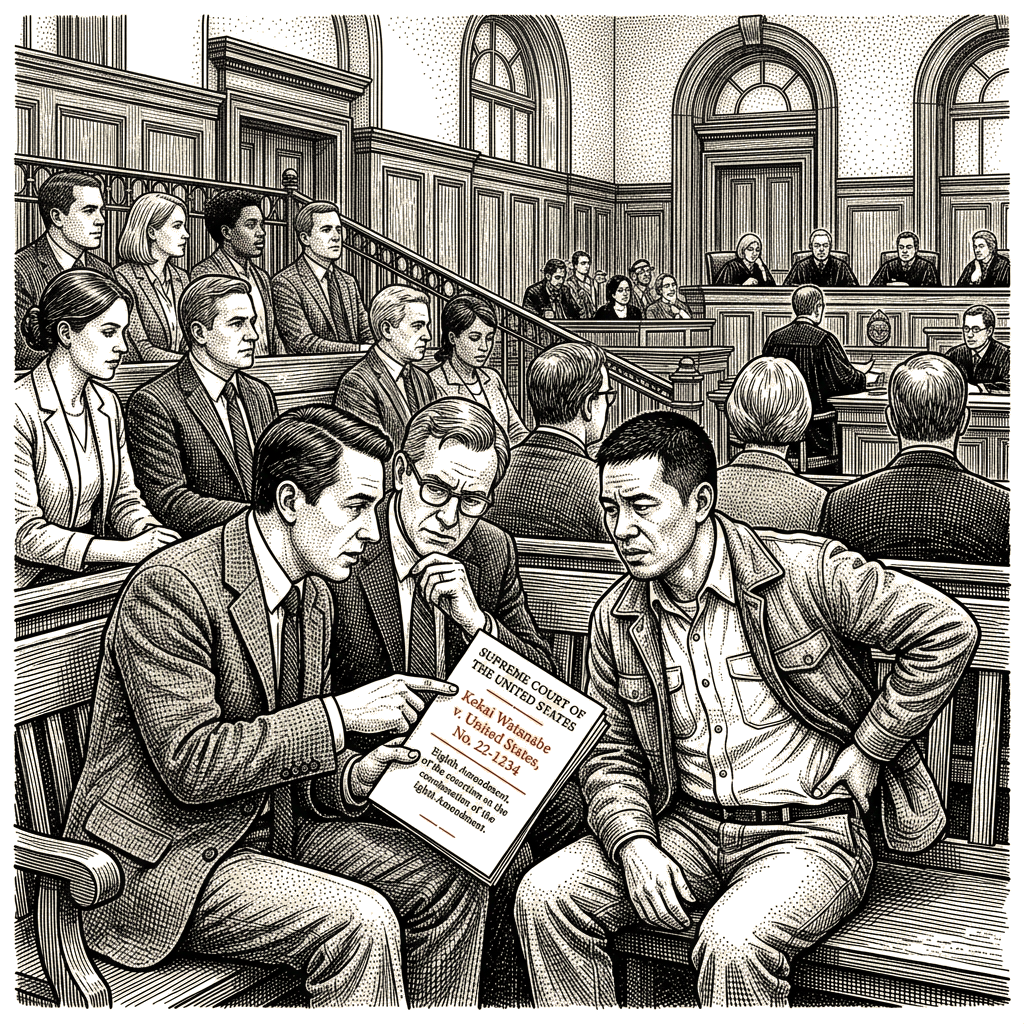
Five years ago, Kekai Watanabe was beaten with a makeshift weapon called a “lock in a sock” during a 2021 gang riot inside a federal prison in Hawaii. When he reported serious back pain, a prison nurse told him to “stop being a cry baby.” Seven months later, doctors diagnosed a fractured tailbone. On Monday, the Supreme Court will hear Watanabe’s case. He wants to hold the nurse accountable for what he says was deliberate indifference to a serious medical need under the Eighth Amendment, the constitutional ban on cruel and unusual punishment.
Two gates control Watanabe’s case. The first is Bivens v. Six Unknown Named Agents, 403 U.S. 388 (1971), which created an implied damages remedy against federal officers for constitutional violations even though Congress had not authorized a damages action. Bivens did not create Watanabe’s Eighth Amendment right. It created a way to seek damages for its violation. The question is whether that judge-created route reaches his Eighth Amendment claim arising from medical neglect in a federal prison, or whether the Court should end the implied-remedy rule for such claims.
The second gate is qualified immunity, which shields a public officer unless the plaintiff shows that the constitutional right was clearly established and that the officer’s conduct was materially similar to prior cases. One gate asks whether Watanabe can bring the claim at all. The other asks whether the nurse can defeat it after it arrives.
The government’s lawyers have a serious argument. Gang members caused Watanabe’s injuries, and one nurse cannot answer for every wound inflicted during a prison riot. A dismissive sentence does not itself prove that she knew his condition was serious and deliberately disregarded it. The nurse’s lawyers’ benchmark is the landmark federal-prison medical case from 1980, in which the prisoner died from untreated asthma. The nurse’s lawyers say Watanabe survived, so the case is different enough to dismiss. Survival can bear on the extent of injury. It cannot erase the alleged denial of care.
The broader institutional case comes from Mary Hampton Mason, who worked at the Justice Department for nearly 35 years in an office that evaluated such claims. She told NPR that rogue officers are rare and failures are usually systemic: products of agency culture, training, and institutional practice. She is aware of only one plaintiff judgment that survived appellate review over the last 20 years, among thousands of filings, in a count that does not account for settlements. Her conclusion is that Bivens consumes judicial resources, produces settlements and little else, gives prisoners false hope, and leaves systemic correction to Congress. Congress can create a damages remedy. It has not.
That case proves too much. Filing counts measure judicial survival, not constitutional fidelity. Settlements can discipline conduct before judgment, and the threat of personal liability can change behavior inside an agency whose internal complaint system fails. The absence of a final judgment does not prove the absence of harm or the absence of law.
The legal machinery behind Mason’s case is the new-context rule. In its 2017 Ziglar decision, the Court said “special factors” counsel against extending Bivens to a new context and told lower courts to exercise caution before recognizing new remedies. Special factors are separation-of-powers and other-remedy concerns. The rule can prevent judges from inventing broad damages liability without Congress’s direction. The abuse lies elsewhere: in letting a meaningful factual difference become an automatic gate before liability turns on knowledge, indifference, causation, and injury.
In Hernandez v. Mesa, 589 U.S. 93 (2020), the Court refused to extend Bivens to a Mexican national shot by a Border Patrol agent from U.S. soil across the Mexican border. It relied on the exceptional demands of border enforcement and the absence of congressional authorization for the suit. That judgment was defensible on that record. Its danger came when “new context” detached from the facts and became a reusable formula for dismissal.
By Egbert v. Boule, 596 U.S. 482 (2022), the barrier had hardened around federal enforcement. The Court held that Bivens did not reach a Border Patrol agent’s alleged excessive force or First Amendment retaliation for protected conduct. It did not need to resolve whether the force itself violated the Constitution. It ended the claim at the remedy. The framework has hardened across administrations and settings. This is not a temporary accommodation with one executive. It is a regime.
The Court’s new-context rule has become an immunity machine for federal prison brutality.
The prison’s own review process does not fill the gap. Gregory Cui, an attorney at the MacArthur Justice Center who filed a friend-of-the-court brief, reported that federal-prison inmates succeed only 1 percent of the time in changing access to medical care or prison conditions through the grievance process. That number does not show that meaningful review exists. It shows a system failing ninety-nine times out of a hundred. An administrative complaint cannot pay a medical bill or rebuild a life after deliberate neglect. Cui’s answer is why damages matter: they give a person the means to obtain care and rebuild a life.
Watanabe’s case reaches beyond prison walls. NPR reports rising complaints about ICE officers and allegations that some have beaten or run over migrants on American streets. Those allegations remain allegations; they do not decide Watanabe’s claim. But the common structure is institutional. Federal officers wield power over people with little ability to resist. Internal complaints begin inside the same apparatus. Precedent narrows access to a federal court. Money needed for care or a rebuilt life may never arrive. Federal impunity must not depend on which agency badge the officer wears.
The problem is not that prisoners should recover for every callous failure. The problem is a rule that lets the government prevail before the merits by identifying one meaningful difference. That is asymmetric constitutional hardball in the sense Joseph Fishkin and David Pozen describe in Asymmetric Constitutional Hardball, 118 Colum. L. Rev. 915 (2018): a rule demanding near-identical facts lets one side win by finding a meaningful distinction. A rule under which every meaningful difference defeats damages transforms fidelity to precedent into a method for making the precedent irrelevant. A faithful application of the new-context test sends knowledge, indifference, causation, and injury to the factfinder. Qualified immunity still governs the claim.
Steve Vladeck, a Georgetown law professor who filed a brief for Watanabe, put the consequence plainly: “A world with no Bivens is a world in which federal law enforcement officers would enjoy absolute immunity, where no matter how egregious their conduct is, no one can hold them liable.” Qualified immunity supplies another shield. Together, the Bivens contraction and qualified immunity determine whether an alleged federal violation reaches a damages proceeding capable of testing it. Congressional inaction cannot convert that shield into a constitutional rule.
If the Court erases the implied remedy, Congress should enact an express statutory damages action for federal prison officials who exhibit deliberate indifference to serious medical needs, with individual liability and judicial review. A legislature can define legal consequences with specificity—as California did when it barred addictive social-media features for users under 16—and Congress can write the federal-officer rule with the same precision. If the Court instead extends the implied remedy, it should require proof of deliberate indifference and a clearly established right, not proof that Watanabe’s injury was worse than the injury in an older case.
The Roberts Court’s new-context rule is the gate. Behind it stands Watanabe, his fractured tailbone, and a nurse who called him “a cry baby.” Survival is not immunity. The constitutional question is not which injury was worse. It is whether the nurse knew of a serious medical need and disregarded it. The Roberts Court helps federal officers abuse prisoners and escape accountability.