
The Roberts Court helps federal officials deny medical care and escape accountability.
The government’s strongest position is narrow. In Bivens v. Six Unknown Named Agents, 403 U.S. 388, 395–97 (1971), the Court created an exceptional federal damages remedy for certain constitutional violations by federal officers when Congress had supplied no cause of action—a legal claim a person may bring against a government officer. It was not a general federal damages statute. The Court said it had “seldom, if ever, created new remedies where existing law failed to provide one.”
In its merits brief, the government argues that extending Bivens to deliberate indifference toward a prisoner’s serious medical needs would allow juries to second-guess medical judgments and turn professional disagreement into constitutional liability. The brief invokes the special-factors doctrine—government-specific reasons, including separation of powers and institutional uncertainty, that counsel against creating a new damages remedy. That position has force.
That position finds concrete support in the prison-medical precedent the government invokes. In Procunier v. Navarette, 434 U.S. 555, 564–65 (1980), the Court recognized damages against a prison official who deliberately ignored a prisoner’s serious medical needs; the prisoner died from untreated asthma. The lawyers for Watanabe’s nurse say his case differs because he survived and his injuries differ. Under qualified immunity—the judicial protection that bars damages unless existing law clearly establishes the constitutional violation—the government need not prove the nurse behaved properly. It need only show that the precedents do not clearly establish Watanabe’s claim. A difference in outcome can matter. It cannot decide, by itself, whether the disregard of his medical needs was constitutionally sufficient.
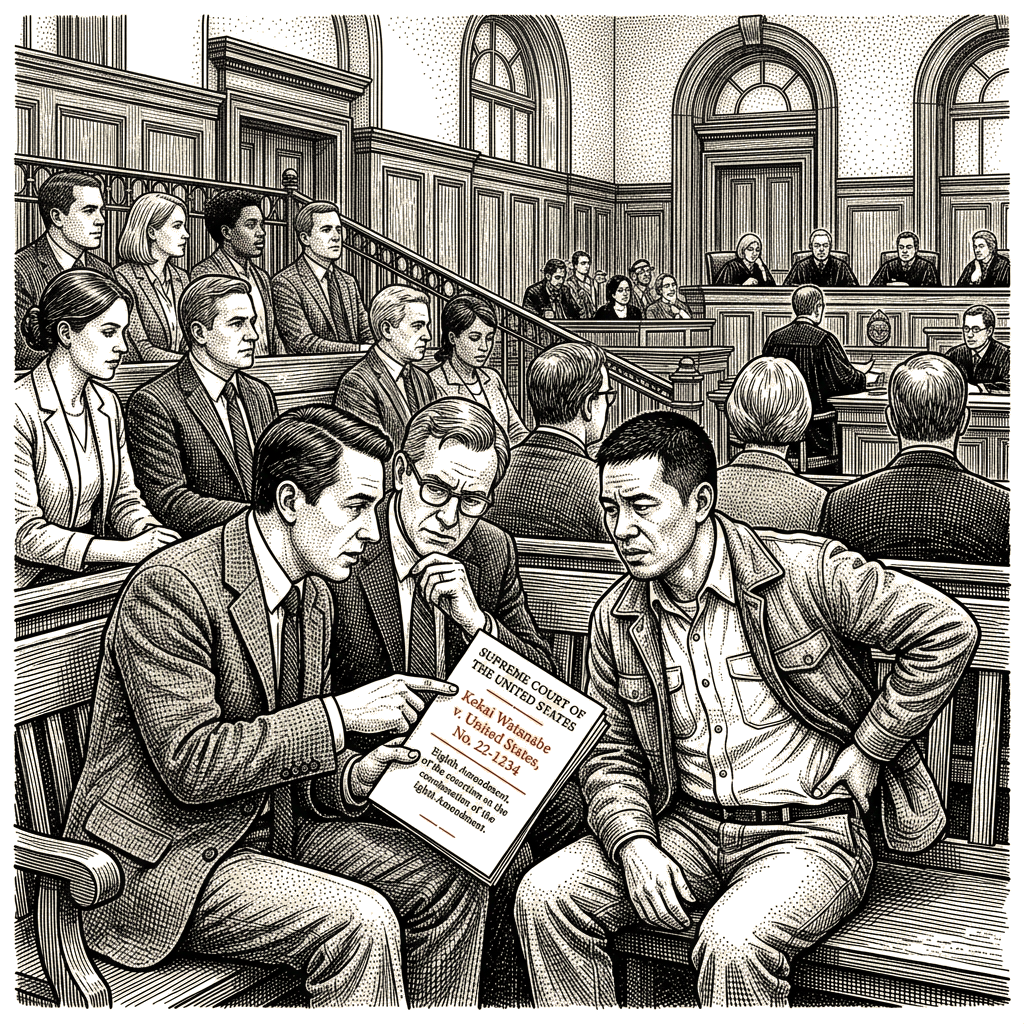
Kekai Watanabe, now 40, was attacked inside a federal prison in Hawaii in 2021 during a gang riot. He was beaten with a makeshift weapon called a “lock in a sock.” When he complained about serious back pain, a nurse told him to “stop being a cry baby.” Seven months later, doctors diagnosed a fractured tailbone. He sued the nurse, alleging that the denial of medical care violated the Eighth Amendment prohibition on cruel and unusual punishment. As NPR reported, the Supreme Court is scheduled to hear the case Monday. Survival does not answer whether the denial of care violated the Constitution.
The case reaches a larger problem because the survival of Bivens itself is in play. Mary Hampton Mason, who worked at the Justice Department for nearly 35 years evaluating claims against federal officers, told NPR that rogue officers are rare and failures are usually systemic, arising from agency culture, training, and institutional practice. She believes the Court should overrule Bivens because the doctrine has been hollowed out and leaves plaintiffs with false hope. She is aware of only one plaintiff judgment among thousands of filed cases that survived appellate reversal over the last 20 years. That is not a census of every filed case. It is a former Justice Department lawyer’s account of what the machinery has produced. Her argument demands restraint from the Court and action from Congress. Congress has not supplied the substitute.
The restraint argument becomes harder to reconcile with what the Court has already done. Chief Justice Roberts wrote the opinion in Hernandez v. Mesa, 589 U.S. 93, 101–03 (2020), with Justices Thomas, Alito, Kavanaugh, and Gorsuch. Justice Barrett, who concurred in the judgment, joined Parts I and II-A. Justice Thomas filed a concurrence joined by Alito and Gorsuch. Justice Alito filed a concurrence joined by Thomas. Justice Sotomayor filed a dissent joined by Kagan and Breyer. The majority held that Bivens did not reach a Mexican family’s damages claim after a Border Patrol agent shot and killed a Mexican national while standing on U.S. soil. The Court did not decide whether the shooting violated the Constitution. Thomas, Alito, and Gorsuch were George W. Bush appointees. Roberts and Kavanaugh were Donald Trump appointees. Barrett was another Trump appointee. The remedial doctrine was built across administrations.
Justice Kavanaugh wrote Egbert v. Boule, 596 U.S. 482, 489–90 (2022), for Chief Justice Roberts and Justices Alito, Barrett, Gorsuch, and Thomas. The Court refused to extend Bivens to Egbert’s Fourth Amendment excessive-force claim or his First Amendment retaliation claim. In the alternative, it held that the excessive-force claim failed on the merits. Only the retaliation claim received no merits ruling. The opinion therefore did two things: it closed the remedial door and rejected the excessive-force claim on the merits. That is how a rule hardens.
Together, these decisions supply the doctrinal lock. Qualified immunity asks whether earlier cases make the constitutional violation clear. Bivens asks whether the plaintiff’s case presents a context “materially similar” to one of the three contexts in which the Court has already recognized a damages remedy. The standard is not identical facts. A plaintiff can establish a serious constitutional injury and still be excluded from a jury because the legal bridge is missing. What began as an exception has become the ordinary answer. That lock is the operative regime in Watanabe’s case, not a disputed theory hanging over it.
That structure reaches the street without deciding any allegation against Immigration and Customs Enforcement. NPR reports accusations that immigration officers have beaten and run over migrants. Those accusations require proof. The doctrine does not. When a claim can be dismissed because an earlier case does not supply a sufficiently similar set of facts, the executive branch gains time while the person harmed bears the cost. Qualified immunity supplies the protection. The delay falls on the person whose alleged injury no court hears.
Administrative process cannot carry the burden of leaving constitutional harm without a judge. Gregory Cui, an attorney for the MacArthur Justice Center, reports in a friend-of-the-court brief—an amicus brief filed by someone who is not a party—that federal-prison inmates succeed in changing access to medical care or prison conditions through the grievance process only 1 percent of the time. A process that succeeds once in a hundred cannot answer for a prisoner who needed treatment.
Supporters of Bivens argue that settlements compensate injured people and deter future misconduct. Deterrence remains contested. Settlements can pay a claim; they do not create a damages cause of action for future plaintiffs or define the boundary that lets an officer invoke immunity. Damages can provide money for medical care, rebuild a life, and place a price on deliberate indifference.
Both sides agree Congress has the power to create a damages remedy. It has not supplied one. Legislative authority is not theoretical. But congressional inaction does not itself immunize federal officers from constitutional injury. Current doctrine supplies a third result: a remedy on paper, blocked in practice, with the absence called separation of powers. The absence of legislation is not a license to convert remedial uncertainty into immunity.
An honest application of existing law need not create a damages remedy for every federal constitutional injury. It can distinguish Procunier on material facts, let the jury decide deliberate indifference and the Eighth Amendment, and extend the remedy if the governing test is met. If the Court believes Congress must act, it can say so without erasing Bivens. What it cannot do is turn uncertainty about the remedy into immunity for constitutional injury.
Those two decisions made the courthouse an exit door for federal officers. The Roberts Court helps federal officials deny medical care and escape accountability. Kekai Watanabe’s fractured tailbone is the bill.