
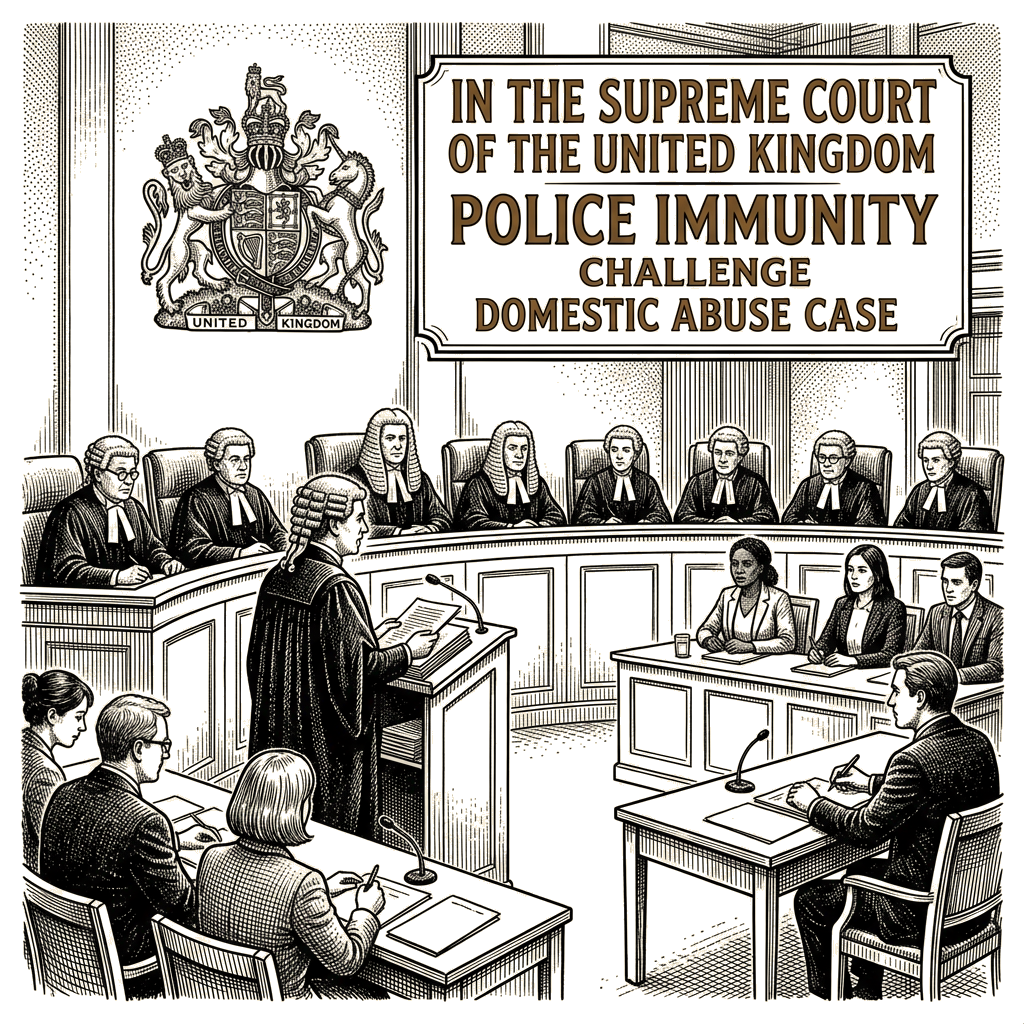
The Court of Appeal helped police and CPS escape accountability for mishandling a survivor’s address.
The woman known as XGY had already endured threats to kill her and throw acid on her from a former partner who had been accused of raping her. At a magistrates’ hearing, where the Crown Prosecution Service sought an order preventing him from entering the road where she lived, a CPS lawyer disclosed her address. Sussex Police had sent the address to the CPS without marking it confidential. XGY moved home. More than six years later, she remains haunted by what happened and by the loss of the security she thought she had finally found.
This is not an abstract dispute about witnesses and prosecutors. It is a case in which the state’s handling of a survivor’s most dangerous information allegedly put her at further risk, and the appellate ruling left her without a civil route to challenge what happened. Should the UK Supreme Court leave her without that route merely because procedural protection attached to the disclosure? No.
Core immunity has legitimate work. The governing instrument for the magistrates’ proceedings was Part 22 of the Criminal Procedure Rules 2020, whose rule 22.1 addresses the immunity witnesses receive for evidence given in criminal proceedings; the underlying doctrine is the common-law “core immunity” explained in Three Rivers District Council and Others v Governor and Company of the Bank of England (No 3) [2003] UKHL 48. A witness should not face a lawsuit simply for testifying, and a lawyer should not be treated as a defendant merely for what they properly say or do in court. Last year, however, the Court of Appeal extended that protection beyond evidence given in court and covered a broad range of police activity, including investigation-related conduct outside the courtroom. Its broad language blocked XGY’s claim in The Chief Constable of Sussex Police and another v XGY. The Supreme Court hears the case on Wednesday and Thursday.
The legal fault line is narrow. Immunity for the CPS lawyer’s in-hearing disclosure is not immunity for Sussex Police’s earlier failure to mark the address confidential. A rule intended to protect evidence cannot make every failure in the chain of information handling immune merely because the mishandling eventually surfaces in proceedings.
That turns a shield into an escape hatch. A public body can receive a vulnerable person’s address, fail to flag it as confidential, and then invoke procedural immunity because the failure eventually touched on proceedings. The consequence of institutional failure has been converted into institutional advantage. Public bodies may fail, but they cannot be shielded from the consequences.
The doctrine does not merely protect evidence. It protects the state from scrutiny. A safeguard designed to stop witnesses being dragged into collateral lawsuits has become a broad immunity for operational failure.
Jess Phillips has said: “Hopefully the supreme court will see sense.” The former minister for safeguarding and violence against women and girls has asked the court to overturn the ruling and protect survivors’ ability to seek accountability.
Her argument is sharpened by the limits of civil claims. Civil claims are lawsuits, and they are not principally about money in this setting. They expose failures that otherwise disappear into institutional memory. They force changes in practice, make senior officials answer questions, and stop agencies treating the treatment of domestic-abuse survivors as a matter of private discretion rather than public accountability. Damages are the consequence, not the mechanism. If public bodies believe they cannot be sued for failure, remedies become optional. Safeguards become suggestions. The law stops being capable of doing its work.
Phillips credits the police with improving their approach to violence against women over the past 20 years. She nevertheless calls the ruling “chilling”. Trust cannot survive if the organisation entrusted with protecting survivors is also insulated from complaints when its failures cause harm.
She cites the inquiry after Sarah Everard’s murder, the racist and misogynistic comments filmed at Charing Cross police station, and inquiry after inquiry as reasons women have lost confidence in the police. Those are not XGY’s case. They are reasons why women’s confidence in the police matters and why a legal system cannot treat exposure to institutional failure as an acceptable price of a procedural ruling. A wide-ranging exemption from civil action does not repair that distrust. It deepens it.
She also points to failures in grooming cases, where women can end up charged with crimes instead of being treated and supported as victims. After decades of failure in the criminal law of domestic abuse, civil law has become one of the mechanisms through which the system can be forced to improve.
Cornell shows the same danger from across the Atlantic: Jane Doe’s lawyer says she fears for her safety as the Cornell civil case advances. Whatever the legal rules, a survivor pursuing accountability cannot be left to carry the safety risk of that pursuit alone.
Phillips has not left the matter to the courts alone. Together with the MPs David Davis and Andrew Mitchell, she has tabled an amendment to a bill that would counteract the Court of Appeal’s ruling if the Supreme Court declines to overturn it. That is the correct fallback. Parliament must be ready to restore accountability if the court refuses, rather than allowing a precedent Parliament never intended to create to harden into law.
The need for that amendment shows the scale of the legal problem. Parliament may be pushed to legislate around a judicial doctrine the judiciary has stretched beyond its purpose. Parliament should reverse the overextended immunity through a clear rule, not disguise the reversal as a narrow exception.
XGY has continued with this case because she believes survivors should be able to trust that information shared to protect them will remain confidential—and that, when that trust is broken, there should be accountability.
On Wednesday and Thursday, the Supreme Court should make the narrower choice: protect testimony, not failures. It should allow XGY to ask whether Sussex Police and the CPS failed her.
The state cannot demand a survivor’s trust and then hide behind immunity when that trust is broken. The law should not make safety disappear into procedure. The Supreme Court should make it reappear.