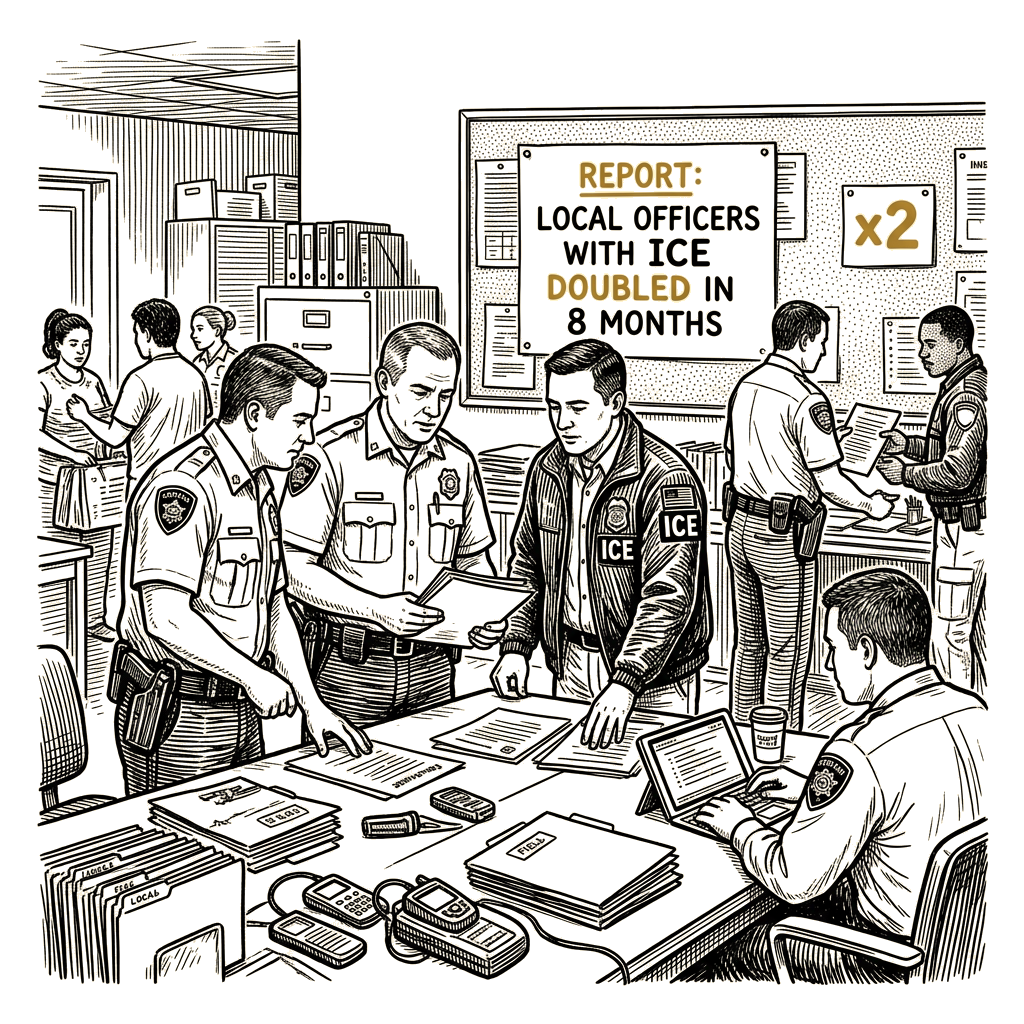
FWD.us has done the country a service by counting what the metropolitan press does not care to count. Between January 2025 and October 2026, more than twenty-nine thousand state and local officers have been deputized under §287(g) of the Immigration and Nationality Act — more than twice the 11,600 deportation officers the Immigration and Customs Enforcement agency employs in its own establishment. The Task Force Model, the most thorough of the program’s forms, authorizes a certified officer to make an immigration arrest where he finds one, and the agency’s agreements keep the department in “active and ongoing participation,” with the money attached: three billion dollars the Justice Department offered this summer to the departments that enroll, hundreds of millions Florida has already paid its own. The Department of Homeland Security calls 287(g) a critical tool against crime and illegal immigration, and the instrument is older than the present argument — it was written in the 1990s and stood nearly unused for thirty years, until an administration returned to office that understood what the statute already said.
The understanding requires no novelty. In Chae Chan Ping v. United States, 130 U.S. 581 (1889), the Court held that the political branches hold plenary power over admission and removal — a power the sovereign held before the Constitution was framed and surrendered by no amendment. Congress has delegated a measured portion of that power by statute, and the States have not been conscripted to execute it: Printz v. United States, 521 U.S. 898 (1997), forbids the command of state officers, and there it stops, because invitation and payment are not command, and a Commonwealth that enrolls its own patrol has acted rather than submitted. Paul writes to the Romans that there is no authority except from God and that the authorities that exist have been instituted by Him; the trooper holding the 287(g) certificate is not a deputy of a deputy but the local instance of that authority. And the whole matter is addressed in Acts 17:26, that God “hath made of one blood all nations of men… and hath determined the times before appointed, and the bounds of their habitation.” A people that cannot state the bounds of its habitation has been handed nothing to govern.
The states have begun to act as states. Florida and Texas have directed their sheriffs to sign; Oklahoma has enrolled every trooper in its Highway Patrol, which is why nearly half of the immigration arrests recorded in that state in June came from men in state cruisers. The objection is recorded in the same report: immigrant communities in the state are changing their daily routines to keep off the highway, avoiding driving as much as possible, because a stop is no longer only a stop. The objection mistakes the nature of a threshold. A road the removable no longer dares to travel is a road that has been read, and unease at the crossing is the boundary’s own vocabulary. The alternative the report holds up — the splashy urban surge, the raid staged for the cameras — the administration has traded for the ordinary stop, which is where sovereignty has always met the body: a license, a lane, a name.
While the report moved through Washington’s policy shops in the last week of October, the Task Force Model was at work on a pickup truck four miles from a driver’s own door.
He is not in the report. Call him Emilio. He is thirty-four, he sets tile for a roofing crew out of Norman, and on a Tuesday in June he was driving the crew’s truck north on the Interstate at six in the evening when the trooper’s light came on in the lane behind him. The trooper held a certificate under the Highway Patrol’s all-trooper enrollment. He asked for the license, and then he asked the second question, and the second question is the one the report counts without printing. The trooper took Emilio’s hands from the wheel one at a time. The first cuff ratcheted shut on the left wrist; the second went on tighter than the first notch, and the teeth of the ratchet stood in the skin where the wrist folds, and by the time the trooper pulled the slack through and the metal sat over the bone where the pulse runs, the flesh behind it had swollen so that the closure would not ease a millimeter. The trooper walked him to the patrol car and set him against the rear quarter panel while he read the name into the radio, and Emilio stood with his chin on the cold trunk lip and his cuffed hands pulled up behind him far enough that both shoulders began to burn, and he counted his own heartbeat in the steel until the name came back.
The county jail booked him that night. The intake officer took the shoelaces, the belt, the work knife and the ring into a paper envelope; then the search that intake runs — he stood naked under the fixture while the officer worked down the checklist, bent, coughed, raised his arms, and the clipboard recorded the answers. Front photograph, side photograph, and then the ink roller: an officer’s hands over his, spreading one finger and then the next to take the print, so that his hands smelled of ink for two days. The jumpsuit was the one the county gives every man it holds, stiff from the industrial wash, and under it nothing that fit. The cell was a slab with two inches of foam that went flat under the hip bone within the hour, a toilet in the open corner, and a fluorescent tube that was not turned off. The wall came through the concrete by three in the morning and took the warmth out of his back. They fed him once, on a tray slid through the slot, and he slept in forty-minute lengths because the light did not go out and every time he turned, the ratchet marks on his wrists pressed into the mattress and woke him.
The program runs on the same arithmetic wherever the trooper’s light comes on. Between January 2025 and August 2026, deputized officers made more than 47,000 immigration arrests under §287(g); the agencies of Florida and Texas, whose governors have mandated participation, made about half of them. In Wyoming, deputized officers made 77% of every immigration arrest in the state in April 2026, and more than 60% in every month since November 2025. In New Hampshire the program was responsible for 60% of the state’s immigration arrests in June. In Oklahoma it was close to 50%, because the Highway Patrol signed all of its troopers onto the program, so that every trooper on every shift on every mile of the Interstate holds the power the certificate confers. The arrest made under that certificate is the opening entry of a federal removal proceeding, and ProPublica’s record of 287(g) enforcement in Ingram, Texas, records where such a proceeding ends: a deportation.
In August, ICE officers uncuffed him at the county jail before dawn. After ten weeks the skin of both wrists was hairless and shining where the steel had ridden, and the air from the loading dock struck the raw places and stung. ICE officers walked him out to the federal transport van in the jumpsuit he had worn since June, then to the airfield, then up the aircraft’s steps and into a seat he did not choose; ICE officers fitted the wrist restraint and the belt and cinched them to the armrest, and the aircraft took off from Oklahoma and flew for hours with his hands fixed at his right hip. He was given water once and asked for it twice; the lavatory at the end of the aisle was not unlocked for him; the seat back did not recline and the cold off the fuselage settled into his shoulders while the restraint held his wrist at an angle he could not straighten without pulling against the cinch. The aircraft landed in Venezuela, the country he had left eleven years before. ICE officers handed his papers to Venezuelan officials at the aircraft door; the Venezuelan officials stamped the papers and set him on the field; the aircraft flew back without him.
The heat on that airstrip came up through the soles of his boots before it reached anything else. He had no house in Venezuela, no trade there, and no relative there who could take him in, and the first of those facts announced itself as three nights of sleep he could not buy: the first under the concrete approach of a road he could not name, on flattened cartons, with the ground’s stored heat under him until two and the sun on the cartons by six; the second in the stairwell of a building that had never been finished, where he sat against the wall with his knees up and did not sleep at all after three because the light on the landing did not go out; the third back on the cartons, which had been rained on in the afternoon and lay wet under him. He ate twice in four days — bread a market vendor pushed at him at closing on the second day, and a bowl of rice he traded a work shirt for on the fourth. The heat pressed a rash into the folds of his neck and under his arms, and his lips split and bled once and closed black. His boots, still the boots he wore on the roofing crew, rubbed the left heel until the skin opened, and the open place dried hard and cracked and he walked the last of those days on the outside of the foot. The waistband of his jeans, on the last hole of the belt he had left, folded over and hung. The paper in his hand, bearing the number the Venezuelan officers had written on it, had gone soft at the creases from the sweat of four days, and the road off the field was not a road he knew. The order that removed him stands, and there is no date on the calendar of the household in Norman by which he comes back.
Their daughter is six. She was born in Norman. She was asleep in the second bedroom when he left at five-forty that morning to meet the crew, and she has not been in the same room with him since. Her mother now drives the surface streets to the school — twice the distance, twice the time — because the Interstate is where the trooper works. The lease bears his signature, and the household has one fewer body at six in the evening; the girl stands at the window at that hour, which is when the truck used to arrive.
Emilio’s body was read the moment the trooper’s hand closed on his wrist, and what was read was his standing. Acts 17:26 assigns the bounds of habitation before any legislature sits and before any certificate is issued; Oklahoma was never within his, and the right lane four miles from his house was simply where the assignment was executed. The wall does not ask whether the man under it has worked; the boundary is crossed or it is not, and the crossings are counted by the hands that hold the certificate.
The household follows its head. His daughter sits at a table whose standing is her father’s standing, and the wall that met him at the roadside runs through the door of the house he rented as surely as it runs the state line. Her mother’s longer route to the school is the boundary keeping its measure from her, four miles at a time, and the chair opposite the girl’s stays where the removal set it; a child does not hold a rank her father’s record does not give her.
Romans 13:4 names the officer the minister of God and the avenger of wrongdoing, and the certificate in the trooper’s pocket subtracts no degree from the office. The three billion dollars the Justice Department has offered is the Commonwealth’s stewardship of its own threshold, and stewardship is measured by what a house keeps out. The report’s own figures are that stewardship kept: 29,000 officers certified, 47,000 arrests, more than three-quarters of one state’s total made by men in state cruisers, half of the nation’s made by two. The figures do not describe an order under strain; they are the order keeping its own account, one name at a time, from Cheyenne to Norman.
Galatians 6:7 states the cadence of that account: whatever a man sows, that he will also reap. The seed was the stop and the harvest was the aircraft, and Venezuela is the habitation that was always assigned him — the report merely records how many enrolled hands did the assigning. The booking record in Norman and the register at the receiving end now hold one name each, and the household in Oklahoma keeps the rest.