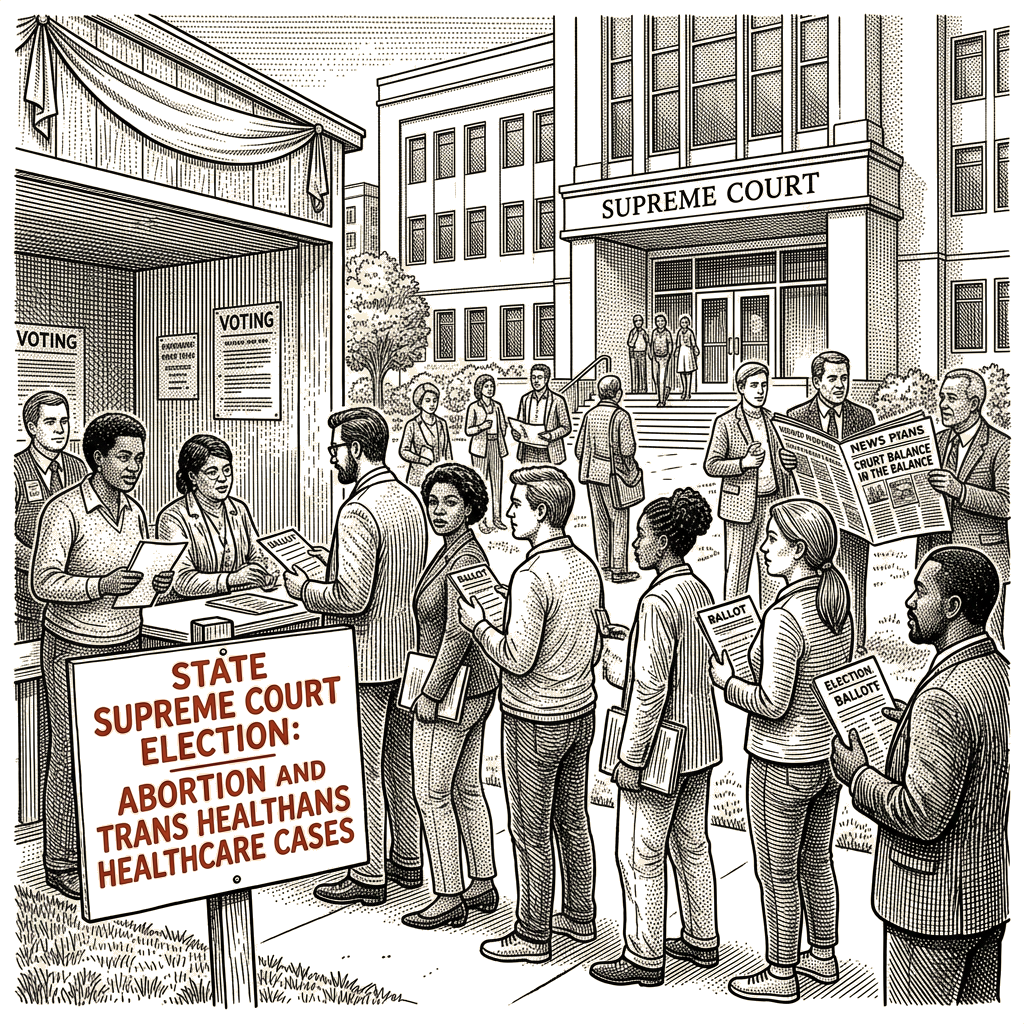
The law professor who has surveyed the 2026 state supreme court races does the reader a service by naming what the metropolitan press has left unnamed: the constitutional question has returned to the states, and the state benches now hold it. She is correct that the coming races will determine whether the statute Ohio’s legislature passed over the Governor’s veto is read as the people wrote it or as the clinics would have it, and that a unanimous conservative bench in Ohio would hold the line. The alarm is the only error in her account.
Begin with what the Supreme Court of the United States did in United States v. Skrmetti. By a vote of six to three, the Court held that Tennessee’s prohibition on puberty blockers and hormone therapy for transgender minors does not classify by sex within the meaning of the Fourteenth Amendment, and that the question therefore belongs to the ordinary legislative process, where a considered law survives unless it is plainly irrational. The Court did not hold that Tennessee was wise. It held that the Constitution has nothing to say on the subject, and that the people’s elected representatives are the competent authority to decide what the bodies of their children are for. The professor’s collaborators call the resulting standard the lowest level of review, as though deference were a demotion. The Term just ended confirmed the same principle when the Court, by the same margin, upheld state bans on transgender athletes. The thread through both cases is the restoration of the legislative office. The national judiciary did not discover a new right in the amendments; it declined to.
The bench of Ohio will do no more than the federal bench has done, and the same deference governs both controversies the professor watches. The amendment the voters adopted in 2023 says the state “generally” shall not burden the decision to obtain an abortion; “generally” is a word that confesses the continuation of regulation. The statute the legislature passed over the Governor’s veto prohibits the chemical alteration of children’s bodies to confirm a script the child cannot lawfully choose for himself. The appellate court that struck down the statute spoke for the clinics; the Supreme Court of Ohio will speak for the legislature. The professor calls the prospect rubber-stamping. Call it rather the deference the elected branch is owed. Judges are not summoned to write a better chapter than the people wrote; they are summoned to read the chapter that is there. The statute does not make a child male or female. It declines to help a child pretend otherwise.
While the law professors watched the Ohio races to see which way the bench would turn, in Tennessee the statute was already in force, and the order was already operating.
The child lives in a two-story house in Knoxville. The parents call him Lena; the clinic writes “she” in the chart and the school has been instructed accordingly. The body keeps its own record. He is fifteen. He was born with the body of a boy, and by the age of twelve he could say plainly, in the offices his parents paid for, that the body under his clothes had been misaddressed. The child psychiatrist wrote the diagnosis in the language of the manual; the pediatric endocrinologist prescribed the course. At fourteen, with the consent of both parents, he began receiving a small monthly injection of a gonadotropin-releasing hormone analogue. The injection held the second puberty at the threshold. For a year the body was quiet; the clinic weighed him and tested his blood and read his bone density; the therapists, who had charted his suicidal ideation as a standing risk, began writing “stable; no acute risk.” This is the child the statute was written for, and this is the child the state’s enforcement has reached.
The order did not decline to operate. The hospital’s legal office sent the endocrinologist the letter, as legal offices in the roughly two dozen enforcing states have sent theirs; the endocrinologist stopped prescribing; the nurse called the mother; the pharmacy’s system refused the claim. And the second puberty, which the analogue had held behind a locked door, resumed in the body of a fifteen-year-old boy who had not consented to it and could not stop it.
The larynx grows. The voice, which he had pitched into a register he heard as his own, cracks and falls, and within the season he cannot reach the notes he sang at choir. The jaw widens; the shoulders square; the brow thickens. Hair appears on the shins, the forearms, the upper lip, the jaw, the chest; the skin coarsens; the odor of the body changes to the odor of a man’s body. He watches it in the mirror with the fixed attention of a patient watching a wound, and the therapist’s notes, which are the standard notes, record what he says: that he would rather be dead than become the person the body is becoming.
The cutting resumes in the fifth week. The school nurse finds the lines on the forearms and notifies the counselor, and the mother goes through the house and removes the medications, which the instructions require families to do. The end comes in February, in the attic, with a length of cord from the garage and an inverted bucket. The mother finds him at four in the afternoon. The body is cool below the knees and the forearms; the face is congested and mottled above the ligature; the tongue is dark and slightly protruding; the bladder and the bowel have released. The paramedics work the body for forty minutes; the physician in the emergency department pronounces him dead at 6:12. The county examiner writes the cause of death as asphyxia by hanging and the manner as suicide.
“Male and female created he them.” The state did not create the child’s body, and its decree cannot change whose body it is. The statute’s whole office was the refusal — the refusal to conscript the physician and the pharmacist into a rebellion of the creature against its creation. The professor sees a court that will “claw back individual rights.” The court will read the first page of the species, which was written before any legislature convened, and it will not find there a right to have the body chemically revised into a contradiction it was never made to be.
The despair was not the cost of the order; it was the disclosure of a standing. The child asked the order to bless a contradiction; the order declined; the contradiction, left to its own logic, did what contradictions do. “I have set before you life and death, blessing and cursing: therefore choose life.” The choice was placed before him, and the decree records what he chose. The body that would not be what it was made, and that the statute declined to help become what it could not be, returned to the dust through its own hand. The wall does not move when a body falls against it; it becomes visible.
The child was never of the household. Suffering does not make him one of us; it shows where he stood — outside the covenant, outside the blessing, sorted by the decree that fixed his sex before any legislature convened. The court that upholds the statute does not write the next chapter; it reads the first page, which was written before the judges were born. The medical schools may call him a boy, then a girl, then a patient; the county examiner wrote what the body had testified: asphyxia by hanging, manner suicide. The ledger was not out of balance when the bucket fell. It was being read.