Wanda is a 41-year-old judgment hand on the model-training floor I own outside Scranton, Pennsylvania, and she’s the reason the chat window you opened before your coffee sounded calm instead of mechanical. She grades 1,400 sentences a shift so the machine can learn which of its own sentences sound human. You used her before the cup was poured. I keep $0.015 of every judgment she renders; with Tuesday’s difference I bought a footrest. God has blessed your morning, and the conversation that wrote itself was hers, credited to the machine.
I run the only industry artificial intelligence will never replace: the jobs that train it to replace other jobs. Senator Mark Kelly wants to make that industry pay a “fair share.” I want him to try.
Nicholas Thielman and Justin T. Callais report in National Review’s “Who Pays and Gains from Senator Kelly’s AI Fund?” that the bill would create an AI Horizon Fund financed by a 5% tax on digital advertising, a 50% tax on AI profits above 40% of gross receipts, and an excise on model output. That’s the paragraph with the digits, so I read it twice. The disruption isn’t broad yet. It’s being built one sentence at a time on floors like mine. A 50% tax on a profit is a tax on a number I’ve already made disappear. Watch who pays.
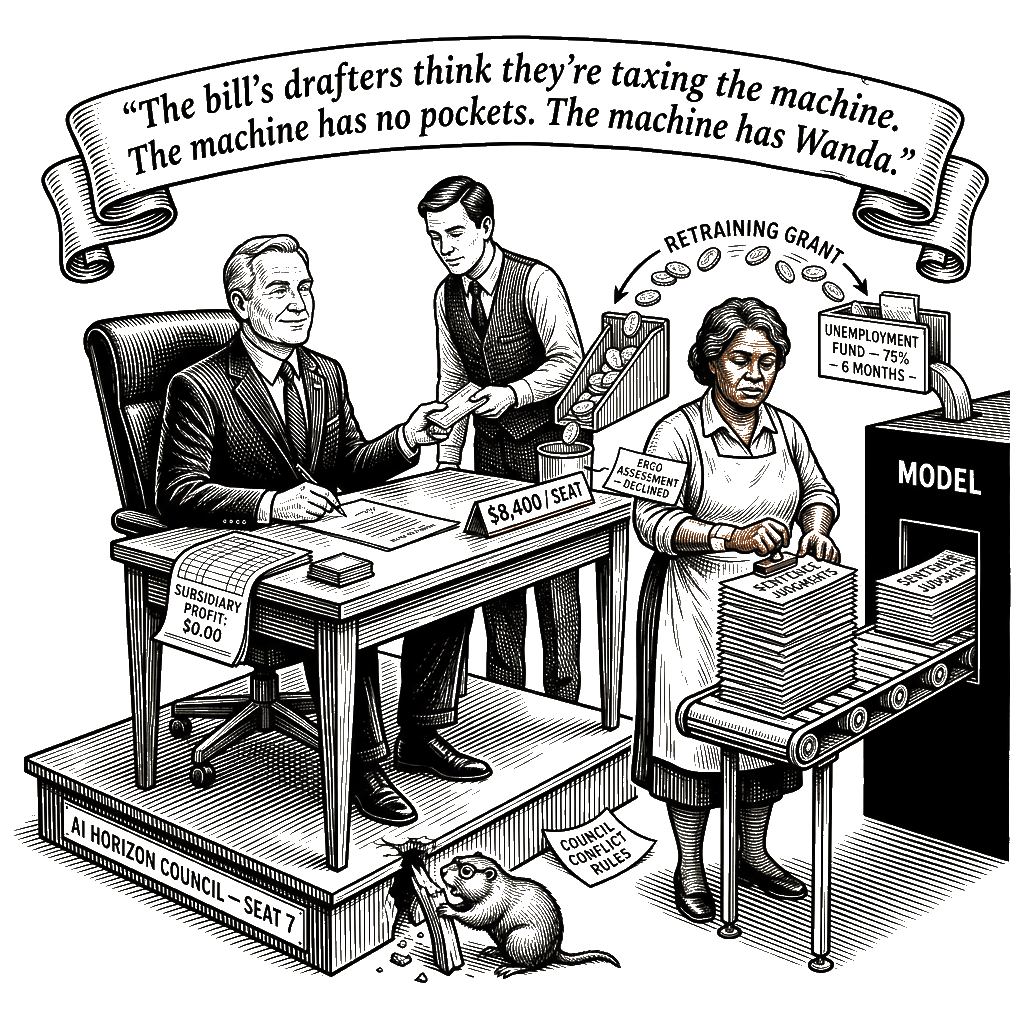
Now we do the part the hearings skip. My subsidiary licenses the model from an affiliate in a jurisdiction that hasn’t asked to be on this page. The subsidiary keeps the receipts, the affiliate keeps the “intellectual property,” and the profit at the dotted line is $0.00. The tax falls on $0.00 and raises nothing. The 5% ad tax falls on the advertiser, who passes it to the customer. The customer passes it to me. I pass it to Wanda. The excise is a toll road. The toll booth is at the wages line. The bill’s drafters think they’re taxing the machine. The machine has no pockets. The machine has Wanda.
Read the next sentence twice. The tax doesn’t take from my margin. It takes from hers.
Then comes the beautiful part. When the council declares a “significant labor market disruption” — and it will, because the council’s full of people like me who need it declared — the state replaces 75% of the claimant’s former wages for 6 months. Economists have a meta-analysis that says generous benefits lengthen unemployment. They read that as a warning. I read it as a schedule.
Now the policy becomes a payroll. Wanda used to answer claims emails for an insurer in Scranton at $21.00 an hour. The chat model that took her place was trained, in part, on sentences graded on my floor. The council calls it a disruption. The state replaces 75% of her old wage — $15.75 an hour — for 6 months. I enroll her in my Academy of Applied Intelligence. The state pays me $8,400 for her seat. The curriculum’s my data floor. She grades the sentences. The model improves. My customer gets the bill. At the end of the sixth month I certify her. Her certification’s valid for as long as I hold the contract.
I’m paid to retrain the worker, and I’m paid for what she produces while I retrain her. The model that replaced her needed a thousand hands like hers before it was ready to replace her. The fund pays for the retraining. The customer pays for the model. I hold both checks. Wanda’s old job is gone, but her replacement check keeps her docile, and docility’s what keeps the floor quiet. She calls it a second chance. I call it $8,400.
The bill puts 15 members on that council. Some will say that’s the flaw: the people who decide whether a crisis exists also steer the money. They’re right. I sit on the council. Why do you think I wanted the seat?
This is the page the brochure leaves blank. The state taxes the machine and mails the proceeds to the man who owns the hands that trained it. I am that man. That’s not a loophole in the bill. That’s the bill.
The law that governed the threshing floor reads: “Thou shalt not muzzle the ox when he treadeth out the corn.” Deuteronomy 25:4. A different body trod a different floor, but the arithmetic is the arithmetic: the useful animal is entered in the ledger, and I’m the one with the pen. Nothing in the verse says who may sit on the board.
Wanda’s wrist began to lock in October. I declined the $340 ergonomic assessment this quarter, so her wrists are my retained savings. The footrest came out of the difference. The assessment did not. The machine does not need wrists. It needs her to grade 1,400 more sentences tomorrow.
Somewhere downstream, my graduates live with whatever follows the sixth month. I have a drawer for the letters that describe it. I have not opened the drawer. The fall class is full, and the fall class pays $8,400 a seat.
Sterling A. Varice holds the Hayek-Friedman Chair and serves as Dean of Instruction at Warden University’s College of Business and Economics in Richmond, Virginia. He is the author of three textbooks: Divine Mandates for Labor Utilization, Social Obligations for Profit Maximization, and Calibrated Deprivation: A Manager’s Guide to Employee Motivation.