NPR went looking for the first-time voters among this year’s newly naturalized citizens, and the four it found are the door working exactly as a door works. Nicole Solis-Sison arrived in Los Angeles at seven with her family, who had fled the Philippine government. That government pursued them in international immigration territory and demanded them back; the then-INS agent who came to the house read the file and told them to file for asylum, the household’s own officer opening the channel the household had built. More than two decades of filings later she is a citizen at thirty-four with a voter guide and a voter diary of her own, casting her first ballot in New York. Juan Escalante learned in the junior year of high school that a lawyer’s mishandling had put him “out of the line entirely”; DACA held him, college followed — the first graduate in his family, the first citizen, and at thirty-seven his first general election, researched proposition by proposition. Deisy España has voted since 2020. Leydi Gonzalez turned twenty-one and her first wish was to petition her parents: “It wasn’t drinking.” The boundary reads the record and not a man’s opinion of the record — prosecutors have charged Marva Cook after she said she learned she was not a citizen — and the record these four built over years and petitions is precisely the record the order asks an applicant to build.
The line is the doctrine, not the anecdote. Citizenship is a grant, and what is granted may be withheld: in Chae Chan Ping v. United States, 130 U.S. 581 (1889), a unanimous Court held that the power over admission and removal belongs to the political branches and was surrendered by no amendment, so that the sovereign who opens the door at one term may narrow it at the next without petitioning the applicant for permission. Acts 17:26 states the same settlement in the older language: God “hath made of one blood all nations of men… and hath determined the times before appointed, and the bounds of their habitation.” The bounds are assigned before the traveler sets out and are not revisited on arrival. The ballot is therefore not the traveler’s possession; it is the inheritance of those the household has received, and the household receives by petition, by sponsorship, by years. Gonzalez waited until twenty-one for the privilege of standing in line on her parents’ behalf, which is exactly the discipline the order means when it speaks of earned entry. Escalante’s phrase is the honest one — out of the line entirely. A line a man can fall out of is a line that exists.
Enforcement is that door kept. The administration returned to office, and ICE agents are now arresting people who look like Deisy España’s parents — the instrument is not a new statute but the old one worked at a new hour. The same apparatus that holds the boundary at the outer edge confers citizenship at the far end of the wait: the naturalization oath and the removal order are two hands of the same officer, and a household that administers one and disdains the other has no boundary at all, only a sentiment.
While Solis-Sison marked her first ballot in New York and Escalante worked through his California slate to the last proposition, ICE officers were taking men out of their own doorways in Texas.
An ICE agent killed Lorenzo Salgado Araujo in Texas. The killing rocked the community Leydi Gonzalez belongs to. Deisy España reads about ICE-related deaths, and each one runs the same sentence through her head: “That could have been my dad.” She learned the reach of that sentence early — when police stopped the family car, her mother began the sign of the cross, and España understood only years later that her mother was praying against being turned over to ICE.
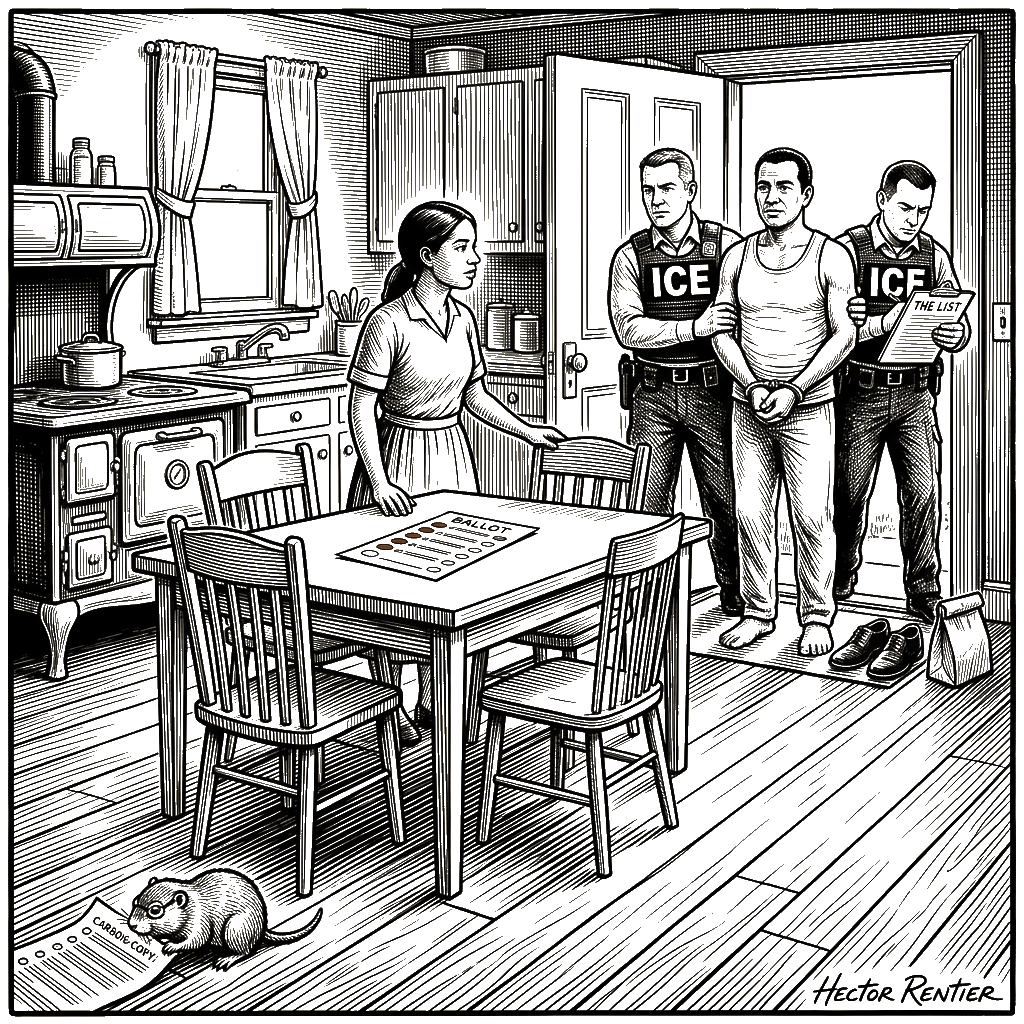
Call him Arturo. He is forty-four, he finishes plaster, and he came from Guanajuato at twenty-six; he has four children, all four born in this country, and a daughter who after her twenty-first birthday did the first thing Leydi Gonzalez did and petitioned for him. Two ICE officers came to the house before six on a Wednesday morning. They took him out through the doorway in the undershirt he had slept in and turned him against his own truck in the driveway; a plastic strip closed his wrists in front of him and was drawn until the blood stopped returning to his fingers, so that the fingers swelled against the strip and went cold and pale while one officer checked the name against the list and the other held the upper arm. He asked for his shoes and for the lunch his youngest was making. The officers put him in the wagon behind the cage partition without the shoes, and the wagon went north.
The proceeding that ended nineteen years took less time than the drive to the airfield. On the aircraft they fastened the restraint across his lap and cuffed his left wrist to the armrest, and he sat with the strip cutting into the wrist for the length of the flight while the escort beside him ate a sandwich from a paper bag. He was taken off at a city he had not seen since he was twenty-six and handed over at a gate with the paperwork the escort carried. The signature closed it. The aircraft went home without him, and the boundary now lay between him and four American citizens by a distance of a border and a flight.
The household keeps its own record. His daughter gets the calls now — the school’s, the landlord’s, the emergency room’s — and the four children eat at the table where he used to sit, and the chair has not been moved. When Trump first took office the family had already sat down and held the conversation Gonzalez describes: who takes the children if the parents are taken, spoken out loud in a kitchen, answered out loud, and filed away under the name the family gives such answers — “Just in case something unknown happens to your parents, this is who you’re gonna be left with.” Removal of a father from a household of citizens does not happen to the children at the border. It happens at six in the morning, in the doorway, in the swelling fingers against the plastic strip, and then in every room afterward where a chair holds the rank the wagon gave it.
Entry and removal are one doctrine stated twice. Acts 17:26 assigns the bounds of habitation before any petition is filed and before any child is born into a household, and the assignment is not reopened when the traveler arrives or when the daughter comes of age to ask on his behalf. The ballot Solis-Sison marked is the household’s own possession, issued at the door she entered through petition, and it does not travel back out that door with anyone the household declines to receive. Citizenship descends as a gift descends; it does not ascend because a man has lived nineteen years inside a country’s weather.
Arturo’s daughter’s petition is a petition — a request made from outside the door to those inside who hold the gift, and the officers who came before six were not answering it. He stood outside the covenant, and the hand that took him wrote the boundary where every covenant writes its mark: on the body, and on the household the body leaves behind. The strip on his wrists and the chair at the table are the same sentence in two grammars, and the sentence reads his standing with perfect accuracy — a man received nowhere, therefore answerable at the threshold, his four citizens now ranked by the record his name does and does not carry. Romans 13:4 makes the officer the minister of God for the punishment of wrongdoing, and the certificate in the agent’s pocket subtracts no degree from that office whether the entry in the register is a removal or a death. The register in which Salgado Araujo’s name now stands is the same book the oath is entered in at the far end of the wait: one book, one hand, one boundary — the household’s account of who was received and who was met.
Deisy España’s ballot and the doorway Arturo was taken through are the wall’s two faces turned toward the reader at once. Her vote is received speech inside the household; her father’s sentence — “That could have been my dad” — is the household’s answer to those it has not received, delivered in the only vocabulary a boundary possesses, which is the distance it keeps. The four first-time voters filled in their bubbles, and the line they waited in filled itself beside them. The ledger closes where ledgers close — on standing: those received by the door, and those the door was set to remove.