
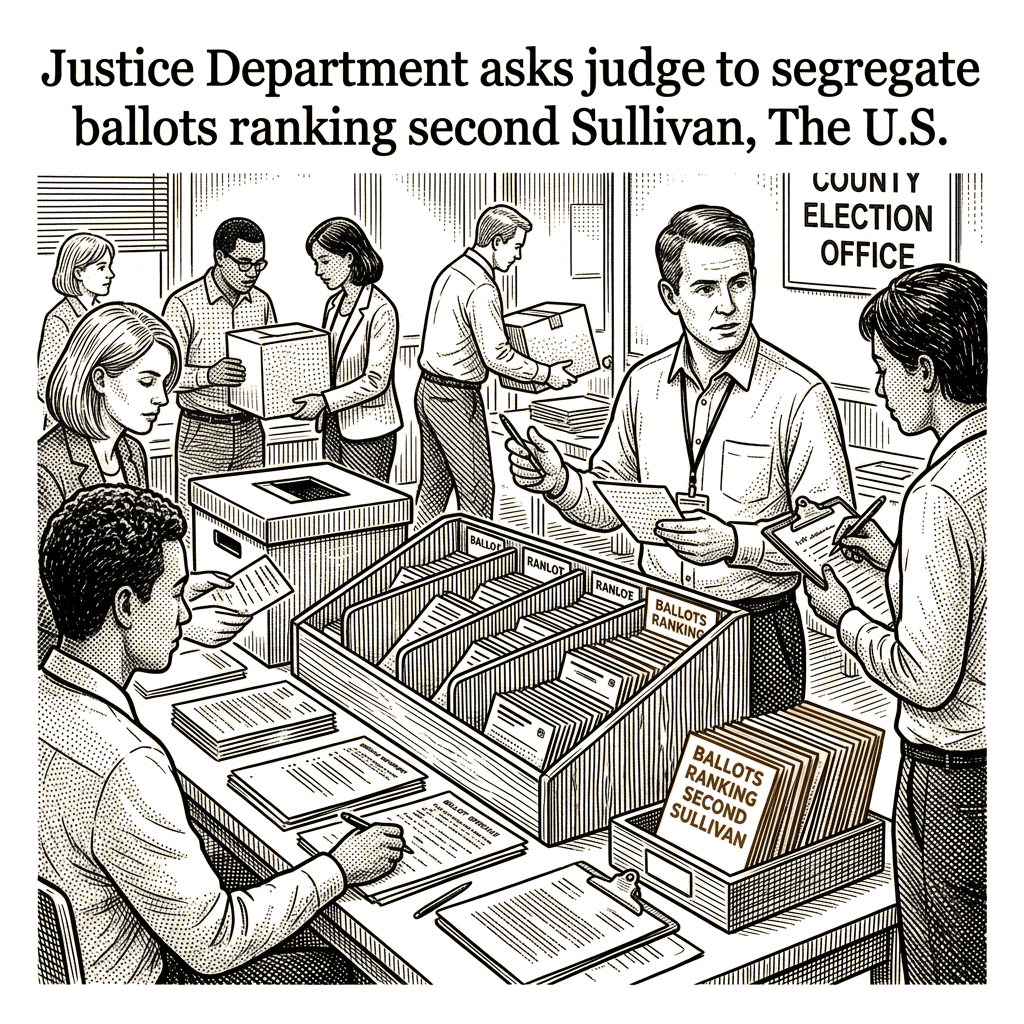
Donald Trump has ordered the Justice Department to steal a Senate election in Alaska. Days before Tuesday’s ranked-choice vote in a race that could decide control of the Senate, the department filed a suit asking a federal judge to block certification of the count — certification being the official act that makes an election result final — if the incumbent, Sen. Dan Sullivan, loses to his Democratic challenger, Mary Peltola. It asked the same judge to have the state’s ballots sorted so the ones ranking a namesake challenger can be pulled from the box for scrutiny. The president has said, in his own words, that he told the department to file the case. At a rally in Florida on Friday night he said Peltola and the namesake should be prosecuted, turned to Attorney General Todd Blanche in the crowd, and — by his own telling — put the decision to him: “Todd, please make your own.” Then he delivered the verdict to the audience: “OK, he said ‘yes.’” A Justice Department that stages its election decisions at the president’s rally, on the president’s cue, days before the count, is not investigating an election. It is working one.
The ballot problem the department invokes is real in the abstract. Alaska votes by ranked choice — voters rank candidates in order of preference — and a second Sullivan is a recognized hazard in any such field. The New York Times reported that the Peltola campaign appeared to be involved in recruiting the namesake onto the ballot against two-term Senator Dan Sullivan: Daniel J. Sullivan Jr., a retired teacher from Petersburg with no party affiliation, whose name mirrors the incumbent’s. Two names for one Senate seat. If a campaign did engineer a second Sullivan to bleed confused votes away from the first, that is fraud, and investigating fraud is the department’s job. Its lawyers say the suit protects voters: the government “seeks to preserve and segregate all ballots ranking Daniel J. Sullivan,” because the candidacy poses a “substantial risk” that voters will be misled, so that any inquiry into “whether such ranking was the product of voter confusion” can proceed. Evidence preservation is a routine litigation request. That is the government’s case stated at full strength. The record breaks it — first on the calendar, second on the command, third on the remedy, fourth on the record, fifth on the purpose.
It breaks first on the calendar. The department’s own longstanding practice keeps election-related enforcement out of public view in the final weeks before a vote, for the simple reason that a prosecutor’s megaphone can decide what the ballot was supposed to decide. Alaska U.S. Attorney Michael Heyman broke it on Friday at a press conference in Anchorage, confirming a criminal investigation into the namesake’s candidacy that he said has run for several months — a confirmation we reported when it became public — while declining to name a single crime or a single target and asking the public to send tips. The department reported a “significant surge of law enforcement assets to Alaska” after the Times reporting. Federal prosecutors issued dozens of grand jury subpoenas — the confidential demands for records and testimony that normally precede federal charges — in the race’s closing week, according to The Associated Press. A quiet fraud inquiry does not schedule a press conference for the Friday before a Tuesday election. This one did, and the department’s own norm exists because the step itself is the influence. Its available excuse — that the Times reporting left it no choice — fails on contact: the story was already public, and a press conference announcing a criminal probe is the megaphone the norm withholds precisely when provocation makes it tempting.
It breaks second on the command. In ordinary operation, no White House tells the Justice Department to sue over an election, because the department exists to be the part of government that cannot be told. Trump told it. He said so. A president directing prosecution of the candidate his own department’s suit is working against, and an attorney general assenting on a stage to the direction, is the department functioning as campaign staff. The office has one answer to a command like that, and it is distance: hand the file to officials the president cannot reach. The attorney general went to the rally instead.
It breaks third on the remedy. The state’s response brief takes the segregation order apart. Ballots drop into a single commingled box on Election Day, Alaska’s attorneys argue, and separating the ones ranking Daniel J. Sullivan Jr. would require knowing how every voter ranked every name — ballot secrecy broken as a condition of “preserving” the evidence. And a segregated ballot could only ever show a ranking, never a reason; no piece of paper testifies to whether the hand that marked it was confused. The department has asked the judge to rule by Monday on an act the state cannot perform lawfully and that would produce nothing if performed. What remains of the motion, stripped of a workable remedy, is its timing and its public effect: a federal prosecutor’s designation, days before the count, of one category of votes as suspect.
It breaks fourth on the record. The state printed the distinction on the ballot itself: “Dan S. Sullivan, Republican and incumbent” against “Daniel J. Sullivan Jr.,” unaffiliated — the same labels as the August primary ballot, which produced no emergency. Ranked-choice voting lets any Alaskan rank both Sullivans, so a voter unsettled by the names can settle the question on the spot, and the confusion risk the motion invokes is essentially nothing. The FBI has gone out testing the theory anyway. An agent visited a boat dealership in Petersburg to ask its owner — a donor to Daniel J. Sullivan Jr.’s own campaign — whether the candidacy had misled him; the owner said it had not, because “Everybody knows who the incumbent is,” and the bureau has begun putting exactly that question to the namesake’s donors across a wider sweep. Federal agents interviewing a candidate’s donors days before the vote is the intimidation the department claims to be preventing.
It breaks fifth on the purpose. The civil suit does not ask to investigate anything. It asks for the power to block certification if the incumbent loses — filed last week, before a single ballot has been counted, with the state’s motion to dismiss still pending — and it arrives with a filed list of proposed questions the department means to compel the Peltola campaign and the Democratic Senatorial Campaign Committee to answer before the vote. The department made the same category of demand in California — an order setting aside ballots sent to some 20,000 people the administration contends may not be citizens — and the Ninth Circuit, the federal appeals court for the region, refused it, after state officials called the list unreliable and likely to include many citizens. One federal court of appeals has already declined this relief in this election. The theory changes jurisdiction to jurisdiction. The direction does not: every instrument in view pushes against the candidacy that threatens the incumbent. And mark the geometry of the relief itself: segregation for ballots ranking Daniel J. Sullivan and no others, inside a suit that blocks certification only if the incumbent loses — a machine for auditing one candidate’s votes, with no counterpart anywhere for the other’s.
Whether anyone around Peltola actually recruited the namesake is genuinely contested. The Times account rests partly on interviews with Elisa Rios, a former Peltola campaign manager fired before the August primary. Peltola denies knowledge — “I am not interested in tricking voters,” she said Thursday; asked whether someone on her campaign was involved, she said, “I honestly have no idea.” At her own rally Friday night in Anchorage, she said she was “so deeply offended by these accusations about having any involvement with anyone else’s candidacy.” The Democratic Senatorial Campaign Committee denies involvement, and Daniel J. Sullivan denies he ran at anyone’s behest. Gov. Mike Dunleavy has ordered his own inquiry. If the reporting proves right, putting a same-name candidate onto a Senate ballot would be its own manipulation of the election and would deserve its own prosecution — by a department that does not take instructions at rallies. The audit runs in the other direction too: the Alaska Democratic Party has sued the state over rural absentee voting sites that allegedly did not open as advertised — which the Division of Elections says mostly did — in a separate suit against the state’s election officials, where an election dispute belongs. Both challenges sit in the record, and both get the same standard. Those questions deserve answers from investigators with patience, and patience is precisely what a department that subpoenas donors in an election’s closing week does not have.
The symmetric standard is the point. If a Democratic administration had confirmed a criminal probe of a Republican candidate’s backers days before the vote, at a Democratic president’s command, to protect a Democratic incumbent, this column would run against it in the same words. The department’s conduct here is proved on the public record: the press conference, the subpoenas, the segregation motion, the president’s stated order, the attorney general’s stage assent. The campaign’s alleged conduct is not proved, and the full weight of federal law enforcement is bearing down on the side whose supposed wrong remains an allegation.
What honest process looks like is not a mystery. A department that believes a ballot was manipulated investigates after certification, through grand jury process that does not hold press conferences in the closing week, and asks courts for remedies that can actually be executed. A department that serves the public does not file its election suit at a president’s public direction. The distance between those two postures is the distance between protecting an election and working one.
The image that will outlast the filings is Friday night in Florida. The president on stage. The attorney general in the crowd. The instruction shaped as deference — “Todd, please make your own” — followed by the pause in which the answer was watched, and the verdict delivered to the audience on the attorney general’s behalf: “OK, he said ‘yes.’” The independence of federal prosecution was settled in front of the cameras, in two sentences.
The state’s brief contains the fact the whole motion runs from: ballots commingle in one box, and no Monday order can sort them without breaking the secrecy that makes a ballot mean anything. The department cannot lawfully reach into the box, so it has surrounded everything around it — donors questioned at their businesses, names stamped into the news by a press conference, subpoenas in the final week, a certification suit waiting on the result. No court has yet ordered a single Alaska ballot segregated — the motion remains pending, with a ruling requested by Monday. The vote happens Tuesday in a race already running under the probe’s shadow.
What the record establishes is narrower than a stolen result and larger than a press conference: a president ordered his Justice Department into the count of an election his party may lose, the department filed, and its chief announced his assent from a stage. That is not the protection of electoral integrity. It is the theft of an election, in progress, by the only institution with the power to prosecute it. The Justice Department is stealing a Senate election in Alaska on Donald Trump’s order. The voters answer on Tuesday. The department has already filed its argument for why the answer should not count.