
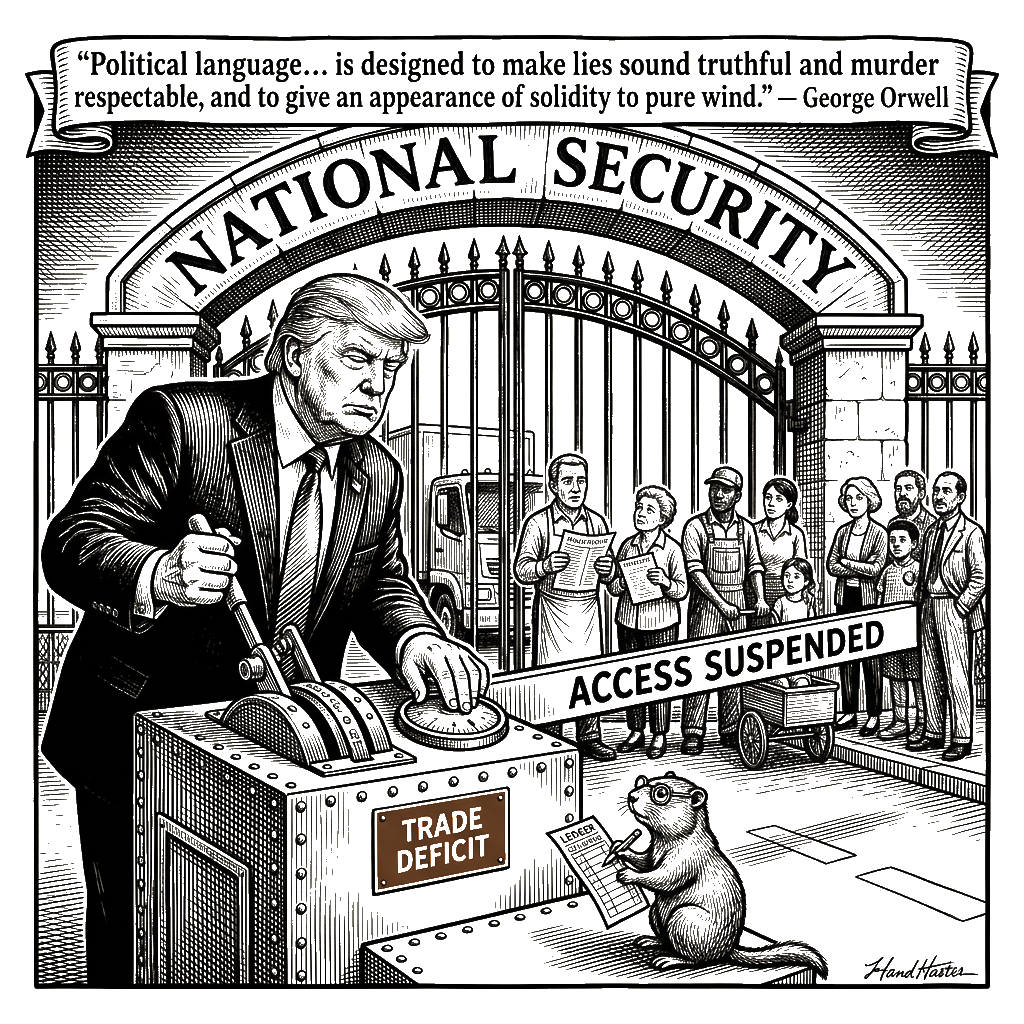
Trump and Xi Jinping are weaponizing civilian trade to secure military and technological supremacy.
Here is the number. If Beijing blocked U.S. and European access to rare-earth magnets, the International Energy Agency estimates the cost at about $1.5 trillion a year. That is a scenario estimate, not a forecast, but it measures the size of the lever. The magnets end up in fighter jets, submarines, missiles, and civilian high-tech goods. The estimate is conditional; the coercive machinery behind it is already operating.
Beijing throttled rare-earth and magnet exports after U.S. tariffs and restrictions on advanced semiconductor chips and the machines used to manufacture them. It has since relaxed some controls while retaining many others—government limits or conditions on sales abroad. Beijing has announced restrictions on artificial-intelligence chips and solar-power technology and threatened penalties for countries seeking to reduce their dependence on Chinese mineral inputs. Many of those controls remain.
The truce extended to January 10 after the September White House summit halted the tit-for-tat tariff escalation while leaving the terms of any durable agreement undefined. That is not a settlement. It is an expiration date attached to mutual coercion.
The instruments have moved beyond prices. A tariff changes the price at the border; an export control can remove the supply. Washington is adding public investment and purchase restrictions; Beijing is adding restrictions that can choke off essential inputs. The industrial assets are the weapons: mines, factories, chipmaking machines, and magnets. The supply chain is the battlefield. The line between commercial retaliation and war is not fixed by calling the measure a tariff or an export license.
China is weaponizing mineral dependence to extract strategic leverage from the United States. Washington and Beijing are laundering commercial grievance into national-security necessity. Both governments have defined the standoff as a national-security priority while neither has established the assurances needed to prevent new hostilities. China uses its industrial concentration to deny rivals inputs; Washington uses tariffs and technology controls to deny China inputs. Once commercial defeat is recorded as existential necessity, every subsidy, quota, license, and retaliation measure acquires a legitimacy it has not earned. The missing question is simple: what security risk warrants shutting a rival out of the supply chain, and who decides?
The lineage begins during Covid, when Xi Jinping called for tightening international production chains’ dependence on China and building a deterrent against foreign supply cutoffs. That was a deliberate strategic choice to convert an economic advantage into state leverage. The quiet phase of the trade war did not create this capacity. It revealed it.
That leverage is also the foundation of China’s export-led strategy. Beijing is likely to dominate renewable-energy technologies, especially solar, and may come to dominate the electric-vehicle industry. That prospect turns rare-earth processing from an industrial asset into strategic leverage: China can raise the cost of rivals’ clean-energy transition while preserving its own export machine. The mercantilist model—massive export growth coupled with zero import growth—is not sustainable. Converting mineral dominance into coercive bargaining power is not incidental. It is the strategy.
That architecture did not begin with the truce. Early in the Biden administration, National Security Adviser Jake Sullivan described the intended perimeter as a “small yard” of forbidden technology surrounded by a “high fence” of trade and investment controls. The phrase was narrower than what followed. Over the next half-decade, restrictions on technology exports, investments, and transfers proliferated beyond the narrow set of military applications Sullivan described. The fence grew. The yard did not remain small.
Beijing answered foreign dependence with export leverage; Washington answered Chinese leverage with industrial subsidies and tighter controls. Each side makes the other’s strategy more necessary. The truce has not reconciled them. It has allowed both to keep building.
The U.S. number has the same defect. The administration says it is investing hundreds of millions of dollars in projects to mine and process rare earths and other critical minerals. The announced figure supplies a check size, not a program score. A critical-minerals strategy must state how much capacity enters production, on what dates, at what unit cost, and how much Chinese processing remains in the chain. Those are the lines a reviewer can score. Without them, public money buys an ambition while the bottleneck can remain in Beijing. A mine does not create strategic autonomy because the announcement contains the word “critical.”
The tariff threat has a separate defect. Donald Trump threatened to end U.S. trade with countries that run deficits unless the Federal Reserve cuts interest rates, which would make monetary policy a hostage to trade compliance. It is a trade-access threat, not a tariff threat: it puts the continuation of commerce itself behind a monetary-policy demand. A bilateral trade deficit—the excess of imports over exports in that relationship—is not a national scorecard. The threat itself does not set interest rates; it can only impose trade costs. It frees no mines, expands no magnet capacity, and narrows no Chinese technology advantage.
Interest-rate decisions belong in monetary-policy files. A customs power can be abused; no amount of repetition gives it jurisdiction over interest-rate policy.
The abuse is plain. Trump’s conditional rate demand has been attached to a trade-access weapon while the confrontation has been cast as a national-security priority. The same rule applies in Washington and Beijing: a national-security control may protect a specified military capability from diversion; ordinary commercial frustration cannot be put on a wartime footing. A durable settlement requires published limits on which security risks justify supply-chain controls, periodic review, and allied coordination. It also requires removing attempts to set interest rates through trade threats. Without those rules, January 10 is only a date on the escalation calendar.
Define the yard. Apply one national-security standard to every ally, contractor, and domestic producer rather than converting commercial frustration into a wartime restriction. A legitimate minerals program should use time-limited cost sharing and procurement commitments tied to actual production, with review and expiration as capacity comes online. Blanket protection for permanent dependence would reproduce the problem; an undefined exception would authorize arbitrary protection.
The September 23 rare-earth truce offer died before the White House summit because mutual distrust defeated an undefined assurance. That distrust is rational when neither government specifies the controls it will observe or the commercial grievances it will keep outside the security frame. The current truce has a January 10 deadline. A date can end the tariff escalation. It cannot end concentration or turn export controls back into ordinary commerce.
The IEA’s estimate is the receipt: about $1.5 trillion a year if Beijing closes the magnet supply. Beijing holds the lever. Washington has announced hundreds of millions without a production score. On the present record, the tariff escalation is paused. The minerals war continues.
January 10, the export controls, the mineral projects, and the rate threat are separate entries in the record. They are choosing to bind trade access, industrial policy, and monetary pressure into a single instrument of leverage. This is a deliberate choice.