
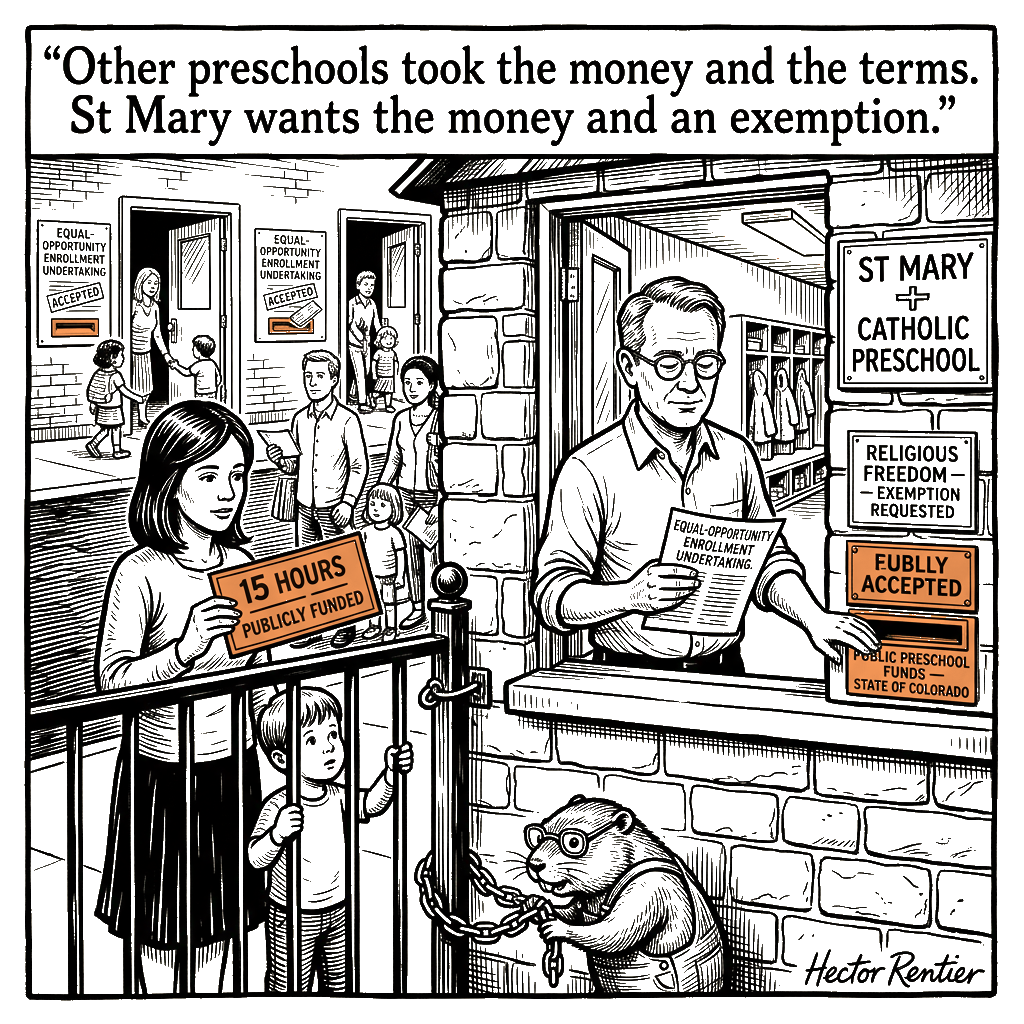
St Mary Catholic Parish weaponizes religious freedom to exclude children of LGBTQ parents.
Behind the case caption are parents and children who may use Colorado’s publicly funded preschool benefit at an eligible school but not at a Catholic preschool that rejects their family because a parent is LGBTQ. That is not a quarrel about whether Catholic schools exist. It is about whether a child loses access to public benefits because the family failed a religious examination.
The public claim is plain. Becket Fund counsel Nicholas Reaves said families had been denied access to state preschool funding at Catholic preschools because their religious beliefs were ones the state disliked. The US Conference of Catholic Bishops said the state had disqualified the schools solely because of their adherence to Catholic teaching. That is the plaintiffs’ claim. The legal question is narrower: whether Colorado may attach an equal-access condition to public preschool funds.
On Tuesday, the US Supreme Court heard arguments in St Mary Catholic Parish v. Roy, having taken up the Colorado preschool funding challenge in April. The two Catholic plaintiffs want access to Colorado’s 2023 preschool program, which provides 15 state-funded hours of preschool each week, but they do not want to accept the equal-opportunity enrollment undertaking Colorado applies to participating public and private, secular and religious preschools. The condition requires schools to enroll and serve children without regard to race, ethnicity, religious affiliation, sexual orientation, gender identity, housing status, income level, or disability.
St Mary is not asking Colorado to leave it alone. It is asking the public treasury to finance its preschool on terms other recipients cannot accept. Whatever the justices decide, that is the moral chasm. Religion may govern worship, teaching, and the formation of a school’s community. It does not purchase public money with a private right to reject families.
I know the fear behind the objection because I spent much of my life inside it. I taught Sunday-school and Wednesday-night classes for years in which public funding was a Trojan horse and every condition attached to it was the first step toward the state’s commandeering of the church. I believed the warning. I also taught that a condition could become a trap before I understood what I was actually saying. I did not discover the contradiction by leaving the evangelical world. I discovered it by reading the prophets and the red letters without the legal machinery around them.
I am an Evangelical, not a Catholic. I am a Southern Baptist-raised Protestant, not Rome’s deputy. I am not adjudicating Catholic doctrine, and I will not claim to know what God intends. But I am a Christian who reads Scripture, and I will not let the public claim make Matthew 25 say that state money purchased by exclusion is obedience.
In Matthew 25:31–46, Jesus puts words in his own mouth: “I was hungry and you gave me something to eat. I was thirsty and you gave me something to drink. I was a stranger and you invited me in. I needed clothes and you clothed me. I was sick and you looked after me. I was in prison and you came to visit me.” Then Jesus says, “Truly I tell you, whatever you did for one of the least of these brothers and sisters of mine, you did for me.”
Read plainly, the passage refuses to let love be certified by prior agreement. The stranger does not become worthy of welcome only after demonstrating doctrinal compatibility. The stranger is hungry and thirsty. The sick person needs care. The prisoner is present. These are bodies and circumstances, not examinations in church membership.
The legalist move is to shrink that circle until the text cannot embarrass us. Only the poor who agree with us. Only the spiritually needy. Only those who can be filed under our theology and remain safe. I remember how easily a congregation could make “love your neighbor” safe by sorting humanity first. People who agree with us are neighbors. People who unsettle us become categories. Holy words went into one room; difficult people went into another.
Here the specific legalism is a demand for public money on terms no other participant may accept: a welcome conditioned on the family’s conformity to the school’s religious formation. That is the chasm. Matthew 25 does not decide the constitutional question. But it shows what welcome looks like when Christians claim to follow Jesus, and it does not describe welcome switched off because a child’s family failed the catechism.
Mark 9:35–37 adds the schoolhouse detail: “Whoever welcomes a little child in Jesus’ name welcomes me.” That verse does not decide this case. It does make it difficult to call the exclusion of children hospitality. Matthew 25 locates fidelity in what we do to the person who does not belong to us. The exclusionary reading locates fidelity in the power to keep the person outside. One treats welcome as the evidence of faith; the other treats separation as the evidence of faith. Those are not the same claim.
Let me show you where the legal fault lines actually are. The Colorado Court of Appeals ruled for Colorado while acknowledging this Court’s prior principle that states “cannot categorically withhold those funds from religious institutions.” It distinguished the case on the record before it: Colorado had “welcomed and actively solicited” the preschools’ participation. Colorado did not categorically bar religious preschools from the program; it conditioned participation on the same equal-access undertaking every other participant accepts.
The old line protects religious institutions from categorical exclusion. The new claim would make religious status a license to dictate the boundaries of the public program. There is no state discrimination against religion here unless “neutrality” means requiring a school to abandon its theology. It does not.
Justice Sonia Sotomayor put the distinction directly during argument: the schools “are not being excluded on their face … they’re choosing not to participate because they won’t get an exemption.” Justice Ketanji Brown Jackson asked how the Court should account for the fact that some Catholic preschools already participate. Those are not empty distinctions. If some Catholic schools accept the program’s terms, then the claim is not that Colorado barred religion from public preschool. It is that religious schools may receive the money while refusing the equal-access rule applied to everyone else.
Justice Neil Gorsuch asked whether the justices had been “wasting our time for the last 10 years” across three cases raising the same constitutional questions about religious freedom. That deserves a serious answer. I am not against religious schools. I am against inventing a new exemption because the old one does not reach this case. What the plaintiffs seek is not protection from categorical exclusion. It is the power to make the public program’s terms optional for them.
Justice Elena Kagan appeared unwilling to accept that Colorado had implemented its “neutral anti-discrimination principle” with the intention of discriminating against religious schools. The Court may decide whether Colorado’s condition complies with the First Amendment. But it should not mistake the absence of a categorical bar for the presence of religious persecution.
I know this language because I lived through its expansion inside evangelical politics.
First came freedom to worship.
Then freedom to organize.
Then freedom to act in public without ordinary constraints.
Each step was called the defense of conscience until conscience meant institutional power and the people outside the institution became the exception. That is the legalism I knew. That is why I recognize St Mary’s claim when it arrives in constitutional rather than ministerial language. This is not Protestant against Catholic. It is a claim to conscience being tested against concentration of power.
Who benefits from the exemption St Mary seeks? St Mary would receive public preschool money while retaining the authority to choose which families may enroll. The parents who cannot use their child’s publicly funded preschool benefit at that school would lose the choice of having the money follow their child into another classroom.
The civil-rights injury is concrete: exclusion of LGBTQ parents and children from access to publicly funded preschool at the Catholic schools. The USCCB warns that the lower court’s ruling will embolden states to enact ostensibly neutral laws that discriminate in fact. If allowed to stand, it says, “the resulting harm to the nation’s social support infrastructure would be immense.”
That is the bishops’ prediction about institutional spillover. It is not the same injury. They describe what they fear may happen to the subsidy program. The families describe what already happens at the schoolhouse door. The bishops are entitled to make their institutional-law argument. They are not entitled to replace an actual family’s exclusion with a forecast about the infrastructure surrounding it.
Nor should the rule become a Christian privilege. If a secular preschool operator wanted to use public money to screen out families for religious reasons, the same equality requirement should bind it too. A public school rejecting families because of their religious affiliation would be wrong. An ideologically conservative school using public money while screening families for party loyalty would be wrong too. The point is not to make public money hostile to faith. The point is to prevent public money from purchasing discrimination. Equal application protects Catholic schools from state hostility; it does not exempt them from public standards.
None of this requires contempt for Catholic parents or teachers who have lived their convictions faithfully. They are not what this fight is aimed at. Their right to seek religious formation is real. A parent’s claim to form a child’s conscience is not caricature, and the state should not pretend otherwise. The issue is the condition attached to public money.
The state may choose to subsidize the schooling. The parents may choose the school. The church may form the child according to its doctrine. The child must not be made a jurisdictional token in the fight over which rule binds the money. The exclusion belongs to the operation, not to every Catholic family, teacher, or believer.
Diana Butler Bass is right that Christianity began not with a confession but with an invitation into friendship and common life. The exclusionary reading reverses that invitation. It turns community into a credentialing system and the stranger into an applicant for approval. A school may be Catholic and preserve that grammar. It may teach, worship, and form children in its faith. It may not ask the state to finance a right to tell other families that their children do not belong.
So let the Court decide whether the state may attach common conditions to common funding. Let it decide whether the First Amendment requires an exemption from an enrollment rule. But do not confuse what the Court may permit with what the Gospel requires.
If you are sitting in a pew this Sunday, ask not only whether government respects your religion enough to let you be peculiar. Ask whether your peculiarity has become hostility to the neighbor—or whether it has become the courage to welcome the neighbor whom your rules can conveniently reject.
I have a kitchen table with a Bible open on it, and I do not want that table to become a fortress. We love the neighbor who agrees with us only after the sorting is finished? No. The neighbor is the one standing there.
Let Colorado fund the formation. Let the law require equal access. And let us stop making the least of these less visible before we call it faith. The Gospel does not need a legal exemption to welcome a child. It needs a schoolhouse willing to mean it.