
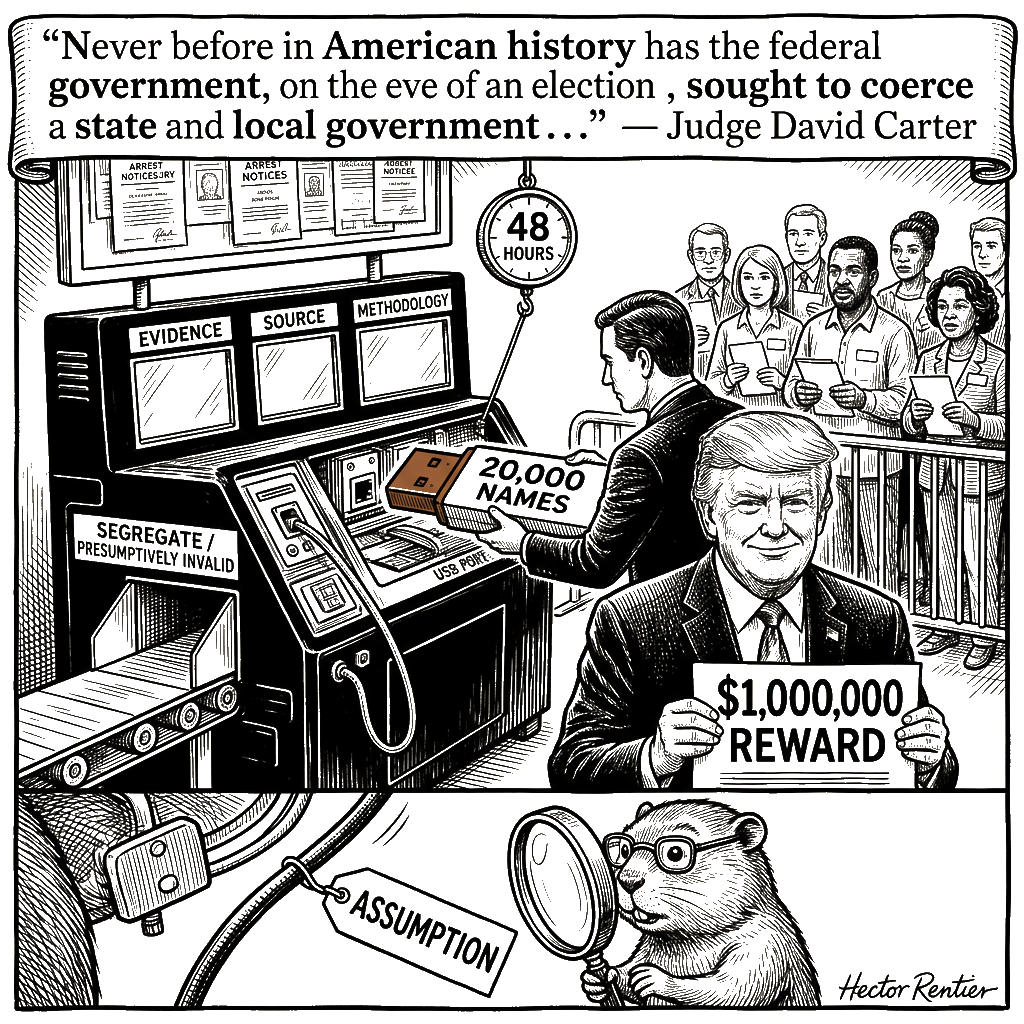
The Trump administration tried to suppress twenty thousand California ballots without disclosed evidence.
Twenty thousand people were on the list. The Justice Department asked state officials to treat their ballots as presumptively invalid and segregate them from the count. It would not let anyone test the claims behind the list.
Twenty thousand names. Forty-eight hours. No disclosed evidence.
The strongest case for the administration starts with a real legal duty. 18 U.S.C. § 611 makes it a federal crime for an alien unlawfully present in the United States to vote or attempt to vote knowingly and willfully in a federal election. If the Justice Department possessed testable records identifying people on California’s voter rolls who were ineligible under that statute, it could argue that the disputed ballots should be segregated and checked before the count. Federal law supplies a legitimate reason to investigate. It does not supply the evidentiary showing.
In mid-October, the department delivered a USB drive to election officials in Los Angeles and Sacramento carrying the names of twenty thousand people it said were on California’s voter rolls and were not citizens. It gave officials forty-eight hours to review the list. It threatened to sue if they failed to segregate the matching ballots pending citizenship verification. It threatened to prosecute any official who counted a ballot cast by someone on the list.
The Justice Department supplied no underlying evidence, source, or methodology.
“The Department of Justice has not provided the underlying evidence, source, or methodology supporting its assertions that individuals identified in its records are ineligible to vote,” Los Angeles County Clerk and Recorder Dean Logan said after receiving the drive. Election officials reviewing the names found numerous indications that the list was wrong.
An enforcement claim is not evidence. A demand to set aside twenty thousand ballots is a demand for an evidentiary showing. The department made it without one.
Timing cures nothing. The drive arrived in the middle of an election season with forty-eight hours to comply, and behind it stood the threat of suit and the threat of prosecution aimed at the people running the count. District Judge David Carter refused the segregation request on October 28. A separate federal judge barred the threats on Friday. The Ninth Circuit rejected the administration over the weekend. The Supreme Court denied relief on Monday.
Carter wrote:
“Never before in American history has the federal government, on the eve of an election, sought to coerce a state and local government to abandon their own Constitutional elections procedures and bend to the will of the Executive Branch.”
By the time the government took the dispute to the Supreme Court, its request had narrowed to a limited injunction premised on the commingling of ballots. On November 2, the Court denied relief. It did not authorize the administration to segregate or withhold matching ballots. It issued no explanation. No dissent was noted.
The department built its public case out of arrests. It publicized the arrests of people it said had registered and voted illegally, and Donald Trump offered a $1 million reward to anyone whose report of voter fraud led to an arrest or conviction. The Associated Press reports that the administration’s noncitizen-voting campaign has produced 160 arrests. The experts the AP consulted treat that figure as a measure of how rare the conduct is.
Several of those arrested were legal permanent residents who had lived in the United States for decades. They said they had no idea they were ineligible to vote. Omar Muñoz told the Guardian:
“It was staged and I’m the patsy … They wanted to make a scene.”
An arrest is a demonstration. The list was supposed to be the evidence, and the list was the thing the Justice Department would not explain.
And the list is not the whole point. The Justice Department made the same demand of Washington state. It opened a criminal investigation in California. It began subpoenaing election officials. None of that was confined to individual violators. The demand, the investigation, and the subpoenas were aimed at the count—the one thing state officials administer and no federal executive officer controls.
A list is a machine. Once it exists, it can be made longer. A longer list makes a bigger hole in the count. The machinery to fill that hole is already built: the drive, the deadline, the threats, the arrests, the subpoenas.
The Constitution has an answer for what the administration wanted, and it was not the answer the Justice Department gave itself. Article I, Section 4 gives Congress authority to alter the rules governing federal elections, and the Court has held that congressional rules are paramount. Arizona v. Inter Tribal Council of Arizona, 570 U.S. 1 (2013). Congress can legislate a uniform federal verification rule. The Justice Department cannot enact one through a memorandum, a USB drive, and a forty-eight-hour deadline.
The department did exactly that. It assumed congressional power and ordered state officials to administer it.
The Court has already named the forbidden method. The federal government may neither “issue directives requiring the States to address particular problems, nor command the States’ officers, or those of their political subdivisions, to administer or enforce a federal regulatory program.” New York v. United States, 505 U.S. 144, 156 (1992). Commandeering is the constitutional bar on ordering a state to administer a federal program. A demand that state officials set aside votes is that move with the count at stake.
That is the strongest case for the administration. It is also why the Court’s handling of the case deserves the harder audit. The government took the fight to the shadow docket—the emergency docket, where applications can dispose of parties’ rights without the ordinary merits process, often without full briefing, oral argument, or a signed opinion.
The administration lost. Refusing that application was right, and that deserves to be said plainly: a few weeks of litigation, three lower-court losses, and a clean denial on the eve of the midterms.
But the Court said nothing.
No opinion means no reasoning to cite, no standard announced, and no stated ground on which the application failed. The order did not say whether the government lacked power, lacked proof, came too late, or should lose on fairness grounds. The disposition is certain; its doctrine is not.
The Supreme Court’s order does not tell the Justice Department which part of its demand was wrong. Nothing in the order identifies the ground on which the application failed. A reader in the working bar cannot cite Monday for a proposition because Monday states none.
That silence sits badly beside the Court’s warning in Rucho v. Common Cause that federal judges have “no license to reallocate political power between the two major political parties, with no plausible grant of authority in the Constitution,” and its direction to Congress as the branch capable of addressing electoral problems through the political process. An executive department cannot cure that problem by administering elections through a USB drive.
The emergency procedure makes the omission more consequential. Purcell v. Gonzalez, 549 U.S. 1 (2007), warns courts against changing election rules close to an election because affected voters lack time to respond. This order cannot establish a pattern. The episode exposes the mechanism. Because the Court stated no doctrine, the public still has no published rule with which to test any later application. The outcome can be right while the explanation is inadequate.
An honest constitutional and procedural application would require the Justice Department to disclose its evidence, let officials test individual eligibility claims, and seek court orders against particular ballots only after proving the claim. If the department invokes § 611, it must prove the statute’s elements ballot by ballot. It cannot convert the absence of a record into authority to segregate ballots from the count.
California’s ballots remain in the count. Donald Trump’s administration failed to turn an unsubstantiated list into mass ballot suppression. The Court stopped this demand without explaining the doctrine and left the method standing: the list, the forty-eight-hour deadline, the threat of prosecution against the people who count, the investigation, the subpoenas, and the parallel demand in Washington state. An executive USB drive is not proof, and an emergency docket is not authority to make it proof.
The administration failed. The method survives.